
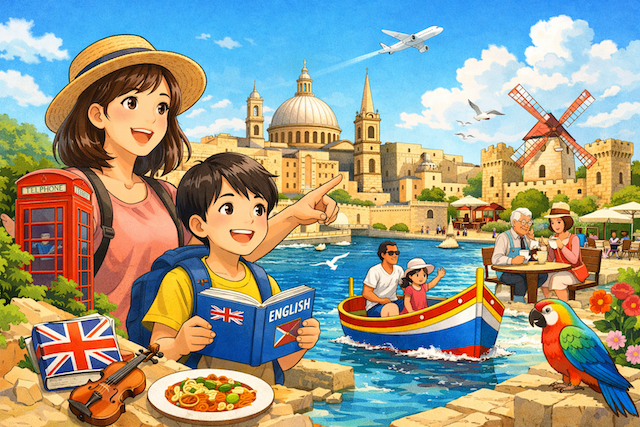
Parent-Child Study Abroad Guide
Malta Parent-Child Study Abroad Guide | European Culture and English
01
Introduction
Malta, a small island nation floating in the Mediterranean, is known for its warm climate, beautiful beaches, and streets lined with historic buildings. As a member of the Commonwealth, it uses English widely as an official language and maintains a high standard of education. For this reason, Malta is a popular destination for parent-and-child study abroad, drawing families not only from Europe but from all over the world.
In Malta, parent-and-child study abroad typically means that the child joins a local English class for kids or juniors while the parent takes a general English course. It is also possible for the parent not to attend classes and simply look after the child's studies, so you can build a flexible plan to suit your lifestyle.
In addition, Malta is safe, and the whole island is compact and easy to get around. It offers an environment where parents and children can experience life abroad with peace of mind while combining sightseeing and study. Beyond English learning, opportunities to experience European culture and to make friends from many countries are also major attractions.
02
Why Choose Malta for Parent-and-Child Study Abroad
1. An environment where English is an official language
Malta belongs to the Commonwealth, and English is an official language in education and administration. Street signs and conversations in shops are in English, so parent and child can naturally get used to an environment where English is used.
2. Safety and ease of living
Malta, known as one of the safer countries in Europe, is a place where parents and children can live with peace of mind. The whole island is compact and easy to get around, making it well suited as a first study-abroad destination.
3. A multinational learning environment
Language schools in Malta attract students from across Europe, including Italy, France, and Germany, as well as from the Middle East and Asia. For children, it is a valuable experience of building international friendships.
4. Experience European culture firsthand
Malta is a place where ancient history and Mediterranean culture blend. The streets of the capital, Valletta, are a World Heritage Site, and you can enjoy cultural experiences and sightseeing between lessons.
5. Combine sightseeing and study as a parent and child
With beautiful beaches, the Blue Grotto, the island of Gozo, and more, Malta has abundant tourist attractions. It is a destination that balances study and vacation: you can enjoy a resort feel with the family on weekends while studying English seriously on weekdays.
03
Types of Parent-and-Child Programs
1. Parent-and-child courses at language schools
The most common option is the parent-and-child package course offered by language schools.
- **Child**: Learns English in a kids or junior class suited to their age.
- **Parent**: Can take a general English course or a daily conversation class on the same campus. Because you attend the same school, there is no need for drop-offs and pick-ups, and you can concentrate on studying with peace of mind.
2. Accompanying-parent type (only the child attends school)
In this style, the child joins a language school or summer camp while the parent does not take classes and instead provides support for daily life. It also suits families with young children or parents who continue working remotely.
3. Summer camp-type programs
Short, intensive junior programs offered only during the summer holidays.
- They combine activities (sports, cultural experiences, sightseeing) with English study.
- Children gather from all over Europe, making international exchange easy. Recommended for families who want a short cross-cultural experience.
4. One-on-one lessons for parent and child
At some schools, parent and child can take private lessons together. Parents can learn while watching over their child's study, which makes this popular with beginner parent-and-child pairs.
04
Accommodation Options
1. School dorms and residences
Student dorms and residences run by language schools sometimes offer family rooms for parents and children.
- Close to the school, so commuting is convenient.
- Easy to interact with other parent-and-child students.
- Often you can choose with or without meals. Recommended for short-term study or families who value interaction.
2. Homestay
Staying with a local family and sharing daily life.
- A family atmosphere that creates more chances to use English.
- You can experience Maltese culture and eating habits.
- Time with a second family becomes a lasting memory for the child. However, lifestyles differ from household to household, so flexibility is required.
3. Apartment or condominium stay
Apartments and condominiums with kitchens are popular with parents and children staying long term.
- You can cook for yourselves and save on food costs.
- You can secure private space and keep your daily rhythm.
- You can also widen your options by using services such as Airbnb.
4. Hotels and serviced apartments
Suited to short stays and families who prioritize comfort.
- Room service and cleaning service included.
- You can enjoy a resort feel with amenities such as pools and kids' rooms.
- Ideal if you want to combine sightseeing and study.
05
Estimated Costs (1 Month, Parent and Child, 2 People)
The cost of parent-and-child study abroad in Malta varies greatly depending on the type of accommodation and school, but the following are typical estimates.
1. Tuition
- Language school parent-and-child course (parent + child): **about JPY 200,000 to 300,000** Parent in a general English course (15 to 20 lessons per week) Child in a kids/junior class (15 to 20 lessons per week)
2. Accommodation costs
- School dorm/residence: **JPY 150,000 to 200,000**
- Homestay (2 meals included): **JPY 180,000 to 250,000**
- Apartment/Airbnb (self-catering): **JPY 150,000 to 250,000** There is a big difference depending on the type of stay.
3. Airfare (round trip, parent and child, 2 people)
- About **JPY 150,000 to 200,000** (varies by season and transit point) * There are no direct flights from Japan, so you need to transfer in a major European city.
4. Local living expenses
- **JPY 50,000 to 100,000** for food, transportation, entertainment, etc.
- Eating out mostly makes it more expensive, so combining it with self-catering can save money.
5. Other costs
- School registration fee and teaching materials: **about JPY 20,000 to 30,000**
- Overseas study insurance: **JPY 10,000 to 20,000 (1 month)**
- Sightseeing and leisure: **JPY 20,000 to 50,000** for weekend family activities
Estimated Total
**About JPY 550,000 to 850,000 (1 month, parent and child, 2 people)**
06
The Appeal of Life in Malta
1. A multinational community
Malta is an international environment where many tourists and students from across Europe gather. In addition to Italy, France, Germany, and Spain, there are many visitors from the Middle East and Asia, and a major attraction is that parent and child can make friends from many countries.
2. A rich food culture
Centered on Mediterranean and Italian cuisine, you can enjoy healthy meals using seafood, pasta, and olive oil. Prices are relatively reasonable, and there are plenty of dishes that children find easy to eat. Fresh vegetables and fruit are available at supermarkets, which is also convenient for those who cook for themselves.
3. Compact and convenient to get around
Because Malta is a small island nation, access to major cities and tourist spots is easy. With a well-developed bus network and ferries, you can get around without a car. Outings with children are smooth.
4. Abundant tourist attractions
- **Blue Grotto**: Spectacular natural scenery enjoyed by boat.
- **Gozo**: Beautiful beaches and countryside scenery.
- **Valletta, a World Heritage Site**: A cultural area with historic architecture and museums. Being able to sightsee and refresh with the family between lessons is an advantage unique to Malta.
5. Warm climate and safety
The climate is warm throughout the year and relatively comfortable even in winter. Because it is safe, parent and child can live with peace of mind.
07
Points to Note
1. Crowded with tourists in summer, and prices rise
Malta is one of Europe's leading tourist destinations and becomes very crowded in summer in particular. Airfare and accommodation costs also tend to soar, so if you want to keep the cost of parent-and-child study abroad down, we recommend considering the off-seasons of spring and autumn.
2. No direct flights from Japan
There are no direct flights from Japan to Malta, so you need to transfer in a major European or other hub city (London, Dubai, Istanbul, etc.). When traveling with children, choose flights with layover time and convenience at the transit airport in mind.
3. Visa and residence permit checks are needed
Short stays of up to 90 days within the Schengen Area do not require a visa, but a visa procedure may be needed if you want long-term study or to extend a parent-and-child stay. Check with the school or agency in advance.
4. English accents and differences in school quality
Maltese English is based on British English but has its own distinctive pronunciation and accent. In addition, there are many language schools and their quality varies, so it is important to research reviews and track records and choose a reliable school.
5. Preparing for medical care and insurance
The quality of medical care in Malta is relatively high, but because it is a small country, specialized treatment may sometimes have to be provided in another country. For parent-and-child study abroad, be sure to take out overseas travel insurance so you are prepared if your child falls ill.
08
Summary
Parent-and-child study abroad in Malta is **a valuable opportunity to experience European culture and English learning at the same time**. Because it is safe and the whole country is compact and easy to live in, parent and child can enjoy life abroad with peace of mind.
Parents can join a general English course while children join junior classes or summer camps, and you can choose a flexible plan to suit your lifestyle, such as parent and child studying together or only the child studying. Accommodation can also be chosen to suit your family's style, from school dorms and homestays to self-catering apartments and hotels.
The estimated cost is about **JPY 550,000 to 850,000** per month for parent and child (2 people). There are points to note, such as the lack of direct flights from Japan, summer crowds, and the need for visa procedures, but in return you gain a multinational learning environment and rich sightseeing and cultural experiences that other destinations cannot match.
Parent-and-child study abroad in Malta, which lets you balance learning and family time, will be an unforgettable experience that not only improves your English but also deepens the bond between parent and child.
09
Frequently Asked Questions
Is Malta suitable for parent-and-child study abroad? I am worried about safety and the environment.
It is relatively safe, and the whole island is compact and easy to get around. English is an official language and the living infrastructure is well developed, so it is a country where parent and child can live comfortably even on a first long stay abroad.
How well is English understood? Is the accent a concern?
English is widely used as an official language. It is basically British English, but it may take a little time to get used to the local accent. Language schools teach in standard English.
What kinds of programs can I choose from?
Typical options are a parent-and-child course at a language school (parent and child at the same school), an accompanying-parent type (only the child attends school), a summer camp type, and one-on-one parent-and-child lessons. You can choose according to the length of stay and your child's age.
What is the target age range? Can siblings of different ages take part?
Many schools accept children from about 5 to 6 years old and organize classes by age. Even if siblings are far apart in age, each is placed in a class for their own age group, so they can take part.
How much does one month cost? (Parent and child, 2 people)
The total is roughly JPY 550,000 to 850,000. The breakdown is tuition of JPY 200,000 to 300,000, accommodation of JPY 150,000 to 250,000, airfare of JPY 150,000 to 200,000, local living expenses of JPY 50,000 to 100,000, and other costs (insurance, materials, leisure) of a few tens of thousands of yen.
What accommodation is best? What is the difference between homestay and an apartment?
A homestay increases opportunities to use English and experience the culture. Apartments and condominiums let you cook for yourselves and keep your daily rhythm, and are popular for long stays and with small children. School dorms have the advantage of easy commuting and interaction.
When is the best season to go?
To avoid crowds and high prices, spring (April to June) and autumn (September to October) are good targets. Summer is also ideal if you mainly want to play in the sea, but airfare and accommodation tend to rise.
How do I get there from Japan? Are there direct flights?
There are no direct flights. You enter the country by transferring in a major European city or a Middle Eastern hub. When traveling with children, choose flights with an emphasis on the number of transfers, waiting time, and airport facilities (such as kids' spaces).
Is a visa required? How long can we stay?
For short stays (up to about 90 days) for tourism or language study, no visa is generally needed within the scope of the Schengen rules. Stays over 90 days or certain study requirements may need additional procedures, so checking in advance is important.
Can my child attend alone without the parent attending classes?
Yes. The parent can stay as an accompanying guardian while the child joins a language school or summer camp. Many families only handle drop-offs, pick-ups, and daily life support.
What should you look for when choosing a school?
Compare whether a parent-and-child course is offered, age-based classes and safety arrangements, quality of activities, campus location (commute time), accommodation arrangement options, reviews and track record, and support languages (whether Japanese is available).
How much do living expenses cost? Any tips for saving money?
A guideline is JPY 50,000 to 100,000 per month. You can keep costs down by cooking for yourselves, using bus passes or multi-ride tickets for commuting, and combining weekday discounts and free sights for sightseeing.
How can I feel secure about medical care and insurance?
Take out overseas travel insurance (including treatment and rescue costs, personal belongings, and personal liability). It is reassuring to prepare your child's regular medications, vaccination history, and medical records (past medical history) in English.
What should I be careful about for safety?
Follow the basics thoroughly: guard against pickpockets in crowds, avoid certain areas of busy entertainment districts at night, split up your valuables, follow the school's drop-off and pick-up rules, and choose beaches with lifeguards for swimming.
Will the food suit my child? What about allergies?
Pasta, seafood, and Mediterranean dishes tend to be easy for children to eat. For allergies, share a list written in English with the school and accommodation in advance, and prepare a card that explains the relevant ingredients in English when eating out.
What is local transportation like? Will it be a problem with children?
You mainly use route buses and ferries. Allow extra time for boarding and alighting if you use a stroller. Managing fares with an IC card or app is convenient. Taxis and ride-hailing apps can also be used.
How should I prepare communications and internet?
It is common to buy a prepaid SIM at the airport or in town. Choose a large-capacity plan for the parent, and limit the child's data to the minimum needed with safety settings.
What payment methods are available? Can I use credit cards?
Card payments are widely accepted in urban areas and tourist spots. Carry a small amount of cash as well, and bring several chip-enabled cards to be safe.
How Far in Advance Should You Prepare?
For the summer season, ideally arrange the school, accommodation, and flights more than six months ahead, and even in the off-season about three months ahead. At the same time, prepare the passport validity period, insurance, vaccinations, and proof of school enrollment.
What Documents Are Required?
Prepare your passports, insurance policy, school admission letter, proof of payment for tuition and accommodation, proof of parent-child relationship (in English if necessary), vaccination records, a list of allergies and regular medications, and an emergency contact list.
What should I bring?
Clothes suited to the season, water-play items, regular medications, school supplies (notebooks and writing tools), an electronic dictionary or tablet, plug adapters, a folding umbrella, sunscreen, and a portable bottle. For infants and toddlers, a lightweight stroller and a baby carrier are handy.
What can we do on weekends?
You can enjoy a balance of study and sightseeing, including Blue Grotto tours, the beaches of Gozo and Comino, sightseeing in the World Heritage city of Valletta, museums and aquariums, and strolling around town and visiting cafes.
Is it possible for a parent to work remotely?
It is possible if you check the Wi-Fi quality of your accommodation in advance and prepare mobile data as a backup. Include in your plan a work schedule that takes the time difference into account and coordination with the school's drop-off and pick-up times.
10
Related article
11
Recommended Courses
Course
One-on-One Intensive Course
A fully one-on-one system with no group classes. Your child's English skills can be intensively trained to match their level and goals.
See moreCourseParent-Child Study Abroad Course
A course where children from first grade of elementary school to age 15 can study together with their parent or guardian. You can join from 1 week, and choose a plan suited to both the junior and the parent.
See moreThe first step in IELTS preparation is choosing the right environment
With one-on-one classes and real-format mock exams, we help you reach your target score by the most direct route.