
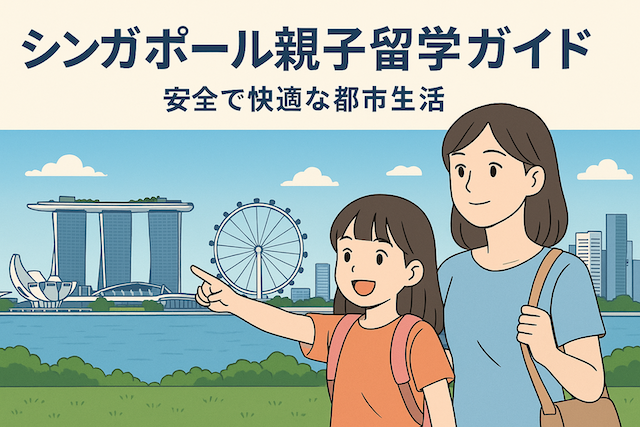
Parent-Child Study Abroad Guide
Singapore Parent-Child Study Abroad Guide | Safe and Comfortable City Life
01
Introduction
Introduction
Singapore is known across Asia for its **safety, cleanliness and high standard of education**. With English widely used as an official language, low crime and well-developed infrastructure, this city-state is a very popular destination for parent-and-child study abroad.
In recent years it has drawn attention in Southeast Asia for "education relocation," "short-term parent-and-child study abroad," and "experiential study programs that build English and an international outlook," and the number of families coming from Japan, Korea and China is increasing.
The whole city is compact and easy to get around, and healthcare and transport are very safe. It is an environment where even parents and children living overseas for the first time can feel at ease. The multicultural education that comes with a multiethnic society is another big attraction, as children naturally develop an understanding of other cultures and flexible values.
This article explains parent-and-child study abroad in Singapore in plain terms, covering types of schools, accommodation, costs and visa procedures. If you are looking for a study style in a safe, comfortable city where both parent and child can grow, please use it as a reference.
The Appeal of Parent-and-Child Study Abroad in Singapore
- **English + a multicultural environment** Singapore is a multiethnic country where English, Chinese, Malay and Tamil coexist. Because most school and daily life is conducted in English, children naturally build English ability and an international outlook at the same time.
- **Safety and comfortable living** Singapore is one of the safest countries in Asia. The whole city is clean and well maintained, and traffic manners and public rules are strictly observed. You can go out safely even at night, and it is relatively safe for women and children to walk alone.
- **World-class education quality** Singapore consistently ranks near the top in OECD international assessments. Not only local schools but also international schools are of high quality and have excellent university placement records. It offers an environment where children can receive an education with future overseas university study in mind.
- **A system that makes it easy for parents to stay** Parents of children holding a student visa can stay legally for the long term by applying for a "Dependant's Pass" or a "Long-Term Visit Pass." Parent and child can build a stable base for daily life with peace of mind.
- **Convenient city functions and standard of living** Healthcare, transport, communications, safety and education are all at a high level, so daily life involves little stress. The climate is warm all year round and the food culture is diverse. It combines both comfort and convenience.
Types of Schools and How to Choose
- **International schools** International schools are the most popular choice among foreign families. All classes are taught in English, and curricula vary, including IB (International Baccalaureate), British, American and Australian systems. Many students are returnees from Western countries and Japan, so you can learn in an international atmosphere. Tuition is somewhat higher, but the quality of education and support systems are excellent.
- **Local schools** This option lets you experience the high standard of local education first-hand. Classes are mainly in English, and students also study Chinese (Mandarin) as a second language. However, admission requires exams and interviews, and for foreign nationals acceptance may be limited depending on availability. It suits families considering a long-term stay.
- **Short-term English programs** Short-term programs lasting from a few weeks to a few months are also popular. There is a wide choice of courses that combine English with cultural experiences during summer and winter holidays. Some schools allow parent and child to attend together, and some offer courses where the parent studies in a separate class, making them a recommended first overseas study experience.
- **Using the support of an education agency** Some agencies support everything from choosing a school to visa applications and arranging accommodation. Especially for your first parent-and-child study abroad, using a specialist agency familiar with local conditions lets you prepare with confidence.
How to Choose Accommodation
In Singapore, **serviced apartments** and **condominium stays** are more common than hotels. For parent-and-child study abroad in particular, accommodation with a kitchen that is easy to live in is popular.
Characteristics of Main Areas
- **Around Orchard (central area)** Recommended for those who prioritize shopping and access. It is also convenient for commuting to major international schools and language schools. Rents are high, but daily convenience is outstanding.
- **Holland Village and Clementi (west)** A residential area popular with foreign families, with many educational institutions. It is green and calm, and suits households raising children.
- **Katong and Tampines (east)** Areas with a local feel, where rents are slightly lower than in the center. A cost-effective choice if you are considering a long stay.
Approximate Rent (per month)
- 1 bedroom: around JPY 200,000-300,000
- 2-3 bedrooms: around JPY 400,000-600,000
- Serviced apartment (furnished, short stays possible): about JPY 10,000-20,000 per night
Condominiums have pools, gyms and full security, so families can feel safe. For long stays, more people are also **signing leases on furnished properties through Airbnb or local real estate sites**.
Staying near the school also reduces commuting stress and stabilizes the child's daily rhythm. Even though urban transport is well developed, **ease of access to the school** is an important point when choosing a place to live.
Approximate Costs (per month, parent and child)
Singapore is known as an expensive country within Asia, but the quality of life and level of education are correspondingly very high. Below is an average guide to the cost of one month for a parent and child.
| Item | Estimated Cost (JPY) | Description |
|---|---|---|
| Tuition (child) | JPY 150,000-300,000 | Varies by school and program content |
| Accommodation | JPY 200,000-400,000 | Condominium or serviced apartment |
| Living costs (food, transport, etc.) | JPY 100,000-150,000 | Higher if you mostly eat out |
| Airfare (round trip, parent and child) | JPY 150,000-200,000 | Varies by season |
| Local expenses (insurance, miscellaneous, etc.) | JPY 30,000-50,000 | Medical insurance, communications, etc. |
| Estimated Total | About JPY 600,000-1,000,000 |
Accommodation accounts for an especially large share of the total. The closer to the center, the higher the rent, so it is important to decide based on the school's location and your style of stay.
If you want to keep food costs down, hawker centers (open-air food courts) are recommended. At around JPY 500-800 per meal, you can easily enjoy local food.
Short stays keep costs down, but for medium- to long-term study of three months or more, costs can reach **JPY 7,000,000-10,000,000 per year**. Be clear about your budget and make a plan that fits your goals.
How Parents Spend Their Time
During parent-and-child study abroad in Singapore, parents are free to use their time while the child is at school. Besides a good educational environment, there are plenty of opportunities for parents to learn and refresh.
1. Studying English at a language school
Many language schools offer English courses for parents. They are divided by level from beginner to advanced, with plenty of short intensive courses. Some schools let you attend during the same hours as your child, so the style of "commuting to school together as parent and child" is popular.
2. Hobbies, qualifications and career development
Besides English, there are many culture centers and short courses where you can learn cooking, yoga, business skills and more. More people are also finding local connections and business opportunities through networks of expatriates' spouses.
3. Refreshing and sightseeing
Singapore offers plenty of places to enjoy everyday life, including nature parks, shopping malls and art galleries. On holidays you can enjoy a resort feel with your child at places such as Sentosa Island and Gardens by the Bay.
4. Parent communities
Communities of Japanese, Korean and Western parents are also active, with lively information exchange through social media groups and school events. They are useful for advice about local life and for making friends.
When parents actively engage with the community and learning, the study abroad life becomes more fulfilling. It also gives the child good motivation to see the parent taking a positive attitude toward learning.
Visa and Procedures
For parent-and-child study abroad in Singapore, you need a **student visa for the child (Student's Pass)** and a **stay visa for the parent (Dependant's Pass or Long-Term Visit Pass)**. Applications are all made online and are relatively smooth.
1. The child's student visa (Student's Pass)
- **How to apply**: Apply through the school you plan to attend, using the online system of the ICA (Immigration & Checkpoints Authority)
- **Required documents**: Letter of Acceptance, passport copy, ID photo, proof of financial means, etc.
- **Processing time**: Usually about 2-4 weeks
- **Validity**: Issued according to the enrollment period (six months to one year is common)
2. The parent's stay visa
- **Dependant's Pass (dependant visa)**: Mainly for the spouse and children of a parent holding an Employment Pass. However, conditions are limited for parent-and-child study abroad, so many people choose a different visa.
- **Long-Term Visit Pass**: If the child holds a Student's Pass, either the mother or the father can apply as an accompanying person. For parent-and-child study abroad where a parent is the main companion, this is the most common visa.
3. Key points of the procedure
- You cannot apply for the visa until the child's **official Letter of Acceptance (LOA) from the school** has been issued.
- At immigration you may be asked in detail about your purpose of stay and school information, so **preparing your documents so you can show them immediately** gives peace of mind.
- Medical insurance during your stay is not mandatory, but **enrolling in overseas travel insurance or local medical insurance** is strongly recommended.
Visa rules may change, so before applying, confirm the latest information with **the Embassy of Singapore in Japan or the person in charge at your school**.
Safety, Healthcare and Living Environment
Singapore's living environment is so well developed that it is said to be "one of the safest and cleanest countries in the world." Here are the key points on safety, healthcare and transport that matter for a parent and child staying together.
1. Safety
Singapore has an extremely low crime rate, and going out at night and using public transport are safe. Many surveillance cameras are installed around the city, and police patrol frequently. Because penalties are strict, rules are firmly observed.
2. High standard of healthcare
The level of healthcare is among the best in the world, and you can receive consultations in English without difficulty. Both public and private facilities are clean and well equipped, with plenty of pediatricians and specialists. If you have overseas insurance, you may be able to receive treatment cashlessly even at local private hospitals. A system is in place to respond quickly even if you become unwell.
3. Transport and access
Public transport (MRT and buses) is safe and punctual. Using IC cards such as "EZ-Link" or "SimplyGo" (similar to Suica) makes transfers smooth. Taxis and Grab (a ride-hailing app) are also widespread, so you will rarely have trouble getting around with children.
4. Climate and living environment
Temperatures are warm all year round at around 25-33°C, a perpetual summer climate. However, humidity is high, so indoor air conditioning and UV protection are essential. The city is green, with well-kept parks and walking paths, making it easy to play outdoors with children.
5. Food and shopping
True to a multiethnic country, the food culture is diverse. At hawker centers you can enjoy local food at reasonable prices, and supermarkets make it easy to find Japanese ingredients. Daily necessities and medicines are available at quality equal to Japan's, so buying locally is no problem.
Clean, safe, and with education, healthcare and transport all in place, Singapore can be called an ideal urban environment where parents and children can live with peace of mind.
Summary
Singapore is an ideal destination for parent-and-child study abroad, combining **"safety," "education" and "comfort"** at a high level.
It is a multicultural society with English as an official language, yet it is very safe and has well-developed healthcare and infrastructure, so you can feel secure even in your first life overseas. Children receive a world-standard education while developing an international outlook, and parents can spend fulfilling time in a comfortable urban environment.
Costs are somewhat higher than in other Asian countries, but the quality of life and education is overwhelmingly high in return. Whether short or long, it will be an experience that becomes a lifelong asset for your child.
Singapore is not only a place to study but a city where a family can grow and gain new values. Why not begin a study abroad life in a safe and comfortable environment where both parent and child enjoy "learning" and "living"?
02
Frequently Asked Questions
Is Singapore suitable for parent-and-child study abroad?
Safety, healthcare and transport infrastructure are at a high level, and English is widely understood. Even for your first life overseas, you can start with relative peace of mind.
Which is better for my child, an international school or a local school?
If you prioritize a short stay and improving English easily, an international school is a candidate; if you prioritize a long stay, lower tuition and bilingual ability, a local school is. Choose according to your purpose and length of stay.
What is the general flow up to enrollment?
The usual order is: choose a school → application and interview/test → acceptance and Letter of Acceptance (LOA) → student visa application → travel and start of school.
What visa does the parent stay on?
Generally, after the child obtains a Student's Pass, the parent applies for a Long-Term Visit Pass (or another residence status depending on conditions).
What is the approximate cost?
As a guide, about JPY 600,000-1,000,000 per month for a parent and child (a rough estimate including tuition, accommodation, living costs, airfare, etc.). It varies widely by area and school.
Where is convenient to stay?
Putting access to school first, serviced apartments or condominiums near the school are practical. The center is highly convenient, but rents are higher.
What Should You Watch Out For Regarding Safety?
Safety is good, but be thorough with basic precautions such as looking after valuables and avoiding quiet places at night. Laws and public rules are strict.
What is the healthcare system like?
The standard of healthcare is high, and you can see a doctor in English. Please consider enrolling in overseas travel insurance or local medical insurance before you travel.
What should I know about the climate and clothing?
It is warm all year round and fairly humid. Prepare light clothing plus a layer for indoors, and sun and rain protection (hat, sunscreen, folding umbrella).
Can you accommodate meals and allergies?
There is a wide range of international food and Japanese ingredients are easy to obtain. For allergies, prepare a card written in English and share it with the school and accommodation in advance.
Can parents study locally?
Yes. Language schools have adult courses and short courses, and you can find programs that let you study at the same time as your child.
Can parents work?
In general, work is not permitted on a residence status intended for accompanying a child. If you wish to work, a separate work pass is required.
Is transport easy to use?
The MRT and buses are well developed, and IC cards (EZ-Link/SimplyGo) let you travel smoothly. Using ride-hailing apps is also common.
Is it OK if my English is weak?
There are language programs that accept beginners. Combining online study before departure with supplementary lessons after arrival helps both parent and child adapt faster.
What documents should I prepare?
Passport, Letter of Acceptance (LOA), school records/proof of enrollment, vaccination records, insurance policy, accommodation contract, proof of financial means, etc. Organize both originals and copies.
Do applications and regulations change?
They may change. Be sure to check the latest guidance from the school you are applying to and the Embassy of Singapore in Japan.
Which do you recommend, short-term or long-term?
For a first time, a two-step approach is safe: start with a short stay to check how well you adapt, then move to a long stay. Decide the length by your purpose (further education, language, or experience).
What about SIM cards and internet?
You can get a prepaid SIM/eSIM at the airport or in the city. It is also reassuring to check the Wi-Fi quality of your accommodation in advance.
What daily necessities should I bring?
Regular medication, insect repellent, sunscreen, a folding umbrella and your child's school supplies (for the first few weeks). Most things can be bought locally, but it is handy to bring familiar items.
03
Related article
04
Recommended Courses
Course
One-on-One Intensive Course
A fully one-on-one system with no group classes. Your child's English skills can be intensively trained to match their level and goals.
See moreCourseParent-Child Study Abroad Course
A course where children from first grade of elementary school to age 15 can study together with their parent or guardian. You can join from 1 week, and choose a plan suited to both the junior and the parent.
See moreThe first step in IELTS preparation is choosing the right environment
With one-on-one classes and real-format mock exams, we help you reach your target score by the most direct route.