
Parent-Child Study Abroad Guide
New Zealand Parent-and-Child Study Abroad Guide | A Place to Learn and Grow Freely
01
Introduction
New Zealand is a country full of magnificent nature and warm-hearted people. For families considering parent-and-child study abroad, it offers an environment where children can “grow up freely” both in their studies and in daily life.
Its education system is known for valuing each child's individuality, and it emphasizes not only English ability but also critical thinking, self-expression and cooperation. Rather than academic competition, it is characterized by nurturing in children an attitude of “enjoying learning” for its own sake.
The country is also safe, and its cities are just the right size, so parents and children can live abroad with peace of mind. In urban areas there are schools and medical facilities offering Japanese food and Japanese-language support, making it an ideal choice for a first study-abroad destination.
“We want our child to learn freely in the midst of nature.” “We want to experience life abroad together as parent and child in a safe environment.” Parent-and-child study abroad in New Zealand can make these wishes come true.
02
The Appeal of Parent-and-Child Study Abroad in New Zealand
Parent-and-child study abroad in New Zealand is attracting attention as an ideal style of study abroad that balances education, nature and living environment. Its great strength is that it offers not just English learning but an environment designed to nurture a child's sensitivity and independence.
1. Harmony Between Nature and Education
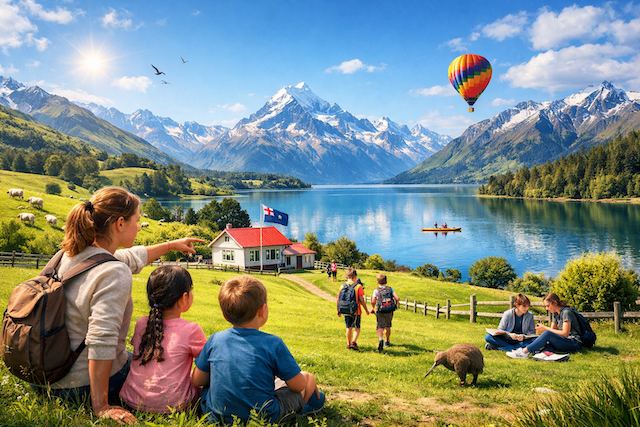
Beautiful mountains, lakes and lush parks are close at hand, and outdoor activities are part of everyday life. Schools also incorporate many nature-based learning experiences, so there are plenty of opportunities to learn outside the classroom.
2. An Education Policy That Respects Individuality
Schools in New Zealand encourage children to voice their own ideas and learn proactively. The distance between teachers and students is small, and small class sizes allow instruction tailored to each individual.
3. A Safe and Peaceful Society
The country is safe, and its people are friendly and kind. There is little discrimination, and as a multicultural society it has a well-established framework for welcoming newcomers, so even foreigners can fit in quickly.
4. A System That Makes It Easy for Parents and Children to Stay Together
When a child obtains a student visa, a parent can accompany them on a Guardian of a Student Visitor Visa. Parents can also attend a language school, which makes a study-abroad style where parent and child learn together possible.
5. English Plus More
In addition to English study, education in a wide range of fields such as art, sports and music is well developed. Another attraction is the many options available for developing a child's interests and strengths.
03
Main Study Destinations
New Zealand has several cities with strong educational environments where parents and children can live with peace of mind. Each region has its own characteristics, so the key is to choose according to your goals and lifestyle.
Auckland
The largest city in New Zealand, and the area with the highest concentration of educational institutions and language schools. Support for Japanese people is extensive, so it is reassuring for a first parent-and-child study abroad. Urban convenience and natural beauty coexist, which also makes it easy to maintain a good life balance.
Christchurch
A lush city known as the “Garden City.” The quality of school education is high, and the whole area has a calm, relaxed atmosphere. It is especially popular with families who value nature experiences and art activities.
Wellington
Although it is the nation's capital, it is a compact and quiet city. It is also a center of culture and the arts, and is recommended for families who value creative education. Surrounded by sea and hills in a beautiful setting, it also offers plenty of family weekend leisure options.
Tauranga
A seaside city on the North Island with a calm, resort-like atmosphere. Living costs are relatively low, and it is popular with families who want a relaxed lifestyle. It offers an environment where you can study while enjoying beaches and marine activities.
Dunedin
A university town on the South Island, known as a city of education. It has a calm student-town atmosphere and suits families who value both nature and culture.
04
Accommodation Style Options
In parent-and-child study abroad, where you live is just as important as where you study. New Zealand offers a wide range of accommodation options, which you can choose flexibly according to the length of your stay and your lifestyle.
Homestay
The most common style, in which you stay with a local family and learn English and culture naturally. You can experience living English through home cooking and everyday conversation, and it is an environment with plenty of cultural stimulation for children. It is also recommended for short-term study and for your first time living abroad.
Rental Apartments and Condominiums
A popular style for families who prioritize long stays and independent living. If you choose a property with a kitchen, you can freely control your meals and daily rhythm. You can secure privacy for your family while blending more deeply into local life.
Holiday Houses and Airbnb
A flexible option suited to short- to medium-term stays. There are many properties in tourist areas and along the beach, making them ideal for parent-and-child study abroad combined with a holiday. Furniture and appliances are provided, so you can start living comfortably right after moving in.
On-Campus Student Dormitories (Limited)
Some private schools and language schools may offer accommodation that parents and children can use together. While living on campus makes commuting convenient, the number of places is limited, so early booking is necessary.
05
Types of Schools and Their Features
Educational institutions in New Zealand come in various types depending on purpose and age. In parent-and-child study abroad, it is common for the child to attend a local school while the parent studies English at a language school. Below we introduce the features of each.
State School
State schools play the central role in New Zealand education. By attending classes together with local children, students acquire natural English ability and an international outlook. Tuition is lower than at private schools, and education is community-based. They have well-established systems for accepting international students, and many schools offer English language support (ESOL) programs.
Private School
Many private schools are distinctive in their educational content and school culture, and offer high-quality education with small class sizes. Many also focus on specialized fields such as art, sports and music, making them an ideal environment for developing a child's individuality. Fees are higher, but they are recommended for families who value teacher support and well-equipped facilities.
International School
They accept many international students, and their appeal lies in curricula that respect multiple languages and cultures in addition to English. They suit families who are considering overseas higher education in the future or who want an international educational environment.
Language School
Often attended by parents, with courses available from short to long term. Some schools also offer a “parent-and-child course” or “Kids English,” so a major attraction is that parent and child can learn together. Classes are conversation-focused, making them ideal for those who want to acquire practical English they can use in daily life.
06
Approximate Costs (1 Month, Parent and Child)
While the quality of education in New Zealand is high, living costs and tuition are also clear, which makes planning easy. Below is an approximate guide for a one-month stay for two people (one parent and one child).
| Item | Estimated Cost (NZD) | Approx. Japanese Yen Equivalent |
|---|---|---|
| Child's tuition (local school or language school) | 1,500-2,000 | Approx. JPY 140,000 - 190,000 |
| Parent's tuition (language school) | 1,500-2,500 | Approx. JPY 140,000 - 240,000 |
| Accommodation (rent, utilities, food, etc.) | 2,000-3,000 | Approx. JPY 190,000 - 290,000 |
| Transportation, communication and miscellaneous living expenses | 300-500 | Approx. JPY 30,000 - 50,000 |
| Total (monthly) | 5,000-8,000 NZD | Approx. JPY 500,000 - 750,000 |
* The above is only an approximate guide and varies depending on the city (Auckland, Christchurch, etc.) and the style of accommodation. * Airfare, insurance premiums and visa application fees are required separately.
Tips for Keeping Costs Down
- Choosing a **regional city** (e.g., Tauranga, Dunedin) can save on rent.
- If the parent takes a **short-term language course**, tuition can be adjusted.
- Switching to a **self-catering lifestyle** can keep food costs down.
It may look expensive as an investment in education, but considering the safety of the environment, the quality of education and the results in English improvement, it can be called an extremely cost-effective study destination.
07
Visa Process and Procedures
For parent-and-child study abroad in New Zealand, the child and the parent each obtain a different visa to stay. The procedures are relatively simple, and the system is flexible compared with other English-speaking countries.
1. Child: Student Visa
If the child will attend a local school or language school, they apply for a student visa. The following documents are required for the application.
- Offer of Place from the school
- Proof of tuition payment (Payment Receipt)
- Bank balance certificate (proof of sufficient living funds)
- Medical certificate and a copy of the passport
A student visa is normally issued to match the period of enrollment. For long-term study, an extension can also be applied for during your stay.
2. Parent: Guardian of a Student Visitor Visa
A visa that a guardian accompanying an international student under 18 can obtain. With this visa, the parent can legally stay in order to support the child.
- Work is generally not permitted, but **attending a short-term language school is allowed**.
- Proof of living expenses and accommodation is also required at the time of application.
3. Application Process
- School selection and enrollment application
- Receive the Offer of Place from the school
- The child applies for the student visa
- The parent applies for the Guardian visa (linked to the child's visa)
- Confirm flights and accommodation, and prepare for entry
4. Length of Stay and Extensions
The visa validity period is issued to match the period of enrollment. If you wish to continue studying, you can apply for an extension within New Zealand.
08
Living Environment and Support System
New Zealand is known as a country that is very easy for international students to live in. The standards of education, healthcare and safety are high, creating an environment where parents and children can live with peace of mind.
A Safe and Peaceful Society
The country is safe and the crime rate is low, making it well suited to living abroad as a parent and child. People are kind and friendly, and have an open attitude toward foreigners. A warm community culture has taken root, where neighbors will help when you are in trouble.
Well-Developed Healthcare and Education
Major cities have international hospitals and clinics with Japanese-speaking staff, so managing your child's health is reassuring. In education, both state and private schools offer generous support, and many schools have staff dedicated to international students on site.
Living Infrastructure
Public transport (buses, trains, ferries) is well developed, and in urban areas you can travel smoothly using a transit IC card. Supermarkets and shopping centers are plentiful, and you can get all daily necessities locally.
Japanese Support and Community
In Auckland and Christchurch there are many Japanese support agencies and study-abroad support centers, where you can get advice in Japanese on choosing a school, finding housing and more. The local parent-and-child study-abroad community is also active, allowing you to exchange information and socialize with other Japanese families staying there.
An Environment Where Parents Can Learn Too
Parents with a Guardian visa can attend a language school, so they can improve their own English and build local connections. Learning in the same environment as your child leads to growth for the whole family.
09
What Kind of Family Is It Recommended For?
Parent-and-child study abroad in New Zealand is chosen by many families as an ideal plan that balances education, nature and living environment. It is an especially good fit for the following families.
Families who want their children to learn freely in nature
Ideal for families who want to nurture their child's sensitivity through nature experiences and activities, not just academics. New Zealand schools have active extracurricular classes and field trips, so learning extends “beyond the classroom.”
Families who value a safe and peaceful environment
The crime rate is low, and the whole town is calm and clean. Recommended for families seeking an environment where they can send their child to school with peace of mind. Even for a first life abroad there is little stress, and it is a country where it is easy to establish a base for daily life.
Families interested in global education
Suited to families who want to nurture not only English ability but also multicultural understanding and an international outlook. Through interaction with local children, an international perspective is acquired naturally.
Families considering overseas higher education in the future
New Zealand's education is compatible with the education systems of the UK and Australia, which can lead to future entry into overseas universities. Getting used to local education early broadens your options for the future.
10
Summary
Parent-and-child study abroad in New Zealand is a valuable experience that nurtures not only English education but also “life skills.” Surrounded by nature, children learn freely and grow while valuing their own opinions.
The education system is flexible and emphasizes “learning in your own way” over competition. Parents can also stay with peace of mind on a Guardian visa and can study at a language school. The greatest appeal of parent-and-child study abroad in New Zealand is that the whole family can gain new values overseas.
A safe and peaceful society, generous educational support and warm-hearted people. All of these make New Zealand an “ideal country for parents and children to learn together.”
A study-abroad life spent together as parent and child goes beyond mere language study and will become a “lifelong treasure.”
11
Frequently Asked Questions
When is the best season for parent-and-child study abroad in New Zealand?
It is possible throughout the year, but enrolling or transferring in line with the start of a school term makes procedures and class placement smoother. Short-term stays (1 to 3 months) are possible year-round, and for long-term stays (by term or school year), aligning with the start of the local school term makes adjustment easier.
Which cities are suitable for parent-and-child study abroad?
Auckland: abundant schools, language schools and Japanese-language support. / Christchurch: a calm university town with plenty of nature-based learning. / Wellington: active in culture and the arts, and compact. / Tauranga / Dunedin: relatively low living costs and a peaceful living environment.
Can parents work? Can they attend a language school?
Work is generally not permitted on a visa for guardians. On the other hand, attending a language school is generally allowed within certain limits. Please check the latest official information for detailed conditions.
Which is better for the child: a state school, a private school or a language school?
Choose based on your purpose and the length of stay. Local schools (state/private) offer an environment of learning with local children and are best for long stays and term-based study. Private schools tend to have small classes and generous support. For short stays or a preparation period, a language school's junior or parent-and-child course is convenient.
Which is better: a homestay or a rental?
For first-timers and short stays, a homestay makes it easy to get used to house rules and an English-speaking environment. For medium- to long-term stays, or if you value self-catering and privacy, a rental with a kitchen or a holiday house is more suitable.
What is the approximate cost?
For two people (parent and child) for one month, including tuition, rent and living expenses, roughly NZD 5,000 - 8,000 is a guide. It varies depending on the city, school and type of accommodation, and airfare, insurance and visa costs are separate.
How Far in Advance Should You Prepare?
For short stays, 2 to 3 months in advance; for long stays or arranging a local school, 3 to 6 months or more is safe. Proceed in this order: school selection, offer of place, preparing funds and insurance, visa application, securing housing.
Is it okay if I'm worried about my English?
Many schools offer ESOL (English language support) for children, and parents can supplement their everyday English at a conversation-focused language school. While valuing Japanese at home, setting a rule to use English locally will speed up improvement.
What about safety?
It is a relatively safe country, but basic security awareness (avoiding walking alone at night, looking after valuables, using reliable transport) is essential. Also check the surroundings of the school and housing in advance.
What about healthcare and insurance?
We recommend taking out overseas travel insurance or insurance for international students before departure. Major cities have international hospitals and clinics with Japanese-language support, and it is reassuring to bring regular medication along with English instructions for taking it.
What about transportation and getting to school?
Urban areas have well-developed buses, trains and ferries, and you can travel smoothly with an IC card. Commuting to school is generally by public transport, school bus, walking or bicycle. Consider commuting time as a criterion when choosing housing.
Is it possible to accommodate meals and allergies?
If you notify the homestay or school in advance, meals that take religious, health and allergy considerations into account can be arranged. With a rental, you can flexibly control this by cooking for yourself.
What about school supplies and uniforms locally?
Local schools often have uniforms and designated supplies, which you purchase after enrollment at a school-designated shop. For short-term language schools, casual clothes and stationery are generally enough.
Can my child transfer in the middle of a school year?
It may be possible. The school decides based on available places, whether English support is offered, and suitability in terms of academic level and age. Check early whether an offer of place is possible.
How can parents and children spend their days off?
There are plenty of options: nature parks, hiking, beaches, museums, watching sports and more. Field trips and using the library are also recommended as an extension of learning.
What are the key points when applying for a visa?
Prepare the Offer of Place, proof of tuition payment and proof of sufficient funds. / The parent applies for a guardian visa and presents accommodation and a plan for supporting the child. / Requirements and processing times are updated, so always check the latest official information.
Is there local community and support?
Major cities have Japanese-speaking agencies and communities, where you can get advice on schools, housing and daily life. Interacting with families of similar age groups makes adjustment smoother.
What are some tips for maximizing progress in learning?
Set aside English time at home (e.g., 30 minutes of English only after dinner). / Take part in activities outside school (sports, music, volunteering). / Increase output through reading habits, journals and presentation practice.
Which suits me better: short-term or long-term?
Short-term is effective for experiencing the environment and boosting motivation; long-term is effective for solidifying academic ability, English ability and independence. Choose based on your purpose (experience-focused or learning retention) and the school-year schedule.
What are the criteria for choosing a school and housing without regrets?
Commuting time (a guide is within 30 to 45 minutes one way). / Whether support such as ESOL is available. / Proximity to daily-life areas (supermarkets, healthcare, libraries, parks). / Optimize including the parent's study and commuting routes.
12
Related article
13
Recommended Courses
Course
One-on-One Intensive Course
A fully one-on-one system with no group classes. Your child's English skills can be intensively trained to match their level and goals.
See moreCourseParent-Child Study Abroad Course
A course where children from first grade of elementary school to age 15 can study together with their parent or guardian. You can join from 1 week, and choose a plan suited to both the junior and the parent.
See moreThe first step in IELTS preparation is choosing the right environment
With one-on-one classes and real-format mock exams, we help you reach your target score by the most direct route.