
Nursing Study Abroad Guide
Pros and Cons of Nursing Study Abroad Explained Thoroughly: 2026 Edition
01
Introduction
“I want to try working as a nurse overseas.” “I want to experience an international healthcare setting.” -- In recent years, more and more people with such aspirations are pursuing **nursing study abroad**.
While you can gain up-to-date medical knowledge and skills, as well as a global perspective, that cannot be obtained in Japan alone, there are also many challenges involving qualifications, visas, and costs.
This article lays out the **pros and cons** of nursing study abroad in an easy-to-understand way, to help those considering the challenge make a realistic decision.
02
Advantages of Nursing Study Abroad
Nursing study abroad has many attractions. It is not just about working overseas; it holds great potential for your future, such as **improving medical skills, acquiring language ability, and broadening your career options**.
Here are the main advantages you can gain through nursing study abroad.
1. Acquiring International Medical Skills
Overseas healthcare settings use systems, the latest medical equipment, and treatment methods that differ from those in Japan. For example, in the United States and Australia, team-based care is thoroughly practiced, and there are many situations where nurses make decisions on their own initiative.
By working in such an environment, you can learn through practice
- New approaches to patient care
- Skills for collaborating with multiple professions
- Nursing skills that are recognized worldwide
in practice.
Such experience becomes a major strength even after you return to Japan, and is a point that sets you apart from other nurses in building your career.
2. A Significant Improvement in Language Ability
One of the great attractions of nursing study abroad is that you can acquire practical language skills. In healthcare settings, high language ability is required for everything: communicating with patients, sharing information with doctors, and writing records.
Especially when studying in English-speaking countries, you can acquire practical skills such as
- Medical English (listening to symptoms, explaining treatments, etc.)
- Specialized communication beyond everyday conversation
- Skills for writing medical documents and electronic medical records
and other practical skills.
This is different from studying at a language school; it is a major growth you can gain precisely because you use “living English” every day.
Improving your language ability also widens your future career options even further.
3. Potential for Career Advancement
Nursing experience overseas remains a major career asset even after you return to Japan. People with a global perspective and up-to-date medical knowledge tend to be highly valued by medical institutions in Japan as well.
After returning home, career paths such as the following also open up.
- **International medical cooperation** (work with NGOs and international medical organizations)
- **Education** (teaching and clinical practice supervision at universities and vocational schools)
- **Foreign-affiliated healthcare institutions and companies** (pharmaceutical companies, medical device manufacturers, etc.)
- **Leadership roles in hospitals** (management positions, overseas training coordinator, etc.)
Being able to map out a career from a wide range of options, beyond the framework of simply being a “nurse,” is a strength unique to nursing study abroad.
4. Opportunities for High Income
In some countries, nurses' salary levels are higher than in Japan. In English-speaking countries such as the United States, Canada, and Australia in particular, experienced nurses can earn **more than twice the annual income** of those in Japan.
In addition, many countries offer generous night-shift and holiday-work allowances, so you can aim for even higher income depending on your effort. There are also cases with generous social security and benefits, providing an environment where healthcare professionals can work with peace of mind.
High income is of course attractive, but financial stability also lets you enjoy a fuller life locally, which is another big advantage.
5. A Richer Life Experience
Nursing study abroad goes beyond improving skills and income; it is an experience that enriches life itself. Living among different cultures and values, and interacting with local people and international students from around the world, greatly broadens your horizons.
In addition, through taking on challenges in an unfamiliar environment, you can develop
- Problem-solving ability
- Flexible adaptability
- Mental toughness
and other strengths.
Such experience leads not only to growth as a nurse but also to growth as a person, and becomes a great asset in your life and career after returning home.
03
Summary of the Advantages of Nursing Study Abroad
As introduced so far, nursing study abroad offers many benefits, including **acquiring international skills, improving language ability, career advancement, the potential for high income, and a richer life experience** and more.
In particular, practical experience overseas brings learning and growth that cannot be obtained in Japan, and becomes a major strength in building your future career.
However, it is not all good news; the challenge also comes with realistic hurdles and risks. Next, let's look at the disadvantages of nursing study abroad.
04
Disadvantages of Nursing Study Abroad
While nursing study abroad has many advantages, there are also realistic issues to be aware of. To make the challenge a success, it is important to understand these disadvantages in advance.
1. High Hurdles (Qualifications and Visas)
In most countries, a Japanese nursing license cannot be used as it is. For example, in the United States and Canada, you cannot work unless you pass the local nursing licensing exam (such as the NCLEX).
In addition, the conditions for obtaining a work visa are strict, and you must meet requirements such as
- High language test scores (TOEFL, IELTS, etc.)
- A certain number of years of clinical experience
- Securing a job locally
and others.
The difficulty of obtaining qualifications and visas will be a major barrier for many who aspire to nursing study abroad.
2. High Cost of Studying Abroad
Nursing study abroad costs a great deal of money. Including tuition for language schools and nursing programs, plus travel and living expenses, it is not uncommon for the total to reach **several million yen**. Some countries offer scholarships and support systems, but in many cases the out-of-pocket burden is large, so financial planning is essential.
3. Language and Cultural Barriers
In healthcare settings, understanding specialized terminology and subtle nuances is required. If you work without sufficient language ability, you may end up under great stress in communicating with patients and colleagues.
Differences in values and culture can also cause friction in relationships, so adaptability is tested.
4. The Possibility of a Career Gap
From preparing to study abroad, through studying locally, to obtaining qualifications, it can take years. During that time, being away from Japanese clinical settings can create a gap in your clinical experience, which may put you at a disadvantage when you look for a job after returning.
5. Mental Strain
Living in an unfamiliar environment, the pressure of licensing exams and visa applications, and feelings of loneliness make for a mental burden greater than you might imagine. While taking on a challenge in a foreign land fosters independence, it also carries the risk of exposure to strong stress, so you need to be mentally prepared in advance.
05
Summary of the Disadvantages of Nursing Study Abroad
It is true that nursing study abroad involves various barriers in cost, qualifications, language, culture, and mental health. Overcoming them requires sufficient information gathering and planning, and a supportive environment.
06
Summary
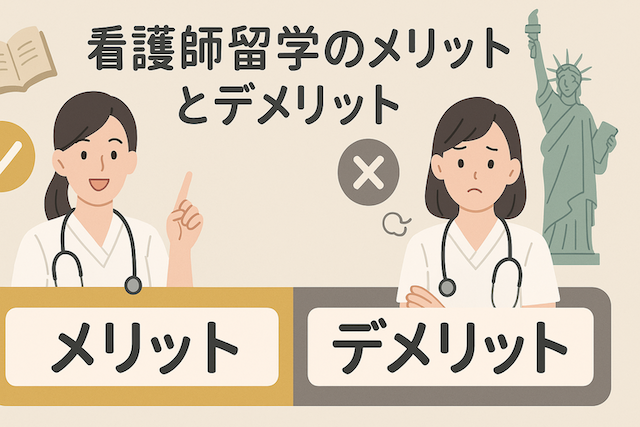
Nursing study abroad has two sides: **Advantages: acquiring international skills, improving language ability, career advancement, high income, and life experience** **Disadvantages: barriers of qualifications and visas, high costs, language and cultural barriers, a career gap, and mental strain** Both need to be weighed.
Whether to take on the challenge is something to decide by weighing it against your own career direction and life plan.
If you prepare well and clarify your purpose, nursing study abroad can bring you great growth and possibilities.
07
Frequently Asked Questions (FAQ)
What is nursing study abroad?
It is study abroad aimed at gaining learning and practical experience related to nursing overseas. It combines language training, nursing courses, clinical placements, and preparation for obtaining local qualifications.
Can a Japanese nursing license be used overseas as it is?
In many countries it cannot be used as it is. You need to register locally after going through the assessments and exams set by each country's nursing registration body (for example, education assessment, state board review, NCLEX, etc.).
Which countries are popular destinations for nursing study abroad?
The United States, Canada, Australia, the United Kingdom, New Zealand, and the Philippines are typical. The best country varies depending on your purpose (obtaining qualifications, learning English, cost, work opportunities).
What is the general process to obtain local qualifications?
- Prepare your language ability (obtain English test scores)
- Education and credit evaluation procedures
- Application to the nursing registration body
- Completing missing credits or taking a bridging program
- Taking and passing the national exam
- Activating your work visa or license
How Much English Do You Need?
It varies by country and program, but as a guideline, scores such as IELTS Academic 6.5 to 7.0, or a passing score in the OET nursing category, are often required.
How much does studying abroad cost?
It varies by country, duration, and school. Including language study, nursing-related courses, and living expenses, it can come to several million yen per year. Check in advance whether scholarships, education loans, or installment payments are available.
Can I work while studying?
Working hours on a student visa are restricted depending on the country. Some countries allow on-campus and off-campus part-time work, but be sure to check whether you can balance it with course attendance requirements and clinical placements.
How much clinical experience is needed?
The required number of years varies by country and employer. In some cases you can apply with 0 to 2 years, while in others experience in a specialty area or recent practical experience is emphasized.
Is There an Age Limit?
Many countries have no legal upper limit, but practical constraints may arise from student visa and work visa requirements and from employers' hiring policies. Individual confirmation is needed.
What is the NCLEX? Is it necessary?
The NCLEX is the US national nursing examination. To work as an RN in the United States, passing the NCLEX is normally required. Eligibility to take it follows the requirements of each state's board of nursing.
What is a bridging program?
It is a course to make up for subjects and clinical practice that fall short of local standards. Completing it aims to satisfy the conditions for local registration.
How do I obtain a visa?
The usual flow is a student visa when you start studying, then a work visa application after local registration. You prepare the necessary documents, such as whether you have a sponsoring employer, test scores, proof of funds, and a police clearance certificate.
How long does studying abroad take?
Language preparation takes several months to one year, bridging or undergraduate or master's study takes one to two years or more, and including passing the exam, registration, and finding a job afterward, a total of about 1 to 3 years is a guideline.
Will it help my career after I return home?
International experience and English ability tend to be valued, and your options widen to acute care, international medical cooperation, education, and companies (pharmaceutical, medical devices).
Is it cost-effective?
Tuition, living costs, and opportunity cost are large, but you can expect expanded skills, income, and career opportunities. Estimate your purpose and payback plan (duration, expected income, country of work) in numbers.
Is there local support?
You can make use of school student support, study-abroad agencies, Japanese communities abroad, hospital education programs, and more. Whether there is support for setting up your life after arrival is also important.
I am worried about whether I can adapt to cultural and healthcare setting differences.
You can reduce the risk through advance study (medical English, EBP, documentation), role-play, and choosing placement sites with mentoring systems. Self-understanding and a stress-coping plan are also effective.
What should I do about safety and insurance?
Check the enrollment conditions for overseas travel insurance, student insurance, and professional liability insurance, and understand safety information for your residential area, emergency contact arrangements, and hospital occupational infection control.
Are resumes and interviews different from Japan?
In English-speaking countries, a results-focused resume format is common. Show evidence-based practice and metrics (for example, reduced fall rates, improved patient satisfaction) in numbers, and prepare for behavioral interviews.
Where should I start?
Start by setting your target country and timeline, planning your English test, checking the requirements for education assessment, making a financial plan, comparing candidate schools and programs, and collecting the documents you will need to submit (academic transcripts, proof of work history).
What are the advantages of choosing the Philippines as a study destination?
An English environment with a relatively low burden of tuition and living costs, plus opportunities to practice medical English and options for clinical observation. Some people also choose it as a stepping stone to other countries in the future.
How to Avoid Failure
The keys are to check the latest requirements, verify local information from primary sources, compare offers from multiple schools, quantify your plan, secure a network of mentors and seniors, and build buffers into your schedule.
What kind of person is suited to nursing study abroad?
People who learn proactively, who are positive about multicultural environments, who can prepare in a planned way, who can adapt to change, and who value patient safety and team-based care are well suited.
I can't decide whether study abroad or changing jobs suits me better.
If your purpose is “language, international qualifications, and settling overseas,” study abroad has the advantage; if it is “deepening clinical skills or pursuing expertise,” a job change within Japan may achieve it. Compare them in terms of cost-effectiveness and timeline.
Nursing Study Abroad Guide 2026: A Complete Roadmap to Working and Studying Overseas08
Related article
09
Recommended Courses
Course
IELTS Preparation Course
One-on-one lessons and exam-format mock tests build all four skills in a balanced way in a short time.
See moreCourseOET Preparation Course
With practical training specialized by profession, for doctors and nurses, you can raise your Writing and Speaking scores in the shortest time.
See moreThe first step in IELTS preparation is choosing the right environment
With one-on-one classes and real-format mock exams, we help you reach your target score by the most direct route.