
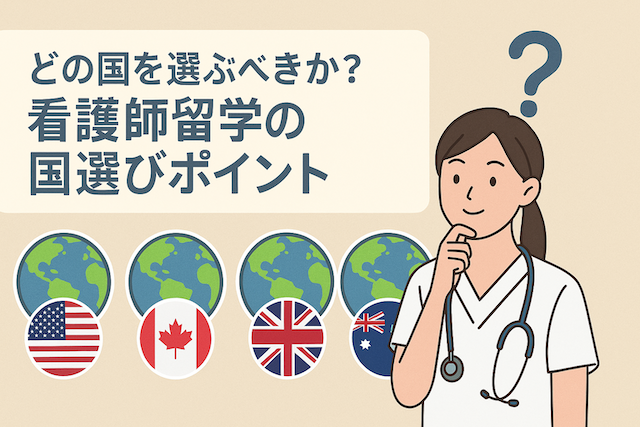
Nursing Study Abroad Guide
Which Country Should You Choose? Points for Choosing a Country for Nursing Study Abroad
01
Introduction
Studying abroad as a nurse (“nursing study abroad”) is not only a way to improve your language skills but also a major step toward acquiring up-to-date medical knowledge and building an internationally recognized career. However, the first big challenge you face is the question of “which country should I choose?” Tuition, living costs, how nursing qualifications are treated, work visa conditions and even the living environment differ greatly from country to country. If you choose a destination without being clear about your purpose, you may end up with regrets because it does not match what you want to learn or your future career.
This article organizes the key points to consider when choosing a country for nursing study abroad and offers hints for finding the destination that suits you.
02
1. Language Environment
One of the greatest purposes of nursing study abroad is **acquiring practical language skills**. The environment for learning English and the speed at which you improve change greatly depending on which country you study in.
- **English-speaking countries (USA, UK, Canada, Australia, New Zealand, etc.)** Because English is the official language, you are in an environment where you use English constantly, both in medical settings and in daily life. This is a major advantage if you aim for long-term employment locally.
- **English-learning-focused countries such as the Philippines** The appeal is that it is close to Japan and lets you study at lower cost. In the Philippines in particular, **one-on-one lessons are the mainstream**, which suits strengthening speaking skills in a short time. It is also often used as “preparatory study abroad” by people who want to obtain a nursing license in an English-speaking country in the future.
- **Choosing according to your purpose** “I want to build my English from the basics first” → Philippines “I am considering working as a nurse locally” → USA, Canada, Australia, etc.
Language ability is directly tied to the overall results of your study abroad, so it is important to be clear about how much English ability you want to develop.
03
2. Tuition and Living Costs
When considering nursing study abroad, **costs** are the most practical and significant point. The balance between tuition and living costs differs greatly from country to country.
- **USA and UK** Tuition is among the highest in the world, and living costs in urban areas are also very high. There is a chance it will lead to a high-income career, but the initial investment is a heavy burden.
- **Canada, Australia and New Zealand** Tuition is somewhat lower than in the USA and UK, and living costs can be adjusted depending on the city and region. These countries make it relatively easy to balance cost and career.
- **Philippines** Both tuition and living costs are far lower, making it **ideal for those who want to improve their language intensively in a short time or keep costs down**. Because it is close to Japan, airfare is also relatively cheap, and you can keep the total cost of your stay down.
- **Points for choosing** “I want an investment that matches my future income” → USA, UK “I want a good balance of cost and career” → Canada, Australia “I want to raise my language skills at low cost first” → Philippines
Study abroad costs are a large investment over months to years, so it is important to think in terms of a **total budget that includes not only tuition but also rent, living costs and transportation**.
04
3. Treatment of National Qualifications and Licenses
What people tend to overlook when considering nursing study abroad is **how a Japanese nursing qualification is treated in the destination country**. Accreditation procedures and examination systems differ by country, and this directly determines whether you can work there in the future.
- **USA and Canada** A Japanese nursing qualification is not valid as it is, and you must pass the **NCLEX-RN (national examination)**. You need not only English ability but also the ability to understand and express specialized knowledge in English, so the hurdle is relatively high, but if you pass, well-paid employment opportunities are available.
- **UK** **Registration with the NMC (Nursing and Midwifery Council)** is required. You need a certain score on an English test (IELTS or OET), and you must also take a practical exam called the OSCE.
- **Australia and New Zealand** You must apply to the local nursing regulatory body, and accreditation follows a qualification assessment and a bridging course. If you meet the conditions, it can readily lead to a work visa and permanent residency, which is a major attraction.
- **Philippines** It is difficult to work as a nurse there using your Japanese qualification directly, so it is generally used as a destination for **building a foundation through language acquisition and preparation for qualification exams**.
The destination changes greatly depending on “in which country you want to work as a nurse” in the future. **Checking the qualification recognition system in advance and choosing by working backward from what you need to study** is the key to success.
05
4. Career Prospects
Nursing study abroad is not just about “learning”; how you can envision your later **career path** is important. The experience you gain and your future options differ greatly depending on each country's healthcare system and working environment.
- **USA and Canada** Salary levels are high and career paths for each specialty are clearly established. There are plenty of systems for advancement, such as graduate school and advanced practice nursing qualifications. Depending on your effort, large income increases and promotion to leadership positions are possible.
- **UK** There is a stable work environment centered on the public healthcare body NHS, and you can build an internationally recognized career while gaining clinical experience. However, salaries are not as high as in the USA, so it suits those who value stability.
- **Australia and New Zealand** Work-life balance is emphasized, and the appeal is that you can gain experience while avoiding long working hours. These countries actively accept nurses from overseas, and many people aim for permanent residency while building their careers.
- **Philippines** It is difficult to build a career as a nurse locally, but **strengthening your English and the experience of studying in an international environment** can be used as a “preparation stage” leading to the next step (obtaining qualifications in the USA or Australia).
The country you choose and how you study will change depending on whether you will “use your career in Japan” or “keep working overseas” after studying abroad. **Picturing your career goal first** is the guide for choosing the best country.
06
5. Living Environment and Culture
Study abroad is not only about study; **comfort in daily life and cultural compatibility** are also important factors. Your motivation and how easily you adapt change greatly depending on the environment in which you study.
- **USA and Canada** These are multicultural societies with many international students, making it an environment where adapting to other cultures is easy. Cities are highly convenient, but high living costs are an issue. Canada is appealing for its safety and closeness to nature.
- **UK** A culture that values history and tradition is firmly rooted, and the appeal is that you can experience a distinctive healthcare system. The climate tends to be cloudy and cold, but its good location also lets you enjoy travel in Europe.
- **Australia and New Zealand** Nature is rich and the climate is mild. They are popular as countries where you can live with peace of mind, friendly to international students and immigrants. A culture that values work-life balance is deeply rooted, suiting those who also want a fulfilling leisure life.
- **Philippines** The advantages are a warm climate and easy travel, as it is close to Japan with short flight times. Prices are also low, and you can enjoy life in resort areas. However, there are times when infrastructure can be inconvenient, so you need flexibility.
Because you will live there for a long time, it is important to choose the country that suits you, including **climate, safety, cultural values and lifestyle**.
07
6. Work Visa and Permanent Residency Prospects
For those who want **to connect nursing study abroad to local employment or a long stay** rather than ending it with “study,” visa and permanent residency conditions are an important checkpoint.
- **USA** Demand for nurses is high, but obtaining a work visa (such as the H-1B) is highly competitive and relatively difficult. Even if you pass the qualification exam (NCLEX-RN), you need to find a hospital that will act as your sponsor.
- **UK** If you can prove NMC registration and a certain level of English, you can obtain a work visa (Health and Care Worker visa). Demand exists because of the nurse shortage, but visa renewal and obtaining permanent residency take time.
- **Canada** It actively accepts immigrants, and nursing is one of the occupations that is advantageous for permanent residency applications. The system differs by province, but after obtaining your qualification, the path to permanent residency tends to be relatively open.
- **Australia and New Zealand** They actively accept overseas nurses, and if you can register locally after a qualification assessment and a bridging course, these are countries where it is easy to go from a work visa to permanent residency. They are popular with people who want a stable life.
- **Philippines** Long-term employment there is difficult, so the general use is as **step-up study abroad before moving on to another country after language study**.
The country you choose changes depending on whether you will “return to Japan” or “work overseas” after studying abroad. In particular, if you have permanent residency in view, choosing **a country with well-established systems such as Australia or Canada** will make it easier to achieve.
Related Articles (Nursing Study Abroad Guides for 6 Major Countries)
- Nursing Study Abroad in the US: A Complete Guide to Making Your Dream Come True
- Nursing Study Abroad in the UK: A Thorough Guide from the Basics to Careers
- Nursing Study Abroad in Canada: A Guide to Benefits, Requirements, and Career Prospects
- Nursing Study Abroad Guide: Australia
- Nursing Study Abroad in New Zealand: Guide to Benefits, Systems, Costs, and Career Paths
- Nursing Study Abroad in the Philippines: Ideal for Building Language Skills and Preparing for Your Career
08
Summary
Choosing a country for nursing study abroad requires considering multiple factors together: **language environment, costs, qualification systems, career prospects, living environment and visa systems**.
- If you want to **study English intensively in a short time** → Philippines
- If you want to **balance cost and career** → Canada or Australia
- If you aim for **high income or specialized career advancement** → USA
- If you value **stability and international experience** → UK
- If you want **work-life balance and the possibility of permanent residency** → Australia or New Zealand
What matters is to clarify your purpose, **“what do I want to achieve through study abroad?”**, and choose a country that fits it. If you decide by working backward from where you want to use the knowledge and experience you gain, you can choose a destination without regrets.
09
Frequently Asked Questions (FAQ)
Q1. Which country is most popular for nursing study abroad?
It depends on the purpose. The USA is popular for high income and specialized career advancement, Canada and Australia for a balance of cost and future prospects, and the Philippines for preparatory study abroad to raise English quickly.
Q2. Which country suits me if I first want to improve my English?
The Philippines is a strong candidate, with mainly one-on-one lessons and short intensive study. A two-stage plan is standard: build your English foundation first, then move on to an English-speaking country (USA, Canada, Australia, UK, New Zealand).
Q3. Which country makes it easier to keep the total of tuition and living costs down?
The Philippines makes it easy to keep the total down. Among English-speaking countries, Canada and Australia tend to be easier to adjust depending on your choice of city.
Q4. What do I need to work as a nurse locally?
Accreditation procedures are required in each country. Generally, the USA and Canada require the NCLEX-RN; the UK requires NMC registration and the OSCE; and Australia and New Zealand involve assessment, a bridging course and so on.
Q5. Which country should I choose if I have permanent residency or long-term employment in view?
In terms of systems, Canada and Australia make it relatively easy to map out a route. Details differ by province or state and occupational requirements.
Q6. Which country is best if I am aiming for high income?
The USA is a candidate. However, hurdles such as visas, exams and securing a sponsor are relatively high.
Q7. How should I judge living environment and cultural compatibility?
Evaluate overall climate, safety, prices, work-life balance and how easily you can adapt to a multicultural environment. Give these particular weight if you plan to live there long term.
Q8. Is it worth going to a country with high tuition?
It depends on return on investment. If income after graduation, career paths and employment opportunities are large, it may be possible to recoup the cost. Decide based on your purpose and length of stay.
Q9. How do I decide the priority for choosing a country?
A practical approach is to work through them in this order: (1) purpose (English, qualification, employment, permanent residency) → (2) required conditions (exams, language scores, funds) → (3) living environment → (4) timeline.
Q10. Where is it efficient to prepare for exams?
A two-stage approach is efficient: intensive short-term study of basic to intermediate English in the Philippines or similar, then finishing specialist exam preparation in the curriculum and clinical environment of the country where you plan to take the exam.
Q11. What should I watch for when choosing a city?
Check rent and commuting time, access to hospital placement sites, safety, public transportation, and whether part-time work is allowed (in compliance with the law).
Q12. How long should the period be?
English preparation takes 4 to 12 weeks, while a route to qualification and employment can take more than a year. It varies greatly depending on target scores and assessment periods.
Q13. What should I prepare before leaving?
A funding plan, raising your language scores beforehand, notarization and translation of required documents, vaccinations, insurance, and securing housing and a commute route to school.
Q14. Are there detailed guides for each country?
Yes, please see the following: Nursing Study Abroad in the USA / Nursing Study Abroad in the UK / Nursing Study Abroad in Canada / Nursing Study Abroad in Australia / Nursing Study Abroad in New Zealand / Nursing Study Abroad in the Philippines
Q15. What is the deciding factor in finally choosing a country?
Clarify “what you want to achieve through study abroad,” and prioritize visa conditions, qualification requirements, costs and living environment in light of that purpose.
Nursing Study Abroad Guide 2026: A Complete Roadmap to Working and Studying Overseas10
Related article
11
Recommended Courses
Course
IELTS Preparation Course
One-on-one lessons and exam-format mock tests build all four skills in a balanced way in a short time.
See moreCourseOET Preparation Course
With practical training specialized by profession, for doctors and nurses, you can raise your Writing and Speaking scores in the shortest time.
See moreThe first step in IELTS preparation is choosing the right environment
With one-on-one classes and real-format mock exams, we help you reach your target score by the most direct route.