2026年3月30日
3D ACADEMY offers affordable English study programs in Cebu, Philippines – perfect for beginners, professionals, and exam takers.

3D UNIVERSAL ENGLISH INSTITUTE INC
info.3d-universal.com
8:00-17:00(Mon-Fri)
Speak App Review: Can It Replace English Teachers?
Contents
- Speak App Review: Can It Replace English Teachers?
- Introduction
- What Is Speak App?
- How Speak App Works
- Key Features of Speak App
- Advantages of Speak App
- Limitations of Speak App
- Can Speak App Replace English Teachers?
- Best Use Case: Hybrid Learning Approach
- Who Should Use Speak App?
- Speak App vs Traditional English Classes
- Final Verdict
- Conclusion
- FAQs (Frequently Asked Questions)
- Can Speak App really improve English speaking skills?
- Is Speak App good for beginners?
- Can Speak App replace an English teacher completely?
- Does Speak App help with pronunciation?
- Who should use Speak App?
- How often should I use Speak App to see results?
- Is Speak App worth paying for?
Speak App Review: Can It Replace English Teachers?
Introduction
In recent years, AI-powered language learning apps have rapidly transformed how people study English. Among these tools, Speak App has gained significant attention for its focus on real-time speaking practice using artificial intelligence. Unlike traditional apps that emphasize vocabulary memorization or grammar exercises, Speak positions itself as a conversation-first platform designed to simulate real-life communication.
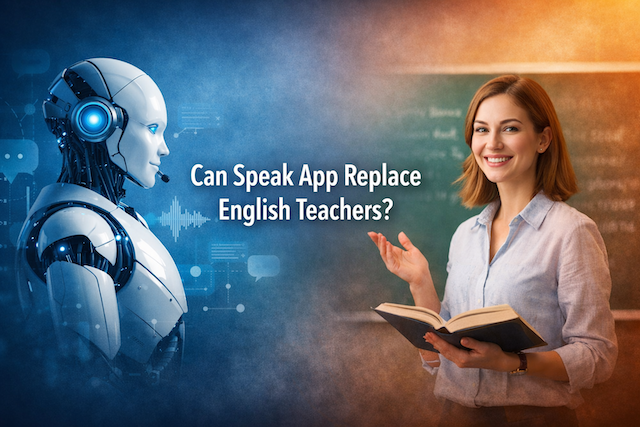
But this raises an important question: Can Speak App actually replace English teachers?
For learners considering alternatives to traditional classes—whether due to cost, flexibility, or accessibility—this is not just a theoretical question. It directly impacts how they choose to invest their time and money.
In this in-depth review, we’ll examine how Speak App works, its strengths and limitations, and whether it can realistically serve as a substitute for human teachers.
What Is Speak App?
Speak App is an AI-driven language learning platform designed primarily to improve speaking skills. It uses advanced speech recognition and natural language processing to create interactive conversations between the user and an AI tutor.
Unlike many language apps that rely heavily on passive learning, Speak emphasizes:
-
Active speaking from the first lesson
-
Real-time feedback
-
Scenario-based conversations
-
Personalized learning paths
The app is available on mobile devices and has gained popularity among learners who want to practice speaking without the pressure of interacting with real people.
How Speak App Works
Speak App’s core functionality revolves around simulated conversations. Instead of selecting multiple-choice answers, users are required to speak out loud.
AI Conversation Practice
The app presents scenarios such as:
-
Ordering food at a restaurant
-
Introducing yourself
-
Job interviews
-
Travel conversations
Users respond verbally, and the AI processes their speech instantly.
Real-Time Feedback
One of the standout features is immediate correction. The app analyzes:
-
Pronunciation
-
Fluency
-
Grammar
-
Sentence structure
It then suggests improvements or provides alternative phrasing.
Repetition and Reinforcement
Speak uses repetition techniques to reinforce learning. If a user struggles with a phrase, the app encourages multiple attempts until the sentence is delivered correctly.
Personalized Learning
The system adapts to the user’s level and progress. Beginners receive simpler prompts, while advanced users engage in more complex conversations.
Key Features of Speak App
1. Speaking-Focused Learning
Most language learners struggle with speaking because traditional methods prioritize reading and writing. Speak flips this model by making speaking the central activity.
This is particularly useful for learners who:
-
Understand English but can’t speak fluently
-
Lack opportunities to practice conversation
-
Feel nervous speaking with others
2. AI-Powered Feedback
Speak provides instant feedback, which is something even human teachers can’t always offer continuously.
Benefits include:
-
Immediate correction of mistakes
-
Clear examples of better responses
-
Continuous performance tracking
3. Flexible Learning Schedule
Users can practice anytime without scheduling lessons. This makes it ideal for:
-
Busy professionals
-
Students with irregular schedules
-
Self-paced learners
4. Real-Life Scenarios
Instead of abstract exercises, Speak focuses on practical communication. This makes learning more relevant and engaging.
5. No Social Pressure
Many learners hesitate to speak because they fear making mistakes in front of others. Speak removes this barrier by allowing private practice.
Advantages of Speak App
Convenience and Accessibility
One of the biggest advantages is accessibility. You don’t need to:
-
Travel to a school
-
Book appointments
-
Coordinate with a teacher
Everything is available instantly on your phone.
Cost Efficiency
Compared to private lessons or language schools, Speak is significantly more affordable. For learners on a budget, this is a major benefit.
Unlimited Practice
With Speak, you can practice speaking as much as you want. In contrast, traditional classes often limit speaking time due to group settings.
Confidence Building
Because there’s no judgment from a human listener, learners can practice freely. This helps build confidence before transitioning to real conversations.
Immediate Feedback Loop
The ability to receive corrections instantly accelerates learning. You don’t have to wait until the end of a lesson to understand your mistakes.
Limitations of Speak App
Despite its strengths, Speak App is not without limitations.
Lack of Human Interaction
The biggest drawback is the absence of real human communication.
AI conversations, while impressive, still lack:
-
Emotional nuance
-
Natural unpredictability
-
Cultural context
Real conversations are messy and dynamic, something AI cannot fully replicate yet.
Limited Deep Explanation
While Speak can correct mistakes, it often doesn’t provide in-depth explanations of grammar rules or language structures.
For example:
-
Why a sentence is incorrect
-
How grammar rules apply in different contexts
This can be a challenge for learners who need conceptual understanding.
Repetitive Patterns
Over time, some users may notice repetition in scenarios or responses. This can reduce engagement for long-term learners.
Pronunciation Feedback Limitations
Although AI pronunciation analysis is useful, it may not always detect subtle errors or provide nuanced coaching like a trained teacher.
No Personalized Teaching Strategy
Human teachers can:
-
Identify learning styles
-
Adjust teaching methods
-
Provide emotional support
AI still lacks this level of personalization.
Can Speak App Replace English Teachers?
Short Answer: Not Completely
Speak App is powerful—but it is not a full replacement for English teachers.
Where Speak App Excels
Speak can effectively replace teachers in certain areas:
-
Daily speaking practice
-
Pronunciation drills
-
Confidence building
-
Beginner to intermediate conversation training
For learners who simply need more speaking exposure, Speak can be extremely effective.
Where Teachers Are Still Essential
Human teachers remain superior in areas such as:
1. Complex Language Explanation
Teachers can explain:
-
Grammar rules in depth
-
Subtle differences in meaning
-
Contextual usage
2. Real Conversation Skills
Real-life communication involves:
-
Interruptions
-
Slang
-
Emotional tone
-
Cultural references
These are difficult for AI to simulate accurately.
3. Personalized Guidance
Teachers can tailor lessons based on:
-
Weaknesses
-
Goals (e.g., business English, exams)
-
Learning preferences
4. Motivation and Accountability
A teacher provides:
-
Encouragement
-
Structure
-
Accountability
This is often missing in self-study apps.
Best Use Case: Hybrid Learning Approach
Rather than choosing between Speak App and teachers, the most effective approach is to combine both.
How to Use Speak App Effectively
You can use Speak for:
-
Daily speaking practice (15–30 minutes)
-
Repetition and fluency training
-
Practicing before real conversations
How Teachers Complement Speak
Teachers can help with:
-
Correcting persistent mistakes
-
Explaining difficult concepts
-
Practicing natural conversation
-
Preparing for exams or interviews
This hybrid approach maximizes efficiency while minimizing cost.
Who Should Use Speak App?
Ideal Users
Speak App is best suited for:
-
Beginners who want to start speaking early
-
Intermediate learners who lack speaking practice
-
Busy professionals who need flexible learning
-
Learners who feel shy speaking with others
Less Suitable For
It may not be ideal for:
-
Advanced learners seeking nuanced conversation
-
Students preparing for academic exams (e.g., IELTS writing)
-
Learners who need structured, guided instruction
Speak App vs Traditional English Classes
| Feature | Speak App | English Teacher |
|---|---|---|
| Flexibility | Very high | Limited |
| Cost | Low | High |
| Speaking Practice | Unlimited | Limited |
| Feedback Speed | Instant | Delayed |
| Human Interaction | No | Yes |
| Deep Explanation | Limited | Strong |
| Personalization | Moderate | High |
This comparison highlights a key insight: Speak excels in scalability, while teachers excel in depth.
Final Verdict
Speak App is one of the most effective AI tools currently available for improving English speaking skills. Its focus on active speaking, real-time feedback, and convenience makes it a powerful addition to any learner’s toolkit.
However, it does not fully replace English teachers.
Instead, it fills a critical gap in language learning: consistent, pressure-free speaking practice.
For most learners, the best strategy is not to choose one over the other, but to combine them. Use Speak App for daily practice and fluency, and rely on teachers for deeper understanding and real-world communication skills.
Conclusion
So, can Speak App replace English teachers?
Not entirely—but it doesn’t need to.
What Speak offers is something traditional education often lacks: unlimited speaking practice anytime, anywhere. When used strategically alongside human instruction, it can significantly accelerate your progress.
In the end, the most effective learning approach is not about replacing teachers with AI, but about using AI to become a better, more confident speaker—faster than ever before.
FAQs (Frequently Asked Questions)
Can Speak App really improve English speaking skills?
Yes, Speak App can help many learners improve their English speaking skills, especially in areas such as pronunciation, fluency, confidence, and sentence-building speed. Its main strength is that it encourages users to speak actively instead of only reading or listening. This is important because many English learners understand grammar and vocabulary but still struggle to speak naturally in real situations.
By using AI-based speaking exercises, the app gives users regular opportunities to practice short responses, useful expressions, and everyday conversation patterns. This kind of repetition can help learners become more comfortable producing English out loud. For people who feel shy or nervous speaking with native speakers or teachers, Speak App can also serve as a low-pressure environment where mistakes feel less embarrassing.
However, improvement depends on how the app is used. If a learner only uses it occasionally, progress may be limited. On the other hand, daily use combined with review and real-life communication can lead to noticeable results over time.
Is Speak App good for beginners?
Speak App can be a good option for beginners because it introduces spoken English in a simple and approachable way. Many beginners are afraid to speak because they think they need perfect grammar before opening their mouths. Speak App reduces that fear by guiding learners through controlled practice and short speaking tasks.
Beginners often benefit from hearing useful phrases, repeating them, and using them in predictable situations such as greetings, travel, shopping, or self-introduction. This helps build a foundation of practical communication. Instead of waiting until they “know enough English,” beginners can start speaking early.
That said, some absolute beginners may still need extra support. If a learner has very limited vocabulary or struggles to understand basic instructions, a teacher or structured beginner course may be more helpful at the start. In that case, Speak App works better as a supplement rather than the main learning tool.
Can Speak App replace an English teacher completely?
No, Speak App cannot fully replace an English teacher for most learners. It is a useful tool, but it does not provide everything that a qualified teacher can offer. A human teacher can explain grammar deeply, adjust lessons based on individual learning problems, answer unexpected questions, and provide feedback that includes emotion, context, and cultural understanding.
Speak App is very strong for regular speaking practice and confidence-building. It helps users practice more often, which is something many students do not get in traditional classes. But when a learner has complex questions such as why one sentence sounds natural and another sounds awkward, a teacher is usually better at giving a clear explanation.
For this reason, Speak App is best viewed as a powerful practice tool rather than a complete substitute for teachers. Many learners will get the best results by combining app-based speaking practice with human instruction.
Does Speak App help with pronunciation?
Yes, pronunciation is one of the areas where Speak App can be especially useful. The app listens to spoken responses and gives feedback based on speech recognition technology. This can help learners notice whether they are pronouncing words clearly enough to be understood.
Regular pronunciation practice is valuable because many learners rarely hear themselves speaking English. Speak App creates repeated chances to say the same words and phrases again until they sound better. Over time, this can improve clarity and confidence.
Still, learners should understand that AI pronunciation feedback has limits. It may identify obvious issues, but it may not always catch subtle problems with stress, rhythm, intonation, or connected speech. A trained teacher can often explain those details more naturally and demonstrate them in a more personalized way. So Speak App is useful for pronunciation training, but not perfect.
Who should use Speak App?
Speak App is best for learners who want more speaking practice in a flexible and private format. It is especially suitable for busy adults, self-study learners, shy students, and intermediate learners who understand English but do not use it often in conversation. It can also help people preparing for travel, workplace communication, or daily English use.
It may be less suitable for learners whose main goals are advanced academic writing, detailed grammar study, or exam preparation that requires human scoring and strategy. In those cases, an app alone may not be enough. The ideal user is someone who wants a convenient way to turn passive English knowledge into active speaking ability.
How often should I use Speak App to see results?
Consistency matters more than long study sessions. For many learners, using Speak App for 15 to 30 minutes a day is more effective than studying for several hours once a week. Frequent speaking practice helps train the brain to respond faster in English and makes familiar phrases easier to remember and use.
Results also depend on what the learner does outside the app. If users review corrections, repeat difficult phrases, and apply what they learn in real conversations, improvement tends to be faster. The app works best when it becomes part of a daily routine instead of a tool used only when motivation is high.
Is Speak App worth paying for?
For many learners, Speak App can be worth paying for if their main goal is to improve spoken English through regular, guided practice. Compared with private lessons, it is usually much more affordable, and it offers the convenience of studying anytime. That makes it attractive for users who want frequent practice without the cost of hiring a teacher several times a week.
Whether it is worth the price depends on the learner’s goals. If someone wants daily speaking drills, faster response time, and more confidence, the value can be high. If someone needs deep grammar instruction, academic feedback, or advanced conversation coaching, the value may be lower unless it is used together with other learning methods.
How to Improve English Speaking Using AI Apps (Complete Guide 2026)

How to Register for eTravel Philippines (2025 Guide)
Step-by-step guide to completing your eTravel registration before arriving in the Philippines, with images and tips.

Night Market in Cebu – Things You Don’t Know About Cebu Life
Discover the hidden charm of Cebu’s night markets, from street food stalls to local life tips you won’t find in tourist guides.

How to Use ChatGPT for IELTS Preparation: A Complete Guide
Learn how to prepare for IELTS using ChatGPT — including strategies for Writing, Reading, Listening, Speaking, and grammar support.

How to Build a Website Without Coding Using ChatGPT
Discover how to build your own website using AI—no coding skills needed. From structure planning to SEO and design, let ChatGPT guide you.