
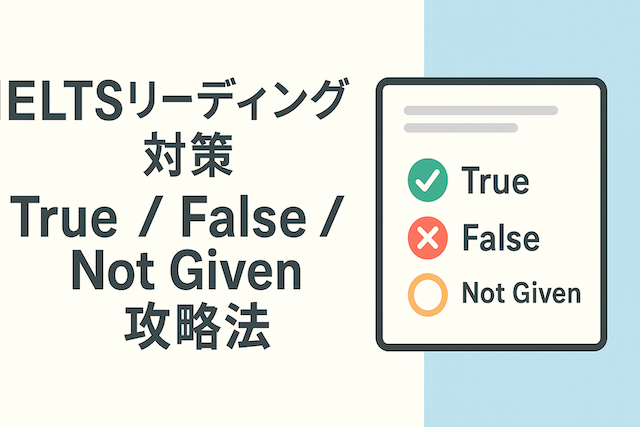
IELTS Reading Preparation
IELTS Reading Preparation: How to Tackle True/False/Not Given
01
Introduction
IELTS Reading has several question types, but the one that troubles many test takers is the True / False / Not Given question. At first glance it seems simple: you just judge whether a statement is right or wrong. In reality, though, you cannot get it right unless you carefully read the fine nuances of the passage and whether the information is there at all.
What trips up many people in particular is telling False and Not Given apart. There are endless cases of test takers mistaking information that is not written in the passage for 'wrong.' In IELTS, you must judge that 'not clearly stated in the passage = Not Given,' so whether you understand this point can make the difference to your score.
This article sorts out how True / False / Not Given works and explains practical strategies to raise your accuracy. By making your thought process clear when tackling questions and avoiding typical pitfalls, you can reliably improve your score.
02
Basic Rules of True/False/Not Given
First, it is important to understand correctly the criteria for this question type. It looks simple on the surface, but IELTS marks it according to strict rules.
True
- When the content of the statement completely matches what the passage says.
- Even if the wording is somewhat paraphrased, it is True as long as the meaning does not change.
- Example: If the passage says 'The university library opens at 8 a.m.' and the statement says 'The library opens at 8 in the morning.', the answer is True.
False
- When the passage clearly contradicts the content of the statement.
- The key is that the meaning is 'the exact opposite' or 'clearly contrary.'
- Example: If the passage says 'The library closes at 10 p.m.' but the statement says 'The library closes at midnight.', the answer is False.
Not Given
- When a related topic appears in the passage, but you cannot judge the statement to be either right or wrong.
- When information is insufficient, or the passage does not mention it at all, choose Not Given.
- Example: If the passage says 'The library has thousands of books.' but the statement says 'The library has more than 20,000 books.', the answer is Not Given because no figure is given.
The key is the attitude of 'judging only by what is in the passage.' Do not mix in your own knowledge or guesses.
03
Steps for success
To solve True/False/Not Given questions correctly, following the steps below will lead to steady scores.
1. Find the keywords in the statement
- Names of people, places, dates, numbers and technical terms are easy clues.
- Verbs and adjectives are also often paraphrased, so be careful.
- Example: For the statement 'The scientist discovered the cure in 1998,' the keywords are 'scientist,' 'cure' and '1998.'
2. Find the relevant part of the passage
- In most Reading tasks, the passage unfolds in the same order as the questions.
- Checking the sentences before and after as well helps you avoid misreading the context.
3. Compare the passage and the statement
- Judge by 'whether the meaning is the same,' not word by word.
- Watch for synonyms and paraphrases (e.g., 'many' = 'a large number of').
4. Decide True / False / Not Given
- Complete match -> True
- Exact opposite or contradiction -> False
- Insufficient information in the passage -> Not Given
5. Be aware of time management
- If you find a question difficult, skip it once and come back to it later.
- It is important not to fixate on one question and break the rhythm of the whole test.
By repeating this flow, you reduce the risk of answering on a hunch and reliably raise your accuracy.
04
Common mistakes and points to note
In True/False/Not Given questions, many test takers repeat the same patterns of mistakes. Let us sort out the typical pitfalls here.
1. Judging by your own knowledge or common sense
- IELTS Reading is a test where you answer based only on what is written in the passage.
- Example: Even if you know as common sense that the Earth is round, if the passage says 'The Earth is flat,' you must answer False.
2. Confusing False and Not Given
- If the passage has no information, it is neither wrong nor right; it is Not Given.
- Many people misunderstand 'not written = False,' but that is a classic example of a wrong answer.
3. Being fooled by a partial match
- Even if only part of the statement matches the passage, if there is a contradiction overall, it is False.
- Example: If the passage says 'Most students passed the exam' and the statement says 'All students passed the exam,' the answer is False.
4. Underestimating emphasis words and quantity expressions
- The difference between 'some' and 'all,' 'often' and 'always,' and 'can' and 'must' is fatal.
- A single word can change True to False, so always check carefully.
5. Rushing and jumping to conclusions
- Especially as the time runs short, many people skim and decide.
- However, this question type requires accurate reading, so staying calm is important.
Just being aware of these cautions can greatly reduce careless mistakes.
05
Practice Points
True/False/Not Given questions test not knowledge but 'how you separate and judge information.' To build your skills efficiently, keep the following methods in mind as you practice.
1. Review thoroughly with past papers and mock tests
- It is especially important to check the explanation of 'why is it Not Given?'
- Look back at the questions you got wrong from the perspective of 'where did I read in information that is not in the passage?'
2. Train your sense of keywords and paraphrases
- In IELTS, paraphrases such as 'increase' = 'rise' and 'because' = 'due to' appear frequently.
- Rather than memorizing a word list, practicing expressing the same meaning in different words is more effective.
3. Get in the habit of solving against the clock
- In the real exam, you have about 1-1.5 minutes per question.
- Use a stopwatch from the practice stage to develop a sense of time.
4. Have the courage to skip
- Not Given questions in particular tend to waste time.
- If you cannot decide, skip it once and return after solving the other questions.
5. Raise your overall reading skills
- Reading English news and magazine articles and practicing summarizing the key points is also effective.
- If you get into the habit of distinguishing 'facts,' 'opinions' and 'what is not written' in daily reading, your judgments in the exam will become faster.
By continuing this kind of practice, you will be able to draw the line between 'False' and 'Not Given' naturally and score consistently.
06
Summary
True/False/Not Given is a question type that test takers struggle with especially in IELTS Reading. Even if it looks simple, you cannot score unless you accurately read the subtle nuances of the passage.
The keys to success are these three points:
- Judge only by the information in the passage
- Clearly distinguish False from Not Given
- Be sensitive to paraphrased keywords and differences in quantity expressions
In practice, always check 'why is this the answer?' and deepen your understanding of Not Given questions in particular, which leads directly to a higher score. If you keep time allocation in mind and develop the habit of analyzing the passage calmly, you can aim for consistently high scores.
07
FAQ: How to Master True/False/Not Given
What are the basic differences between True / False / Not Given?
True means the passage and the statement have the same meaning. False means the passage and the statement contradict each other. Not Given means the passage does not have the information needed to judge. If the meaning matches even in a paraphrase, it is True.
What is the trick to telling False and Not Given apart?
If the passage denies the content of the statement, it is False; if the passage does not mention the point, it is Not Given. When in doubt, check whether you can say which sentence in the passage denies the statement.
Do the question order and the passage correspond?
In most cases, the questions follow the order in which things appear in the passage. Once you find the relevant part, look for the next question in the same paragraph or after it for efficiency.
Which keywords should I focus on?
Focus on proper nouns, dates and years, numbers, comparison words (more than, less than), quantity words (all, most, some, few), frequency words (always, often, rarely) and modal verbs (must, may, can).
How do I deal with paraphrases?
Judge by matching meaning, not matching words. Examples: increase = rise, because of = due to. Read while expecting thesaurus-style substitutions.
What should I watch out for in questions involving numbers or comparisons?
Check boundary expressions such as 'more than / over / at least' strictly. If the passage says 'over 50' and the statement says 'at least 50,' they do not match. A difference of even one in a number can be grounds for False.
What should I do when I am tempted to fill in a gap with a guess?
If the passage lacks supporting evidence, choose Not Given. Do not bring in common sense or background knowledge; judge only from the information in the text.
How should I allocate my time?
Aim for about 1-1.5 minutes per question. If you get stuck, mark it, skip it and return at the end. Not Given-type questions tend to consume time, so leaving them for later is also effective.
How much of the passage should I read?
Also read the sentences before and after the relevant sentence (at least 1-2 sentences). Conjunctions (however, therefore) and contrast expressions can reverse True and False.
What is the difference from Yes/No/Not Given?
True/False/Not Given asks whether the facts match or do not match. Yes/No/Not Given asks whether the writer's opinions or claims match or do not match.
How can I avoid being fooled by a partial match?
Compare the meaning of the whole statement with the whole passage. If the passage says 'Most' but the statement says 'All,' it is False. Even if part of it matches, if the whole is contradictory, it is False.
How do I handle negative expressions and emphasis words?
Words such as no, not, never, only, exactly, always and must change the meaning greatly. Even small words can reverse the conclusion, so pay very close attention.
What is a checklist for when my judgment wavers?
Do the passage and statement have the same subject, predicate and conditions? Do the words for quantity, frequency and comparison match? Does the passage clearly deny it (-> False), or is information lacking (-> Not Given)?
What are taboo words and pitfalls?
'Probably,' 'by common sense' and 'it is likely so' are taboo. Filling in causes, purposes or quantities that are not in the passage leads directly to wrong answers.
What is an efficient way to practice?
Organize a mistakes notebook along two axes: 'why is it Not Given?' and 'which word decided True/False?' Get into the habit of writing out the link from the question to the evidence in the passage in one line.
What should I check at the end when reviewing?
Emphasis words in the statement (only, all, always, etc.) Contrast words in the passage (however, although) Boundary values (at least, more than, less than)
08
Related article
09
Recommended Course
The first step in IELTS preparation is choosing the right environment
With one-on-one classes and real-format mock exams, we help you reach your target score by the most direct route.