
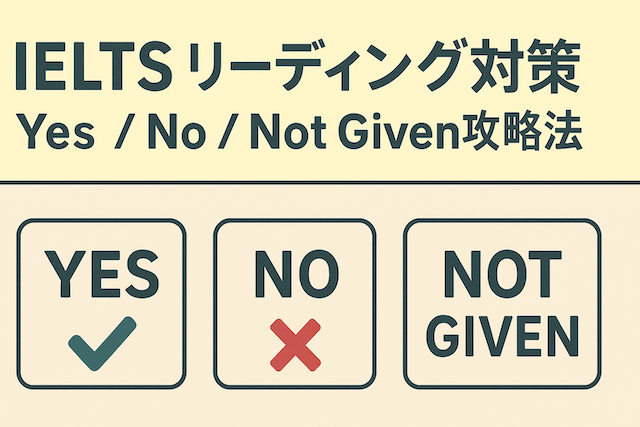
IELTS Reading Preparation
IELTS Reading Preparation: How to Tackle Yes/No/Not Given
01
Introduction
One of the question types that troubles many candidates in IELTS Reading is Yes/No/Not Given. It looks similar to True/False/Not Given at first glance, but the intent of the question and the way to solve it are actually different. This question type calls for the ability to tell whether a statement agrees with **the writer's opinion or claim**, not whether it is factually correct.
Typical mistakes are “I cannot find the answer in the passage” and “I cannot tell Yes and No apart”. However, if you correctly understand the features of the questions and follow the steps for answering, you can answer correctly and consistently. This article explains in an easy-to-follow way the way of thinking and the practical strategies for solving Yes/No/Not Given questions.
02
Features of Yes/No/Not Given
Yes/No/Not Given is a question format about **the writer's claims and opinions** in the Reading passage. Its feature is that it is not a fact check; you judge how the writer thinks, whether the writer agrees, disagrees or does not mention the point.
- Yes = the statement in the question agrees with the writer's opinion or claim
- No = the statement in the question contradicts the writer's opinion or claim
- Not Given = the claim is not written in the passage, or there is not enough to make a judgement
Key Points
- Questions that ask you to understand the writer's position -> You need the ability to read out “the writer thinks this”.
- Not a fact-check type -> Unlike True/False/Not Given, you judge based on opinion and position, not objective fact.
- If it is not written in the passage, it is Not Given -> Do not force a choice of Yes or No; if there is no information, Not Given is the answer.
03
The Difference from True/False/Not Given
The two question types that are easily confused in IELTS Reading are True/False/Not Given and Yes/No/Not Given. They look very similar, but the intent of the questions is actually different.
True/False/Not Given
- Target: the facts in the passage
- True = the statement in the question agrees with the fact in the passage
- False = the statement in the question contradicts the fact in the passage
- Not Given = the fact is not written in the passage
You judge based on **objective information**, such as scientific explanations and historical events.
Yes/No/Not Given
- Target: the writer's opinions or claims in the passage
- Yes = the opinion in the question agrees with the writer's claim
- No = the opinion in the question contradicts the writer's claim
- Not Given = the writer does not touch on that point
In critical and opinion texts, it is important to grasp what the writer thinks.
The difference in one line
- True/False/Not Given -> checking against facts
- Yes/No/Not Given -> checking against the writer's opinion
04
Steps for Answering
For Yes/No/Not Given questions, the shortcut to the correct answer is to judge by following steps instead of reading the passage blindly.
Step 1: Check the statement in the question
- Be aware whether the statement is about the writer's opinion or claim and not a fact check.
- Pay attention to keywords (for example: believes, claims, argues).
Step 2: Find the relevant part of the passage
- The questions often follow the order of the passage.
- Use the keywords in the statement to identify the corresponding paragraph or sentence.
Step 3: Read the writer's opinion
- Grasp it including paraphrases and implications, not just direct expressions.
- Sort out clearly the writer's position (agree, disagree or neutral).
Step 4: Compare with the statement
- The opinions agree -> Yes
- The opinions are opposite -> No
- Cannot say either way / not mentioned -> Not Given
Step 5: Watch out for extreme expressions
- Absolute expressions such as “always”, “never”, “all” and “only” easily contradict the passage.
- If the question asserts something that the passage does not state in such strong terms, the answer is likely to be No or Not Given.
05
Common Mistakes and Solutions
1. Forcing an answer of Yes/No for Not Given
- Example of the mistake: guessing “it is not written directly in the passage, but it must be Yes”.
- Solution: If there is no information in the passage, cleanly choose Not Given. Do not fill gaps with guesses or common sense.
2. Judging by your own knowledge or common sense
- Example of the mistake: thinking “that is generally the case, so it must be Yes”.
- Solution: IELTS is a test in which you judge only by the information written in the passage. Set aside your background knowledge.
3. Confusing Yes and No
- Example of the mistake: thinking the writer “doesn't mention it” even though the writer clearly disagrees.
- Solution: Clearly determine whether the writer agrees or disagrees. If the writer opposes the view, choose No without hesitation.
4. Missing paraphrase
- Example of the mistake: not noticing that the content is the same because the wording of the question and the passage differ.
- Solution: Get used to synonyms and paraphrased expressions. Examples: “increase” <-> “go up” “important” <-> “crucial / significant”
5. Being misled by absolute expressions
- Example of the mistake: automatically judging Yes whenever the statement contains “always” or “never”.
- Solution: If the passage has no expression meaning “without exception”, the answer is likely to be No or Not Given.
06
Tips for Practice
1. Work intensively on Yes/No/Not Given only
- Divide past papers and practice questions by type, and first get used to this question format.
- By repeating the same type, you develop a feel for the criteria for judging.
2. Always check the evidence
- When you choose an answer, always check which sentence in the passage was the evidence.
- The ideal is to be able to explain, “It is Yes because of this sentence”.
3. Strengthen your Not Given practice
- Not Given is what candidates find hardest.
- If you build up practice in confirming that the passage does not mention the point, your hesitation will decrease.
4. Get used to paraphrasing
- The same words are often not used in the question and the passage.
- Make a list of synonyms and learn the paraphrases that are likely to be used in practice.
5. Keep the time limit in mind
- Yes/No/Not Given is a format that can be solved in a relatively short time.
- If you are unsure, it is also important to decide to move on to the next question without spending too long.
07
Summary
Yes/No/Not Given questions test your ability to read **the writer's opinions and claims**. Unlike True/False/Not Given, which checks facts, the key is to correctly grasp the writer's position.
- Yes = agrees with the writer's opinion
- No = contradicts the writer's opinion
- Not Given = the writer does not mention it
If you clearly understand these rules and thoroughly handle paraphrase and extreme expressions, you can raise and stabilize your accuracy.
Finally, what matters is to **base your answer only on the information in the passage**. By making it a habit to judge within the text without being pulled by background knowledge or common sense, you will be able to handle difficult questions calmly.
08
FAQ: How to Master Yes/No/Not Given
How is Yes/No/Not Given different from True/False/Not Given?
Yes/No/Not Given judges whether a statement agrees with, contradicts or is not mentioned in terms of the writer's opinion or claim. True/False/Not Given, on the other hand, judges whether a statement agrees with, contradicts or is not mentioned in terms of objective facts.
What are the basic criteria for judging Yes/No/Not Given?
Yes: the claim in the question agrees with the writer's claim No: the claim in the question contradicts the writer's claim Not Given: there is nothing in the passage to base a judgement on (the writer does not mention it)
How can I recognize Not Given?
If you read the passage closely up to the relevant part and cannot find direct evidence that confirms or denies the claim in the question, it is Not Given. It is important not to fill the gap with guesses or general common sense.
Does the order of the questions match the order of the passage?
In many cases, the questions follow the flow of the passage. The evidence for the next question is often close to the paragraph containing the evidence for the previous question.
How should I judge when extreme expressions (always, never, all and so on) appear?
If the passage does not make an assertion at that level, the answer tends to be No or Not Given. Check whether the passage clearly states “without exception”.
How should I deal with paraphrase?
The question and the passage often do not use the same words. Examples: increase <-> go up, important <-> crucial/significant. Get used to synonyms, antonyms and cause-and-effect paraphrases (because <-> due to).
What is the deciding factor when I cannot choose between Yes and No?
Judge by whether the writer's position clearly points toward agreement or disagreement. If the nuance is weak or the position is ambiguous, do not force Yes/No; recheck how explicit the passage is, and if it does not fit, consider Not Given.
Can I use my own background knowledge?
No. IELTS tests reading comprehension based on the information in the passage. Filling gaps with outside knowledge causes wrong answers.
What is an efficient procedure for answering?
Be aware that the question is asking about “the writer's opinion”. Use the keywords in the question to identify the relevant paragraph of the passage. Read the writer's position and compare it with the claim in the question. Agreement = Yes, contradiction = No, not mentioned = Not Given.
What review should I do during practice?
After choosing, always underline the evidence sentence in the passage and explain in one sentence why you made that choice. For Not Given in particular, confirm that there is no evidence however far you read.
What is a guideline for time allocation?
Yes/No/Not Given can be solved in a relatively short time. Aim for about 60 to 90 seconds per question; if you are unsure, mark it and move on, then go back at the end to judge again.
Is there a checklist for reducing mistakes?
Is the statement about an opinion? (not a fact) Does the passage make an assertion? (check for extreme expressions) Have I missed a paraphrase? Can I point to at least one clear evidence sentence? Am I filling gaps with outside knowledge?
What are the tips for judging with a mini example?
Example: Question “The author believes online learning can fully replace classroom education.” Passage “Online learning offers valuable flexibility, but it should complement classroom instruction rather than replace it.” => The writer says it is a complement and denies that it is a complete replacement, so the answer is No.
What if I cannot find the evidence in the same paragraph?
Use the context around the question as a clue and widen the range to nearby paragraphs. If you still cannot find it, do not guess; consider the possibility of Not Given.
09
Related article
10
Recommended Course
The first step in IELTS preparation is choosing the right environment
With one-on-one classes and real-format mock exams, we help you reach your target score by the most direct route.