2026年4月5日
3D ACADEMY offers affordable English study programs in Cebu, Philippines – perfect for beginners, professionals, and exam takers.

3D UNIVERSAL ENGLISH INSTITUTE INC
info.3d-universal.com
8:00-17:00(Mon-Fri)
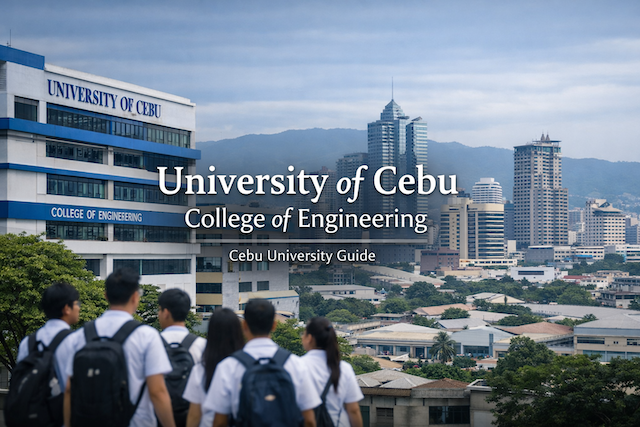
University of Cebu (UC) College of Engineering: Cebu University Guide
Contents
- University of Cebu (UC) College of Engineering: Cebu University Guide
- Overview of University of Cebu and the College of Engineering
- Campuses Offering Engineering Programs
- Engineering Programs Offered at UC
- Curriculum Structure and Teaching Approach
- Laboratories and Facilities
- Licensure Exam Performance and Reputation
- Admission Requirements
- Tuition Fees and Cost of Study
- Student Life and Engineering Culture
- Career Opportunities and Industry Outlook
- Strengths and Limitations of UC College of Engineering
- Who Should Consider UC College of Engineering?
- Conclusion
- FAQs (Frequently Asked Questions)
- Is the University of Cebu (UC) College of Engineering a good choice for engineering in Cebu?
- Which UC campus should I choose for engineering: UC Main or UC Banilad?
- What engineering programs are available at UC?
- How long does it take to complete an engineering degree at UC?
- Does UC engineering prepare students for the licensure (board) exams?
- What facilities and labs can engineering students expect at UC?
- How much is the tuition for UC College of Engineering?
- Are there scholarships or financial support options for engineering students?
- Is UC College of Engineering suitable for international students?
- What is student life like for engineering students at UC?
- What careers can UC engineering graduates pursue after graduation?
- What should I consider before choosing UC for engineering?
University of Cebu (UC) College of Engineering: Cebu University Guide
Overview of University of Cebu and the College of Engineering
The University of Cebu (UC) is one of the largest and most established private universities in Cebu, Philippines. Founded in 1964, UC has grown into a multi-campus institution known for practical education, affordability, and strong industry-oriented programs. Among its many academic units, the College of Engineering stands out as a core pillar of the university, producing thousands of licensed engineers who now work in the Philippines and abroad.
UC’s College of Engineering is particularly popular among local students due to its balance of academic rigor, hands-on training, and competitive tuition fees. For international students, especially those considering engineering education in English within Southeast Asia, UC offers an accessible entry point into the Philippine engineering education system.
Campuses Offering Engineering Programs
The University of Cebu operates multiple campuses across Cebu, but engineering programs are mainly offered at:
-
UC Main Campus (Sanciangko Street, Cebu City)
-
UC Banilad Campus (Cebu City)
Both campuses are well-equipped for engineering education, with laboratories, workshops, and classrooms designed specifically for technical courses. The Banilad Campus, in particular, is known for its more modern facilities and proximity to business districts, residential areas, and major roads.
Engineering Programs Offered at UC
The College of Engineering at the University of Cebu offers a wide range of CHED-accredited undergraduate engineering programs, each designed to meet national licensure standards and industry requirements.
Bachelor of Science in Civil Engineering (BSCE)
Civil Engineering is one of UC’s flagship programs. It attracts a large number of students each year and has a strong track record in the Civil Engineer Licensure Examination.
Key focus areas include:
-
Structural engineering
-
Construction management
-
Transportation engineering
-
Water resources and hydraulics
-
Geotechnical engineering
Students undergo extensive training in surveying, materials testing, and design software, preparing them for careers in construction firms, government agencies, and international infrastructure projects.
Bachelor of Science in Mechanical Engineering (BSME)
The Mechanical Engineering program emphasizes both theory and application, covering:
-
Thermodynamics
-
Machine design
-
Fluid mechanics
-
Power generation
-
Manufacturing systems
Graduates often pursue careers in manufacturing plants, power facilities, shipyards, and industrial maintenance, both locally and overseas.
Bachelor of Science in Electrical Engineering (BSEE)
Electrical Engineering at UC focuses on power systems and industrial applications, making it suitable for students targeting careers in utilities, energy companies, and industrial operations.
Core areas include:
-
Power generation and distribution
-
Electrical machines
-
Control systems
-
Industrial electronics
-
Renewable energy fundamentals
The program aligns closely with the Registered Electrical Engineer (REE) licensure requirements in the Philippines.
Bachelor of Science in Electronics Engineering (BSECE)
Electronics Engineering is another strong program at UC, reflecting the growing demand for engineers in telecommunications, electronics manufacturing, and automation.
Students study:
-
Analog and digital electronics
-
Telecommunications systems
-
Microprocessors and embedded systems
-
Control and automation
-
Signal processing
Graduates are eligible to take the Electronics Engineer (ECE) licensure exam and often work in telecom companies, semiconductor firms, and technology-related industries.
Bachelor of Science in Computer Engineering (BSCpE)
Computer Engineering bridges hardware and software, making it attractive to students interested in technology, programming, and system design.
Program highlights include:
-
Computer architecture
-
Embedded systems
-
Programming and algorithms
-
Networking fundamentals
-
Robotics and automation basics
This program is increasingly popular as industries demand engineers who can work with both physical systems and software platforms.
Curriculum Structure and Teaching Approach
The College of Engineering at UC follows a competency-based curriculum mandated by the Commission on Higher Education (CHED). Programs typically run for five years, including on-the-job training (OJT) and a capstone or thesis project.
Teaching Methodology
UC places strong emphasis on:
-
Problem-solving and analytical thinking
-
Laboratory-based instruction
-
Board exam-oriented review integration
-
Practical applications and case studies
Many instructors are licensed professional engineers with industry experience, which helps bridge the gap between theory and real-world practice.
Laboratories and Facilities
Engineering education at UC is supported by a range of specialized facilities, including:
-
Materials testing laboratories
-
Electrical and electronics labs
-
Mechanical workshops
-
Computer laboratories with engineering software
-
Surveying and fieldwork equipment
While UC may not always match the newest private universities in terms of aesthetics, its facilities are functional, heavily used, and aligned with licensure exam requirements, which is a key factor for many students.
Licensure Exam Performance and Reputation
One of the strongest selling points of UC’s College of Engineering is its consistent performance in Philippine licensure examinations. UC regularly produces board passers and top-performing graduates across multiple engineering disciplines.
To support this, UC integrates:
-
In-house review sessions
-
Mock board examinations
-
Faculty-led review programs
-
Strict academic retention policies in higher years
This board-focused culture is particularly appealing to students whose primary goal is professional licensure.
Admission Requirements
For Local Students
Admission to the College of Engineering typically requires:
-
High school diploma (K–12 compliant)
-
Entrance examination
-
Interview or screening (program-dependent)
-
Minimum grades in mathematics and science subjects
Some engineering programs may have retention policies, especially after the first or second year.
For International Students
International applicants generally need:
-
Authenticated academic transcripts
-
Proof of English proficiency (depending on background)
-
Student visa (9F)
-
Medical clearance
-
Additional documentation required by Philippine immigration authorities
While UC is not traditionally known as an international engineering hub, it remains a cost-effective option for foreign students who want English-taught engineering programs in Cebu.
Tuition Fees and Cost of Study
One of UC’s biggest advantages is affordability. Compared to other private universities in Cebu, UC offers relatively low tuition fees, even for engineering programs.
Approximate annual tuition range:
-
PHP 40,000 to PHP 70,000 per year (varies by program and year level)
Additional costs may include:
-
Laboratory fees
-
Uniforms and safety gear
-
Books and supplies
-
Review and examination fees
For budget-conscious students, UC is often considered one of the best-value engineering schools in Cebu.
Student Life and Engineering Culture
Engineering students at UC are known for their intensive academic schedules. Long hours in laboratories, group projects, and review sessions are common, especially in higher years.
Despite this, students benefit from:
-
Active engineering student organizations
-
Inter-school competitions and quiz bowls
-
University-wide events and activities
-
Affordable food options around campus
The surrounding areas of UC Main and Banilad campuses are filled with dormitories, boarding houses, eateries, and transport options, making daily student life convenient.
Career Opportunities and Industry Outlook
Graduates of UC’s College of Engineering pursue careers in:
-
Construction and infrastructure firms
-
Manufacturing and industrial plants
-
Power and energy companies
-
Telecommunications providers
-
IT and technology companies
-
Government agencies
-
Overseas engineering positions
Many alumni work in the Middle East, Japan, Singapore, and other parts of Asia, leveraging Philippine engineering licenses and international experience.
Strengths and Limitations of UC College of Engineering
Strengths
-
Affordable tuition fees
-
Strong licensure exam focus
-
Wide range of engineering programs
-
Large alumni network
-
Practical, industry-oriented teaching
Limitations
-
Large class sizes in popular programs
-
Facilities may feel dated compared to newer universities
-
Limited international exposure compared to global engineering schools
Who Should Consider UC College of Engineering?
The University of Cebu College of Engineering is well-suited for:
-
Students aiming for Philippine engineering licensure
-
Budget-conscious families
-
Students seeking practical, exam-oriented education
-
Those planning to work locally or overseas in technical roles
It may be less ideal for students seeking research-intensive programs or extensive international exchange opportunities.
Conclusion
The University of Cebu (UC) College of Engineering remains one of the most accessible and reliable choices for engineering education in Cebu. With its wide program offerings, strong board exam performance, and affordable tuition, UC continues to play a major role in producing engineers who contribute to the Philippines and the global workforce.
For students who prioritize licensure success, practical skills, and cost efficiency, UC’s College of Engineering offers a solid and proven pathway into the engineering profession.
FAQs (Frequently Asked Questions)
Is the University of Cebu (UC) College of Engineering a good choice for engineering in Cebu?
Yes. The University of Cebu (UC) College of Engineering is widely considered a practical, value-focused option for students who want an engineering degree in Cebu. UC is known for offering engineering programs that align closely with Philippine licensure requirements, which is important if your goal is to become a licensed professional engineer in the Philippines. Many students choose UC because it combines structured academic training with laboratory activities and review-oriented preparation. Like any large university, your experience will depend on factors such as your study habits, your instructors, and how actively you use available resources. If you are looking for an engineering school that prioritizes hands-on learning, affordability, and board exam readiness, UC is often shortlisted by students in Cebu.
Which UC campus should I choose for engineering: UC Main or UC Banilad?
Both UC Main and UC Banilad are common choices for engineering students, and the best option depends on your daily routine and personal preferences. UC Main is located near the city center, which can be convenient if you live around downtown Cebu City or prefer easy access to traditional commercial areas. UC Banilad tends to feel more modern and is closer to major roads, residential neighborhoods, and business hubs. In practical terms, you should consider commute time, class schedules, availability of dorms or rentals nearby, and your preferred environment for studying. If possible, visiting both campuses before enrolling can help you judge facilities, crowd levels, and the surrounding neighborhood.
What engineering programs are available at UC?
UC’s College of Engineering typically offers major undergraduate programs such as Civil Engineering, Mechanical Engineering, Electrical Engineering, Electronics Engineering, and Computer Engineering. These programs follow a structured curriculum designed to build strong foundations in mathematics, physics, and core engineering sciences before moving into specialized professional courses. Each program also includes laboratory subjects and project-based requirements. When choosing a program, focus on your long-term career direction. For example, Civil Engineering fits students aiming for construction and infrastructure, while Electronics and Computer Engineering may appeal to students who prefer technology, systems, and automation-related work.
How long does it take to complete an engineering degree at UC?
Most engineering programs in the Philippines, including those at UC, commonly take around five years to complete. The length is influenced by required major subjects, laboratory classes, and progression policies. In later years, students usually handle heavier technical loads, design subjects, and major examinations. Many programs also include an on-the-job training (OJT) component and a capstone project or thesis requirement. Planning your schedule carefully matters because engineering programs can become demanding once you reach higher-level professional courses.
Does UC engineering prepare students for the licensure (board) exams?
UC’s engineering culture is often described as board exam-aware, meaning many subjects and assessments are designed to reflect the concepts and problem-solving approaches tested in Philippine licensure examinations. Students may encounter mock exams, review sessions, and structured assessments intended to build exam readiness. However, passing a licensure exam still depends on the student’s consistent preparation, mastery of fundamentals, and disciplined review strategy. If your goal is licensure, you should treat every major subject as a building block and start review habits early rather than waiting until your final year.
What facilities and labs can engineering students expect at UC?
Engineering students at UC can expect access to laboratories and workshops that support core technical subjects. Depending on the program, this can include materials testing, electronics and electrical labs, mechanical workshops, computer labs, and equipment used for practical activities such as measurement and fieldwork. The most important point is that these facilities are meant to support learning outcomes required by the curriculum. To maximize the value of lab classes, students should come prepared, take lab reports seriously, and treat experiments and exercises as professional training rather than simple requirements.
How much is the tuition for UC College of Engineering?
Tuition varies depending on program, year level, and the number of units and laboratory subjects taken per term. Engineering can have additional fees because labs and specialized classes often include extra charges. UC is generally regarded as more affordable compared with many other private universities in Cebu, which is one reason it remains popular among local students. The best approach is to request the latest fee breakdown from UC directly, then budget for both tuition and extra costs such as supplies, printing, uniforms or safety gear (if required), transportation, and day-to-day living expenses.
Are there scholarships or financial support options for engineering students?
Many universities offer a mix of internal scholarships, academic discounts, and external scholarship pathways, and UC students often explore options through university offices and government programs. Availability, eligibility, and application schedules can change, so you should check UC’s official channels and scholarship desk for updated requirements. If you are aiming for financial support, prepare documents early and maintain strong grades, as academic performance is a common requirement. Some students also combine partial scholarships with flexible living arrangements to control costs in Cebu.
Is UC College of Engineering suitable for international students?
UC can be suitable for international students who want an English-taught engineering program in Cebu and prefer a cost-effective option. International applicants typically need academic documents, immigration-related requirements, and school-specific admissions steps. While UC may not be marketed primarily as an international engineering destination, motivated international students can still succeed if they are comfortable adapting to local academic expectations and campus culture. Before enrolling, international students should clarify visa processing timelines, document authentication requirements, and the expected language level used in technical classes.
What is student life like for engineering students at UC?
Engineering student life at UC is usually busy. Students often balance lectures, laboratory classes, group projects, and frequent quizzes or assessments, especially in higher years. Time management becomes a key skill, and many students form study groups to handle problem sets and design requirements more efficiently. Outside academics, students may join engineering-related organizations, attend campus events, and participate in competitions. The areas around UC campuses also offer many practical options for food, supplies, and student housing, which helps students manage daily routines while keeping up with demanding coursework.
What careers can UC engineering graduates pursue after graduation?
UC engineering graduates pursue careers across construction, manufacturing, utilities, energy, telecommunications, technology, and government. Some graduates also aim for overseas employment after gaining local experience and credentials. Your career direction will depend on your specialization, internship or OJT exposure, and whether you pursue licensure. Students who take licensure seriously and build a strong portfolio through projects, internships, and technical skills often have more opportunities. If you want to work internationally, it also helps to develop communication skills, software proficiency, and familiarity with global standards used in your field.
What should I consider before choosing UC for engineering?
Before choosing UC, consider your priorities: budget, location, commute, learning style, and licensure goals. Engineering success depends heavily on your consistency in mastering math and science foundations, not only the school name. If you prefer a practical environment, can handle a demanding schedule, and want an affordable engineering education in Cebu, UC may fit your needs well. To make a confident choice, compare campuses, ask about facilities for your specific program, and think about where you plan to live, how you will commute, and what academic support systems you will rely on during tough semesters.
University of Cebu (UC) Guide: Courses, Campuses, and Admissions

How to Register for eTravel Philippines (2025 Guide)
Step-by-step guide to completing your eTravel registration before arriving in the Philippines, with images and tips.

Night Market in Cebu – Things You Don’t Know About Cebu Life
Discover the hidden charm of Cebu’s night markets, from street food stalls to local life tips you won’t find in tourist guides.

How to Use ChatGPT for IELTS Preparation: A Complete Guide
Learn how to prepare for IELTS using ChatGPT — including strategies for Writing, Reading, Listening, Speaking, and grammar support.

How to Build a Website Without Coding Using ChatGPT
Discover how to build your own website using AI—no coding skills needed. From structure planning to SEO and design, let ChatGPT guide you.