2026年1月9日
3D ACADEMY offers affordable English study programs in Cebu, Philippines – perfect for beginners, professionals, and exam takers.

3D UNIVERSAL ENGLISH INSTITUTE INC
info.3d-universal.com
8:00-17:00(Mon-Fri)
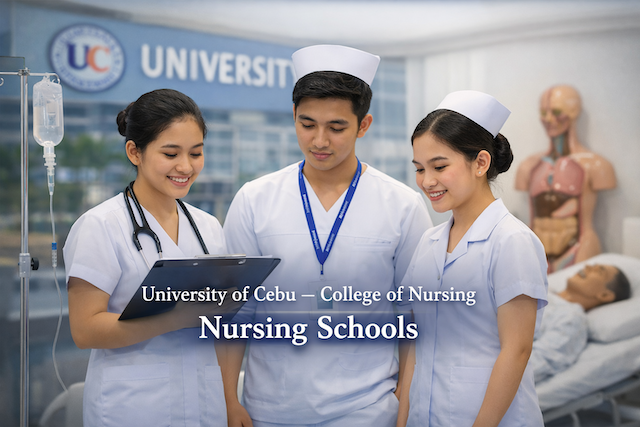
University of Cebu (UC) – College of Nursing: Nursing Schools
Contents
- University of Cebu (UC) – College of Nursing: Nursing Schools
- Overview of University of Cebu and Its College of Nursing
- Vision, Mission, and Educational Philosophy
- Bachelor of Science in Nursing (BSN) Program Structure
- Clinical Training and Hospital Affiliations
- Nursing Laboratories and Learning Facilities
- Faculty Qualifications and Teaching Approach
- Licensure Examination Performance and Board Preparation
- Student Life and Support Systems
- Tuition Fees and Affordability
- Career Opportunities for UC Nursing Graduates
- Research, Community Engagement, and Social Responsibility
- Why Choose University of Cebu – College of Nursing
- Conclusion
- FAQs (Frequently Asked Questions)
- Is the University of Cebu (UC) College of Nursing a good choice for nursing students in Cebu?
- What degree program does UC College of Nursing offer?
- How long does it take to complete the BSN program at UC?
- Does UC provide clinical training and hospital exposure for nursing students?
- What skills do students practice before entering real clinical settings?
- How does UC prepare students for the Nurse Licensure Examination (NLE) in the Philippines?
- Is UC College of Nursing affordable compared to other nursing schools?
- What are the admission requirements for UC nursing students?
- Can international students enroll in UC College of Nursing?
- What career paths are available after graduating from UC College of Nursing?
- Does UC offer student support and mentoring for nursing students?
- What should students do to succeed in UC’s nursing program?
University of Cebu (UC) – College of Nursing: Nursing Schools
Overview of University of Cebu and Its College of Nursing
The University of Cebu (UC) is one of the largest and most established private universities in the Philippines, with a strong reputation for accessible, career-oriented education. Founded in 1964, UC has grown into a multi-campus institution with locations across Cebu City, Lapu-Lapu City, and Mandaue. Among its many academic units, the College of Nursing stands out as a key contributor to the healthcare workforce, producing competent, board-ready, and globally competitive nurses.
The UC College of Nursing is designed to address both local and international healthcare demands. It combines rigorous academic instruction, hands-on clinical exposure, and values-based education. The program is particularly attractive to students seeking quality nursing education at a more affordable cost compared to elite private universities, while still maintaining solid licensure performance and employability.
Vision, Mission, and Educational Philosophy
The UC College of Nursing aligns with the university’s broader mission of providing accessible, relevant, and quality education. Its vision is to develop professional nurses who are competent, compassionate, and committed to lifelong learning and service.
The college emphasizes:
-
Patient-centered and evidence-based nursing practice
-
Ethical and professional responsibility
-
Community-oriented healthcare
-
Holistic development of students, including leadership and communication skills
Rather than focusing solely on theory, UC’s nursing education stresses real-world readiness. Graduates are expected not only to pass the Philippine Nurse Licensure Examination (NLE) but also to adapt effectively to hospital, community, and international healthcare environments.
Bachelor of Science in Nursing (BSN) Program Structure
The Bachelor of Science in Nursing (BSN) at the University of Cebu is a four-year program that follows the standards set by the Commission on Higher Education (CHED). The curriculum integrates general education, professional nursing courses, and extensive Related Learning Experiences (RLEs).
Core Academic Components
The program typically includes:
-
General education subjects (communication, humanities, social sciences)
-
Foundational sciences (anatomy, physiology, microbiology, biochemistry)
-
Core nursing courses (fundamentals of nursing, medical-surgical nursing, maternal and child health, mental health nursing, community health nursing)
-
Research and evidence-based practice
-
Leadership and management in nursing
Courses are sequenced to ensure progressive learning, starting with foundational knowledge and moving toward complex clinical decision-making and leadership roles.
Clinical Training and Hospital Affiliations
Clinical exposure is one of the strongest pillars of the UC College of Nursing. Students undergo structured and supervised clinical rotations across a variety of healthcare settings.
Hospital and Community Exposure
UC nursing students typically gain experience in:
-
Tertiary and secondary hospitals
-
Community health centers
-
Public health units
-
Specialized care facilities
These rotations allow students to apply classroom knowledge to real patient scenarios, develop technical nursing skills, and build professional confidence. Exposure to diverse patient populations helps students understand the realities of healthcare delivery in both urban and community-based settings.
Emphasis on Skills and Competency
Clinical training focuses on:
-
Safe and accurate nursing procedures
-
Critical thinking and clinical judgment
-
Teamwork and interprofessional collaboration
-
Patient communication and documentation
By the time students reach their final year, they are expected to function with a high level of independence under supervision, closely resembling entry-level professional nurses.
Nursing Laboratories and Learning Facilities
The UC College of Nursing supports clinical readiness through well-equipped nursing laboratories. These facilities simulate real hospital environments and allow students to practice skills before engaging with actual patients.
Simulation-Based Learning
Laboratory facilities commonly include:
-
Nursing skills labs with hospital beds and mannequins
-
Simulation tools for vital signs monitoring, injections, and emergency procedures
-
Demonstration rooms for faculty-led instruction
Simulation-based learning helps reduce anxiety among students and improves competence and confidence, especially during early clinical exposure.
Faculty Qualifications and Teaching Approach
The strength of the UC College of Nursing is also reflected in its faculty. Instructors are licensed nurses, many with advanced degrees and extensive clinical experience.
Practitioner-Oriented Instruction
Faculty members bring real-world insights from:
-
Hospital nursing practice
-
Community and public health work
-
Nursing education and research
Teaching methods include lectures, case studies, skills demonstrations, return demonstrations, group discussions, and reflective learning. Faculty members emphasize not just “how” to perform procedures, but also “why” certain nursing decisions are made.
Licensure Examination Performance and Board Preparation
Preparing students for the Philippine Nurse Licensure Examination (NLE) is a major priority of the UC College of Nursing. The curriculum is closely aligned with board exam competencies, and review integration is embedded throughout the program.
Board Exam Readiness
Support for licensure preparation includes:
-
Comprehensive review sessions
-
Mock board examinations
-
Faculty-led coaching and mentoring
-
Emphasis on critical thinking and test-taking strategies
UC nursing graduates consistently demonstrate competitive board exam participation, and many go on to secure hospital positions shortly after passing the NLE.
Student Life and Support Systems
Life as a nursing student at UC is demanding, but the university provides academic and personal support systems to help students succeed.
Academic and Personal Support
Students benefit from:
-
Academic advising and mentoring
-
Access to libraries and learning resources
-
Student organizations, including nursing-related groups
-
Guidance and counseling services
The environment encourages discipline, time management, and resilience—qualities essential for nursing professionals.
Tuition Fees and Affordability
One of the key advantages of the University of Cebu is its relatively affordable tuition compared to other private nursing schools in the Philippines. This makes UC a popular choice for students from Cebu and nearby provinces.
Financial Accessibility
While exact tuition fees may vary by campus and academic year, UC is known for:
-
Competitive fee structures
-
Transparent payment schedules
-
Options for installment payments
This affordability allows more students to pursue nursing without compromising educational quality.
Career Opportunities for UC Nursing Graduates
Graduates of the UC College of Nursing are prepared for a wide range of career paths, both locally and internationally.
Local Employment
Many graduates find employment in:
-
Private and public hospitals
-
Clinics and diagnostic centers
-
Community health programs
-
Educational institutions (with further studies)
International Pathways
With appropriate licensure, experience, and additional requirements, UC nursing graduates also pursue opportunities abroad, including:
-
Middle East healthcare facilities
-
Asia-Pacific hospitals
-
Western countries after meeting equivalency standards
The solid clinical foundation gained at UC helps graduates adapt to different healthcare systems and cultural contexts.
Research, Community Engagement, and Social Responsibility
The UC College of Nursing emphasizes the social role of nurses as community advocates and health educators.
Community Health Involvement
Students participate in:
-
Community health assessments
-
Health education campaigns
-
Outreach programs and medical missions
These activities instill a sense of social responsibility and highlight the importance of preventive care and public health nursing.
Research Integration
Nursing research is introduced to help students:
-
Understand evidence-based practice
-
Analyze healthcare problems systematically
-
Contribute to quality improvement initiatives
Research skills are essential for modern nursing practice and lifelong professional development.
Why Choose University of Cebu – College of Nursing
Choosing a nursing school is a critical decision, and the University of Cebu offers several compelling advantages.
Key Strengths
-
Accessible and affordable nursing education
-
Strong emphasis on clinical training
-
Experienced and supportive faculty
-
Board exam–oriented curriculum
-
Multiple campuses and hospital exposure
For students seeking a practical, results-oriented nursing education in Cebu, UC represents a balanced option that combines quality, affordability, and real-world readiness.
Conclusion
The University of Cebu – College of Nursing plays a significant role in shaping the next generation of Filipino nurses. Through a comprehensive BSN program, strong clinical exposure, and a commitment to accessible education, UC continues to produce competent, compassionate, and globally competitive nursing professionals.
For aspiring nurses who want solid training without excessive financial burden, and who value hands-on experience and community engagement, the UC College of Nursing stands as a reliable and respected choice among nursing schools in the Philippines.
FAQs (Frequently Asked Questions)
Is the University of Cebu (UC) College of Nursing a good choice for nursing students in Cebu?
Yes. The University of Cebu (UC) College of Nursing is widely considered a practical and accessible option for students who want a structured Bachelor of Science in Nursing (BSN) program with strong skills training and clinical exposure. UC is known for career-focused education, and its nursing program is designed to prepare students for both the Philippine Nurse Licensure Examination (NLE) and real-world clinical work. Many students choose UC because it offers a balance of affordability, multiple campus locations, and a learning environment that emphasizes discipline, competency, and patient safety.
What degree program does UC College of Nursing offer?
UC College of Nursing primarily offers the Bachelor of Science in Nursing (BSN), a four-year undergraduate degree program aligned with Commission on Higher Education (CHED) requirements. The BSN curriculum typically includes general education courses, foundational sciences, core professional nursing subjects, and extensive Related Learning Experiences (RLEs). The program is built to develop students’ knowledge, clinical skills, communication, ethics, and critical thinking—key competencies expected of entry-level professional nurses.
How long does it take to complete the BSN program at UC?
The standard BSN program length is four years, assuming a student follows the regular curriculum sequence and completes all academic and clinical requirements on time. However, the total duration can vary depending on factors such as academic performance, availability of subjects, or changes in curriculum policy. Nursing is a demanding program with both classroom and clinical components, so consistent attendance, time management, and meeting competency requirements are essential to graduating on schedule.
Does UC provide clinical training and hospital exposure for nursing students?
Yes. Clinical training is a central part of nursing education at UC. Students participate in supervised clinical rotations and practical experiences as part of their Related Learning Experiences (RLEs). These placements are structured to help students apply theoretical learning to real patient care situations and build confidence in professional settings. Clinical exposure typically includes hospital-based rotations and community-based experiences, allowing students to understand a range of patient needs, healthcare workflows, and public health priorities.
What skills do students practice before entering real clinical settings?
Before entering clinical placements, students typically undergo laboratory-based training and simulation activities. Nursing skills labs help students practice core procedures such as taking vital signs, performing basic nursing care, administering injections (as allowed under supervision and policy), wound care, patient communication, and documentation. Simulation-based learning supports safe practice, reduces errors, and helps students build competence and confidence before working with actual patients in clinical environments.
How does UC prepare students for the Nurse Licensure Examination (NLE) in the Philippines?
UC’s nursing curriculum is designed to align with competencies tested in the Nurse Licensure Examination (NLE). Many nursing schools, including UC, reinforce board-relevant concepts throughout the program by using comprehensive exams, quizzes, case analyses, and periodic assessments. Students often benefit from structured review activities, practice tests, and faculty guidance in key nursing areas such as medical-surgical nursing, maternal and child nursing, psychiatric nursing, community health nursing, and nursing leadership and management. Consistent study habits and active participation in review opportunities are important for exam readiness.
Is UC College of Nursing affordable compared to other nursing schools?
UC is often viewed as more affordable than many private universities, which is one reason it attracts a large student population. Tuition and fees may vary by campus, academic year, and student load, so it is best to confirm the most current cost breakdown directly with UC admissions or the nursing department. Beyond tuition, students should also budget for uniforms, books, clinical requirements, transportation, and other nursing-related expenses that can add up over time.
What are the admission requirements for UC nursing students?
Admission requirements may differ slightly depending on UC campus policies and year-level entry, but most nursing programs require applicants to submit basic academic records, complete an admissions process, and meet any program-specific screening requirements. Some nursing schools also consider health clearances, immunization records, and other clinical prerequisites before students begin hospital exposure. For the most accurate and updated requirements, applicants should contact UC directly and ask for the nursing program’s official admissions checklist.
Can international students enroll in UC College of Nursing?
In many Philippine universities, international students can enroll as long as they meet institutional and government requirements, including documentation for student visas and credential evaluation. Nursing programs may also require proof of English proficiency or completion of prerequisite subjects, depending on the student’s background. Because nursing includes clinical training and regulated requirements, international applicants should coordinate early with UC’s admissions office to confirm eligibility, timelines, and any additional steps needed before enrollment.
What career paths are available after graduating from UC College of Nursing?
Graduates who complete the BSN program and pass the NLE can pursue a wide range of nursing roles. Many start in hospital settings such as medical-surgical units, emergency departments, intensive care units, operating room support, or specialized wards depending on training and hiring needs. Others work in community health, school health services, occupational health, clinics, and public health programs. With experience and additional requirements, some graduates also pursue opportunities overseas. Career growth may include leadership roles, specialization, and graduate studies in nursing or healthcare management.
Does UC offer student support and mentoring for nursing students?
Most nursing programs, including UC, provide some form of student support through academic advising, faculty mentoring, and access to campus learning resources. Nursing students often benefit from guidance on study strategies, clinical performance, professional behavior, and board exam preparation. Students may also find support through nursing organizations or peer groups that encourage collaboration and stress management—important factors in a program known for heavy workloads and high performance expectations.
What should students do to succeed in UC’s nursing program?
Success in nursing school typically requires strong time management, consistent study routines, and active engagement during lectures, skills labs, and clinical rotations. Students should focus on building solid foundations in anatomy, physiology, pharmacology concepts, and nursing fundamentals, because these subjects influence performance in advanced clinical courses. It also helps to practice communication skills, maintain professionalism, and develop safe habits—especially in medication safety, infection control, documentation, and patient interaction. Finally, students should seek help early when struggling, whether through faculty consultation, peer study groups, or structured review sessions.
Cebu Universities: Nursing Degree – Top Nursing Schools, Tuition, and Board Exam Pass Rates

How to Register for eTravel Philippines (2025 Guide)
Step-by-step guide to completing your eTravel registration before arriving in the Philippines, with images and tips.

Night Market in Cebu – Things You Don’t Know About Cebu Life
Discover the hidden charm of Cebu’s night markets, from street food stalls to local life tips you won’t find in tourist guides.

How to Use ChatGPT for IELTS Preparation: A Complete Guide
Learn how to prepare for IELTS using ChatGPT — including strategies for Writing, Reading, Listening, Speaking, and grammar support.

How to Build a Website Without Coding Using ChatGPT
Discover how to build your own website using AI—no coding skills needed. From structure planning to SEO and design, let ChatGPT guide you.