
目次
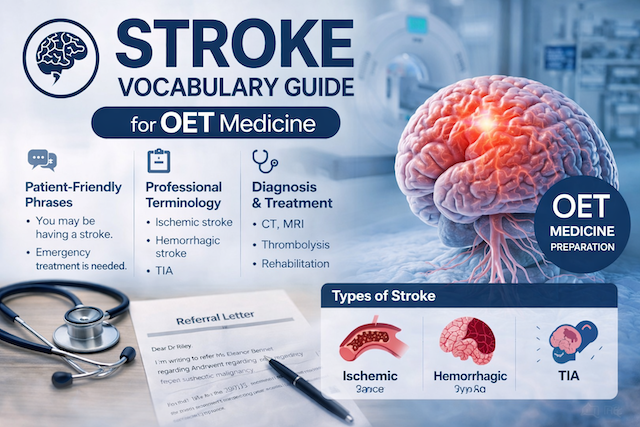
Stroke(脳卒中)ボキャブラリー完全ガイド【OET for Medicine対策】
はじめに
Stroke(脳卒中)は、OET Medicineにおいて非常に重要なテーマの一つです。
特に以下の理由で頻出です:
- 緊急疾患であり、説明能力が問われる
- 症状が特徴的(片麻痺・言語障害など)
- Writing(紹介状)とSpeaking(患者説明)両方で出題されやすい
このガイドでは、以下を体系的に解説します:
- Strokeの基本定義
- 種類(ischemic / hemorrhagic)
- 症状表現
- 診断・治療
- OETで使えるフレーズ
Strokeとは何か(基本定義)
Stroke(脳卒中)
Stroke is a medical condition in which the blood supply to part of the brain is interrupted or reduced, causing brain cells to die.
脳卒中とは、脳への血流が遮断または低下することで、脳細胞が損傷・死亡する状態です。
Strokeの種類(超重要)
1. Ischemic Stroke(虚血性脳卒中)
血管が詰まるタイプ(約80%)
- Blood clot(血栓)
- Blocked artery(動脈閉塞)
例文:
- “The patient suffered an ischemic stroke.”
患者は虚血性脳卒中を発症しました
2. Hemorrhagic Stroke(出血性脳卒中)
血管が破れるタイプ
- Intracerebral hemorrhage(脳内出血)
- Subarachnoid hemorrhage(くも膜下出血)
例文:
- “CT confirmed a hemorrhagic stroke.”
CTで出血性脳卒中が確認されました
TIA(重要)
Transient Ischemic Attack(TIA)=一過性脳虚血発作
- 短時間で症状が消える
- 本格的な脳卒中の前兆
例文:
- “The patient had a transient ischemic attack.”
一過性脳虚血発作がありました
患者向け説明(Speaking対策)
わかりやすい説明
- “You may be having a stroke.”
脳卒中の可能性があります - “This is a medical emergency.”
緊急の状態です - “We need to act quickly.”
すぐに対応が必要です - “We will send you to the hospital immediately.”
すぐに病院へ搬送します
医療者向け表現(Writing対策)
高得点フレーズ
- “The patient presented with symptoms suggestive of stroke.”
- “An acute ischemic stroke is suspected.”
- “Urgent neurological assessment is required.”
- “CT imaging has been arranged.”
典型症状(超重要)
FAST(必須)
- Face drooping(顔の歪み)
- Arm weakness(腕の脱力)
- Speech difficulty(言語障害)
- Time to act(時間が重要)
その他症状
- Sudden weakness(突然の脱力)
- Numbness(しびれ)
- Loss of vision(視力低下)
- Dizziness(めまい)
- Loss of balance(バランス障害)
例文
- “The patient presented with sudden left-sided weakness.”
- “She had difficulty speaking.”
診断(Investigation)
- CT scan(CT)
- MRI(MRI)
- Blood tests(血液検査)
例文
- “CT scan ruled out hemorrhage.”
- “MRI confirmed ischemic stroke.”
治療(Treatment)
急性期
- Thrombolysis(血栓溶解療法)
- Mechanical thrombectomy(血栓回収)
慢性期
- Rehabilitation(リハビリ)
- Medication(抗血小板薬など)
例文
- “Thrombolytic therapy was administered.”
- “The patient is undergoing rehabilitation.”
後遺症(Complications)
- Paralysis(麻痺)
- Speech impairment(言語障害)
- Cognitive impairment(認知障害)
リスク因子
- Hypertension(高血圧)
- Smoking(喫煙)
- Diabetes(糖尿病)
- Obesity(肥満)
OET Writingテンプレ表現
- “I am writing to refer…”
- “The patient presented with…”
- “CT scan revealed…”
- “I would appreciate your assessment…”
実戦用サンプル表現
“The patient presented with sudden onset of right-sided weakness and slurred speech. CT imaging ruled out hemorrhage, and ischemic stroke is suspected. Urgent neurological evaluation is required.”
ハイレベル表現(Band A)
- “acute neurological deficit”
- “consistent with stroke”
- “requires urgent intervention”
- “time-critical condition”
よくあるミス
1. strokeだけ使う
❌ stroke
✅ ischemic stroke / hemorrhagic stroke
2. 症状が弱い
❌ weak
✅ sudden unilateral weakness
3. 緊急性が弱い
❌ needs treatment
✅ requires urgent intervention
まとめ
Stroke対策のポイントは:
- 種類(ischemic / hemorrhagic)を区別
- FAST症状を使う
- 緊急性を強調する
これができれば、
OET Writing・Speakingともに一気にスコアが上がる。
FAQs (Frequently Asked Questions)
脳卒中(Stroke)とは何ですか?
What is a stroke?
脳卒中とは、脳への血流が遮断または減少することで、脳細胞が損傷する状態です。早急な治療が必要な緊急疾患です。
A stroke is a condition in which blood flow to the brain is interrupted or reduced, leading to damage of brain cells. It is a medical emergency requiring immediate treatment.
脳卒中にはどんな種類がありますか?
What are the types of stroke?
主に2種類あります:
- 虚血性脳卒中(Ischemic stroke):血管が詰まるタイプ
- 出血性脳卒中(Hemorrhagic stroke):血管が破れるタイプ
There are two main types:
- Ischemic stroke (caused by blockage)
- Hemorrhagic stroke (caused by bleeding)
TIAとは何ですか?
What is a transient ischemic attack (TIA)?
TIA(一過性脳虚血発作)は、一時的に脳への血流が減少する状態で、症状は短時間で回復しますが、将来の脳卒中の前兆とされます。
A transient ischemic attack (TIA) is a temporary reduction in blood flow to the brain. Symptoms resolve quickly but it is a warning sign of a future stroke.
脳卒中の初期症状は何ですか?
What are the early symptoms of stroke?
代表的な症状は以下の通りです:
- 顔の歪み(Face drooping)
- 腕の脱力(Arm weakness)
- 言語障害(Speech difficulty)
Common early symptoms include:
- Face drooping
- Arm weakness
- Speech difficulty
FASTとは何ですか?
What does FAST stand for?
FASTは脳卒中の早期発見のためのチェック法です:
- Face(顔の歪み)
- Arm(腕の脱力)
- Speech(言語障害)
- Time(すぐに対応)
FAST is a tool for identifying stroke symptoms quickly:
- Face drooping
- Arm weakness
- Speech difficulty
- Time to act immediately
脳卒中はなぜ緊急疾患なのですか?
Why is stroke a medical emergency?
脳細胞は酸素が不足すると短時間で損傷するため、早期治療が非常に重要です。
Brain cells are rapidly damaged without oxygen, so early treatment is critical.
脳卒中はどのように診断されますか?
How is stroke diagnosed?
主に以下の検査が行われます:
- CTスキャン(CT scan)
- MRI(MRI)
- 血液検査(Blood tests)
Stroke is diagnosed using:
- CT scan
- MRI
- Blood tests
脳卒中の治療方法は何ですか?
What are the treatments for stroke?
主な治療は以下です:
- 血栓溶解療法(Thrombolysis)
- 血栓回収(Mechanical thrombectomy)
- リハビリ(Rehabilitation)
Common treatments include:
- Thrombolysis
- Mechanical thrombectomy
- Rehabilitation
脳卒中の後遺症には何がありますか?
What are the complications of stroke?
- 麻痺(Paralysis)
- 言語障害(Speech impairment)
- 認知障害(Cognitive impairment)
Common complications include:
- Paralysis
- Speech impairment
- Cognitive impairment
脳卒中のリスク因子は何ですか?
What are the risk factors for stroke?
主なリスク因子:
- 高血圧(Hypertension)
- 喫煙(Smoking)
- 糖尿病(Diabetes)
- 肥満(Obesity)
Major risk factors include:
- Hypertension
- Smoking
- Diabetes
- Obesity
OETで脳卒中をどう表現すればいいですか?
How should stroke be described in OET?
OETでは以下の表現が有効です:
- “The patient presented with symptoms suggestive of stroke.”
- “An ischemic stroke is suspected.”
- “Urgent neurological assessment is required.”
These are commonly used expressions in OET:
- “The patient presented with symptoms suggestive of stroke.”
- “An ischemic stroke is suspected.”
- “Urgent neurological assessment is required.”
患者に脳卒中を説明する際のポイントは?
How should you explain stroke to a patient?
専門用語を避け、分かりやすく説明することが重要です。
例:
“We think you may be having a stroke. We need to act quickly.”
Avoid technical terms and explain clearly:
“We think you may be having a stroke. We need to act quickly.”