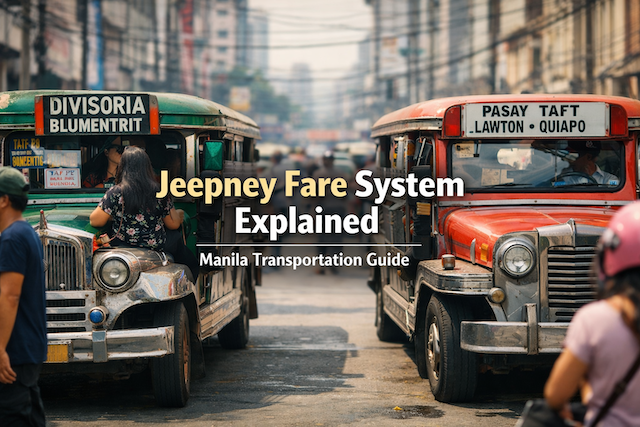
Jeepney Fare System Explained: Manila Transportation Guide
Introduction: Why Understanding Jeepney Fares Matters
Jeepneys are the backbone of public transportation in Metro Manila. They are cheap, frequent, and reach areas where trains and buses cannot. However, for first-time visitors, expats, and even some locals, the jeepney fare system can feel confusing because it relies heavily on tradition, distance-based pricing, and informal communication.
Unlike trains with fixed fares or taxis with meters, jeepney fares depend on route length, recent government fare adjustments, and how far you travel. There are no printed tickets, no digital screens, and often no clear fare charts posted inside the vehicle.
This guide explains the jeepney fare system in Manila in a clear, practical way, so you know how much to pay, how to pay, and how to avoid common mistakes.
How the Jeepney Fare System Works
Distance-Based Fare Structure
Jeepney fares are primarily distance-based, not flat-rate. This means:
However, unlike buses or trains, the driver does not calculate your fare precisely. Instead, the system is based on standard distance brackets.
In practice, this creates a semi-fixed pricing system that locals understand intuitively.
Minimum Jeepney Fare in Manila
Base Fare Explained
The minimum jeepney fare covers the first portion of the route (usually the first few kilometers). This is what most passengers pay for short trips.
Key points:
-
Applies when traveling a short distance
-
Paid even if you ride only one or two stops
-
Considered the “default” fare if you do not specify otherwise
For visitors, this is the most common fare you will encounter.
Additional Fare for Longer Distances
Incremental Fare System
Once you exceed the base distance, the fare increases in small increments based on how far you travel.
How it works in real life:
-
The driver already knows the route’s common drop-off points
-
Locals often say their destination when paying
-
The driver either accepts the amount or asks for more
There is no meter. The system depends on route familiarity and social norms rather than strict measurement.
Fare Adjustments and Government Regulation
Who Sets Jeepney Fares?
Jeepney fares are regulated by the Land Transportation Franchising and Regulatory Board (LTFRB). When fuel prices rise or inflation increases, the government may approve fare hikes.
Important things to know:
-
Fare changes do not happen often, but when they do, they apply nationwide
-
Drivers are required to follow official rates
-
In reality, enforcement can vary
This is why some jeepneys still display old fare signs that are no longer accurate.
How to Pay Your Jeepney Fare
Cash-Based Payment Only
Jeepneys in Manila do not accept cards, apps, or QR payments. Payment is strictly cash-based.
Best practices:
-
Carry small bills and coins
-
Avoid large denominations
-
Prepare your fare before boarding if possible
Handing over a large bill can delay the ride and annoy other passengers.
The “Pass the Payment” System
Jeepneys operate on a unique community-based payment method.
How it works:
-
You hand your fare to the passenger nearest you
-
They pass it forward until it reaches the driver
-
Any change is passed back the same way
This system is normal and efficient, even though it may feel strange at first.
How to Ask About the Fare
Using Simple English or Filipino
If you are unsure how much to pay, you can ask the driver or nearby passengers.
Common phrases:
Drivers are used to answering fare questions, especially from foreigners.
Paying the Correct Amount: Common Scenarios
Short Rides
For short trips:
This applies if you are getting off within a few minutes of boarding.
Medium-Distance Rides
For medium distances:
-
Pay slightly more than the minimum
-
Mention your destination if unsure
-
Watch what locals pay for reference
If you underpay, the driver may say the correct amount.
Long Rides
For long routes:
Long-distance jeepney rides are still cheap compared to taxis.
Discounts: Who Gets Reduced Fares?
Senior Citizens
Senior citizens in the Philippines are entitled to:
-
Fare discounts
-
Priority seating
They usually show an ID when paying.
Students
Students often receive discounted fares:
Not all drivers enforce this strictly, but it is common.
Persons with Disabilities (PWD)
PWD passengers are also eligible for fare discounts when presenting a valid ID.
Common Fare-Related Mistakes to Avoid
Overpaying Without Asking
Tourists sometimes overpay because they assume jeepneys are flat-rate. While drivers usually do not exploit passengers, it is still better to pay correctly.
Handing Large Bills
Giving large bills causes problems because:
Always break large bills beforehand.
Not Speaking Up About Change
If you are owed change:
Silence may be interpreted as acceptance.
Differences Between Jeepney Routes
City Routes vs Provincial Routes
City jeepneys:
-
Shorter routes
-
Lower fares
-
More frequent stops
Provincial or longer routes:
-
Higher fares
-
Fewer stops
-
More direct travel
Fare expectations differ based on route type.
Traditional Jeepneys vs Modern Jeepneys
Modern jeepneys:
Traditional jeepneys:
Fare systems are similar, but modern units may feel more structured.
Comparing Jeepney Fares to Other Transport Options
Jeepney vs Bus
Jeepneys:
-
Cheaper
-
More frequent
-
Slower
Buses:
Jeepney vs Train
Trains:
Jeepneys:
-
Flexible routes
-
Cheaper for short trips
-
Slower due to traffic
Jeepney vs Taxi or Ride-Hailing
Taxis and ride-hailing:
-
Much more expensive
-
Door-to-door service
-
Comfortable and private
Jeepneys:
-
Extremely affordable
-
Public and crowded
-
Ideal for budget travel
Tips for First-Time Riders
Observe Before You Ride
Watch how locals:
-
Pay their fare
-
Ask for change
-
Announce their stop
This observation helps you blend in quickly.
Sit Near the Front if Possible
Sitting closer to the driver:
Prepare Your Fare Early
Have your money ready before the jeepney fills up. This makes the payment smoother for everyone.
Why the Jeepney Fare System Still Works
Despite its informality, the jeepney fare system works because:
-
Routes are familiar to drivers and locals
-
Social norms guide payment
-
Community cooperation keeps things moving
It is not designed for tourists, but it is surprisingly efficient once understood.
Final Thoughts: Mastering Jeepney Fares in Manila
The jeepney fare system in Manila may seem outdated, but it reflects the city’s practical, people-centered approach to transportation. Once you understand the basics—minimum fare, distance-based increments, cash payment, and community passing—you can ride with confidence.
For travelers and expats, learning how jeepney fares work is more than saving money. It is a way to experience everyday life in Manila, interact with locals, and navigate the city like a resident.
With this guide, you now have the knowledge to pay correctly, avoid confusion, and use one of Manila’s most iconic forms of transport with ease.
FAQs (Frequently Asked Questions)
What is the minimum jeepney fare in Manila?
The minimum jeepney fare is the base amount you pay for a short ride that stays within the first distance bracket of the route. This “base fare” is meant to cover the first few kilometers, so if you are traveling only a few stops, you usually pay the minimum. Because fare rules can be updated by regulators, the exact peso amount may change over time. If you are unsure, look for a fare notice posted inside the jeepney, listen to what locals are paying, or politely ask the driver, “How much is the minimum fare?”
Are jeepney fares fixed or based on distance?
Jeepney fares are generally based on distance, not a single flat rate. The system uses a base fare for short rides and then adds small increments for longer distances. In daily practice, drivers and regular passengers recognize common destinations along the route and know roughly how much each segment costs. If you are traveling farther than the usual short ride, it helps to say your destination when paying so the driver understands you are not paying only the minimum fare.
How do I know how much to pay for my destination?
The easiest method is to ask the driver or nearby passengers. You can say, “How much to [destination]?” or use a simple Filipino phrase like “Magkano po hanggang [place]?” If you are seated far from the driver, you can still ask someone next to you and they may tell you the typical amount. Another practical approach is to watch what local riders pay when they get off near your destination, but this only works if you clearly understand where they are leaving the jeepney.
Do jeepneys provide tickets or receipts?
Traditional jeepneys usually do not provide tickets or printed receipts. Payment is made in cash, handed to the driver directly or passed forward through other passengers. Because there is no ticket, your “proof” of payment is simply the social system of passengers paying as they ride. If you need a receipt for business or reimbursement, jeepneys are generally not the best option. Consider using trains, some bus services, or ride-hailing if documentation is required.
Can I pay with a card, QR code, or mobile wallet?
Most jeepneys in Manila are cash-only. A few modern or pilot routes may experiment with cashless systems, but you should not rely on them. Carry coins and small bills so you can pay quickly and receive change smoothly. If you only have large bills, it may be difficult for the driver to give change, especially during rush hours when many passengers are paying at once.
What denominations should I carry for jeepney rides?
Bring small denominations such as coins and low-value bills. This helps you pay the exact fare or close to it. Large bills can slow down the payment flow because the driver may not have enough change, particularly early in the day or when the jeepney is crowded. If you arrive from the airport or a mall, it is smart to break large bills at a convenience store before taking a jeepney.
How does the “pass the payment” system work?
If you are seated far from the driver, you hand your fare to the passenger nearest you and say something like “Bayad po” (payment, please) while showing your money. That passenger passes it forward until it reaches the driver. If you need change, the driver sends it back the same way. This is normal etiquette in jeepneys. Keep an eye on your money and change as it moves along the line, and be patient because it may take a moment in a crowded vehicle.
What should I do if I do not receive my change?
First, wait briefly because change may still be making its way back through other passengers. If it seems delayed, politely ask again. You can say “Sukli po” (change, please) or “My change, please.” Try to speak clearly and keep your tone calm, as the driver is often managing traffic while collecting multiple payments. In many cases, other passengers will help relay your request to the driver.
Are there discounts for students, seniors, or PWD passengers?
Yes, fare discounts may apply to eligible passengers such as senior citizens, students, and persons with disabilities (PWD), usually with a valid ID. The exact discount rules and enforcement can vary, so it is best to show your ID when paying and ask politely if the discount applies on that route. If you are a visitor, do not assume a discount unless you have an official ID recognized in the Philippines.
Is it okay to pay the minimum fare even for a longer ride?
It is better not to. Paying only the minimum for a longer ride can create confusion and may result in the driver asking you to add more later. If you know you are going farther than a short trip, mention your destination when handing your fare. If you are unsure of the correct amount, pay slightly above the minimum and ask, “Is this okay for [destination]?” The driver will tell you if you need to add more.
Do modern jeepneys have different fare rules?
Modern jeepneys often follow the same regulated fare structure, but they may display fare charts more clearly and sometimes feel more standardized. Some may have more formal boarding and seating arrangements. Even so, cash payment is still common, and you should be prepared to follow similar etiquette: pay promptly, ask if unsure, and request change politely.
What is the best way to avoid overpaying as a tourist?
To avoid overpaying, learn the concept of the minimum fare and understand that longer trips cost more. Carry small money, listen to what locals pay, and ask simple questions when needed. Overpaying is not always due to scams—sometimes it happens because passengers hand large bills and accept incorrect change. Paying with exact change and confirming the fare for your destination is the safest approach.
Can the jeepney driver refuse to take me if I ask too many questions?
It is very unlikely. Drivers are generally used to passengers asking about fares and destinations. The key is to keep questions simple and quick, especially during busy traffic. Ask politely, use basic English if you do not speak Filipino, and be ready with your payment. If you feel uncomfortable, you can always wait for the next jeepney or choose another transport option.
What should I do if there is no posted fare sign inside the jeepney?
If there is no fare sign, rely on local knowledge and direct communication. Ask the driver about the fare to your destination before or immediately after boarding. You can also ask a nearby passenger. In Manila, many routes have “typical” fares that regular riders know well. When in doubt, it is better to ask than to guess, especially if you are traveling beyond a short distance.