2026年1月23日
3D ACADEMY offers affordable English study programs in Cebu, Philippines – perfect for beginners, professionals, and exam takers.

3D UNIVERSAL ENGLISH INSTITUTE INC
info.3d-universal.com
8:00-17:00(Mon-Fri)
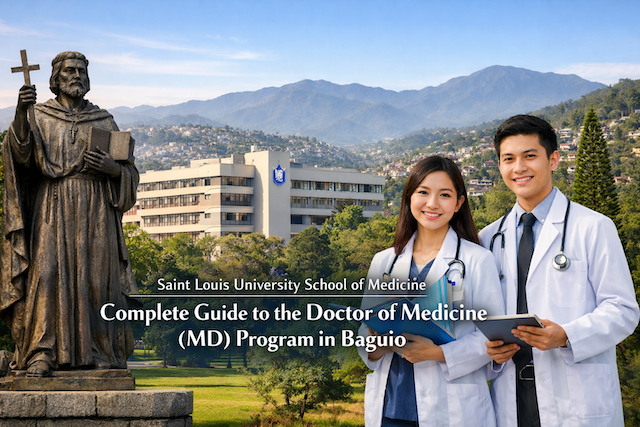
Saint Louis University School of Medicine: Complete Guide to the Doctor of Medicine (MD) Program in Baguio
Contents
- Saint Louis University School of Medicine: Complete Guide to the Doctor of Medicine (MD) Program in Baguio
- Quick Profile: What SLU School of Medicine Is Known For
- Campus Location and Learning Setting in Baguio City
- Doctor of Medicine Program Overview
- Typical MD Curriculum Flow (What to Expect Year by Year)
- Clinical Training and Hospital Exposure
- Admissions: Eligibility and Requirements (General Expectations)
- Application Process: A Practical Step-by-Step Approach
- Tuition, Fees, and Real Cost of Medical School in Baguio
- Scholarships and Financial Support
- Student Life, Culture, and Support Systems
- Research, Community Work, and Professional Formation
- Board Exam Preparation and Career Path After Graduation
- Who Should Consider SLU School of Medicine?
- Practical Tips for Applicants
- Contact and Next Steps
- FAQs (Frequently Asked Questions)
- Is Saint Louis University School of Medicine a good choice for studying medicine in Baguio?
- Where is SLU School of Medicine located, and is it convenient for students?
- How long is the Doctor of Medicine (MD) program at SLU?
- What are the typical admission requirements for SLU School of Medicine?
- Does SLU accept international applicants to the MD program?
- What is the teaching style like in Philippine medical schools, and what should I expect at SLU?
- Where do SLU medical students get clinical exposure and clerkship training?
- How much does it cost to study medicine at SLU, and what expenses should I budget for?
- Are scholarships available for SLU School of Medicine students?
- How can I improve my chances of getting accepted into SLU School of Medicine?
- What is student life like in Baguio for medical students?
- Does graduating from SLU School of Medicine prepare me for the Physician Licensure Examination (PLE)?
Saint Louis University School of Medicine: Complete Guide to the Doctor of Medicine (MD) Program in Baguio
Saint Louis University (SLU) School of Medicine in Baguio City is one of the most established medical schools in Northern Luzon, known for training physicians with a strong sense of service, professional ethics, and community-oriented practice. Located in the heart of Baguio, the school attracts students from across the Philippines who want to pursue medicine in a cool-climate city with a long academic tradition.
This guide walks you through what to expect from SLU School of Medicine: the learning environment, typical MD program structure in the Philippines, clinical training exposure, admissions and application flow, tuition considerations, scholarships, student life, and practical tips for applicants.
Quick Profile: What SLU School of Medicine Is Known For
SLU’s medical education is anchored in the idea that physicians should be clinically competent, ethically grounded, and socially responsive. In practice, that often shows up in:
- Service-oriented training: Community engagement and outreach are commonly integrated into student activities and institutional priorities.
- Regional health relevance: A strong interest in health concerns relevant to the Cordillera region and surrounding provinces, where patient demographics and health needs can differ from Metro Manila.
- Structured professional formation: Emphasis on values formation, professionalism, and communication alongside scientific training.
Campus Location and Learning Setting in Baguio City
SLU School of Medicine is based at the SLU Main Campus area in Baguio City, with offices and learning spaces situated in the Jose Rizal Building. Being in central Baguio means students typically have convenient access to public transport routes, food options, libraries, and student services.
Baguio’s environment can be a practical advantage for many medical students. The cooler climate often supports long study hours and a more walkable daily routine. At the same time, the city setting still provides access to a broad patient population, which is critical for clinical exposure.
Doctor of Medicine Program Overview
The Doctor of Medicine (MD) pathway in the Philippines commonly follows a multi-stage structure: foundational medical sciences, organ-system and clinical sciences, clinical clerkship rotations, and then a post-MD internship year (depending on institutional design and national training requirements). While specific course sequencing and teaching methods vary by school, you can generally expect SLU’s MD training to cover:
- Foundational sciences: Anatomy, physiology, biochemistry, microbiology, pathology, pharmacology, and related subjects that build your medical base.
- Clinical sciences: Internal medicine, surgery, pediatrics, obstetrics and gynecology, psychiatry, family and community medicine, and other core disciplines.
- Skills development: History-taking, physical exams, case presentations, clinical reasoning, and professional communication.
- Ethics and professionalism: Medical ethics, patient safety, and values formation embedded into the program culture.
As you progress, the learning experience usually shifts from classroom-based instruction to hospital-based training, where your performance depends not only on exams but also on clinical competence, teamwork, discipline, and bedside manner.
Typical MD Curriculum Flow (What to Expect Year by Year)
Because medical curricula can change, it’s best to confirm the exact structure with the school. However, most Philippine MD programs follow a recognizable arc. Here’s a practical way to think about it:
Early Phase (Pre-clinical / Basic Medical Education): You will spend much of your time on medical sciences and early clinical skills. Expect heavy memorization at first, but the goal is not memorization alone. Strong programs push students toward understanding mechanisms and applying them to patient problems.
Middle Phase (Integrated Clinical Sciences): You’ll typically move into more disease-focused learning: how conditions present, how to diagnose, what tests to order, and how to manage treatment safely. This phase is where you learn how to think like a clinician, not just a student.
Clinical Phase (Clerkship Rotations): This is where medical school becomes real. You rotate through departments, follow resident and consultant teams, and learn hospital workflow. The rhythm is different: early mornings, rounds, case conferences, and direct patient contact under supervision.
Post-MD Internship (PGI): Many graduates complete an internship year in an accredited training hospital to consolidate hands-on competencies before licensure and/or residency. Confirm how SLU aligns its training pathway with internship placement and national requirements at the time you apply.
Clinical Training and Hospital Exposure
Clinical training is the heart of medical education. In SLU’s ecosystem, students may gain exposure through university-linked healthcare facilities and partner clinical settings. One notable facility connected to the university is the SLU Sacred Heart Medical Center, described as a Catholic hospital facility of the university that supports preventive, curative, and rehabilitative services and aims to contribute to an integrated academic healthcare system sustained by research.
In practical terms, strong clinical exposure often means:
- High patient volume: Enough cases to build clinical pattern recognition and procedural familiarity.
- Varied cases: Common conditions plus referrals and complex cases that stretch clinical reasoning.
- Structured supervision: Residents, fellows, and consultants who teach, not just assign tasks.
- Skills opportunities: Chances to practice history-taking, exams, charting, and procedural assisting.
If you’re comparing schools, ask about: where clerkship rotations happen, how students are evaluated in the hospital, whether there are simulation or skills labs, and how the school supports students during high-pressure rotations.
Admissions: Eligibility and Requirements (General Expectations)
Medical school admissions in the Philippines typically require a bachelor’s degree (or an approved accelerated pathway for selected applicants), academic transcripts, and standardized testing as required by national and institutional policies. Applicants should expect to submit documentation that supports academic readiness, character, and professional potential.
Universities usually maintain general admission and enrollment policies that apply across programs, including application timelines, examination rules, and policies for local and foreign applicants. International applicants often have additional requirements, including proof of English proficiency, credential evaluation, and visa compliance.
Because requirements can shift by academic year, treat the following as a checklist framework and verify the current list directly with SLU:
- Completed application forms and personal information documents
- Official academic records (transcripts, diploma, certificates as applicable)
- Entrance or qualifying exams and interview (as required by the program)
- Medical clearance and other compliance documents
- For foreign students: additional steps for English testing and student visa processing
Application Process: A Practical Step-by-Step Approach
Applicants often get overwhelmed by medical school requirements, so here’s a clean process you can follow:
- Track application dates early: Medical schools can open applications months ahead of the start of classes. Build your timeline around document processing lead times.
- Prepare your documents: Request transcripts early. If you’re transferring or applying as an international student, your lead time should be longer.
- Study for required exams: If an entrance/qualifying exam or standardized test is part of the process, schedule focused prep weeks. Don’t leave it to the last minute.
- Get interview-ready: Many schools assess motivation, maturity, communication, and ethical thinking. Practice explaining why medicine, why SLU, and what kind of physician you want to become.
- Plan your finances: Beyond tuition, factor in housing, transportation, food, uniforms, equipment, and clinical rotation costs.
Even strong candidates can be delayed by missing paperwork. Build a checklist and track everything in a spreadsheet (document requested date, expected release date, and submission status).
Tuition, Fees, and Real Cost of Medical School in Baguio
Tuition for MD programs can vary year to year, and medical school typically involves additional costs beyond standard university tuition. Rather than focusing only on the published tuition figure, budget for the full reality of training:
- School fees: Tuition, laboratory fees, development fees, and miscellaneous school charges.
- Learning materials: Textbooks, digital resources, printing, and subscriptions.
- Equipment: Stethoscope, BP apparatus, penlight, otoscope/ophthalmoscope (sometimes shared), scrubs, and clinical uniforms.
- Clerkship costs: Transportation to rotation sites, meals during duty, and possible additional requirements.
- Living costs in Baguio: Rent, utilities, internet, food, and occasional travel home.
To estimate your monthly cash flow, build two budgets: a “regular month” (mostly classroom) and a “rotation month” (hospital duties). Rotation months usually cost more due to transportation and meals outside your normal routine.
Scholarships and Financial Support
Medical school is a long investment, and scholarships can make a significant difference. SLU has participated in scholarship initiatives that support Doctor of Medicine students as part of broader educational support programs. When evaluating scholarship options, ask these questions:
- Is the scholarship merit-based, needs-based, or service-based?
- Does it cover tuition only, or also includes allowances?
- Are there maintaining grade requirements?
- Is there a return-service obligation after graduation?
Even if you don’t qualify for full scholarships, partial support (tuition discounts, stipends, or limited grants) can reduce stress and improve academic performance over time.
Student Life, Culture, and Support Systems
Medical school is academically intense, but your environment matters as much as your study habits. In a school like SLU, students typically rely on a combination of:
- Batch culture: Your class becomes your main support network for notes, review schedules, and emotional resilience.
- Student organizations: Interest groups, outreach organizations, and council-led initiatives that provide leadership opportunities and community engagement.
- Academic support services: University services such as counseling and wellness programs can help during burnout periods.
In Baguio, lifestyle can be balanced if you manage time well. There are quiet study cafés, libraries, and a city rhythm that can support sustained study. However, do not underestimate how exhausting clerkship duties can be. The best student life strategy is not “having more free time,” but building routines that keep you stable even when free time disappears.
Research, Community Work, and Professional Formation
A strong medical education teaches you to ask good questions, not just memorize correct answers. SLU School of Medicine’s stated goals include conducting faculty and student research relevant to regional needs and developing physicians who can serve as healthcare providers, educators, researchers, administrators, and social mobilizers.
For students, this often translates into opportunities such as:
- Participating in faculty-led or student-led research projects
- Community health outreach and medical missions
- Health education initiatives and prevention programs
- Leadership roles in student organizations and service activities
If you’re aiming for competitive residency training later, research and leadership can strengthen your profile. More importantly, these experiences train you to see patients in their real-life context, not just in hospital charts.
Board Exam Preparation and Career Path After Graduation
In the Philippines, the Physician Licensure Examination (PLE) is a major milestone. A medical school’s culture and academic system can influence how students prepare: the structure of exams, the intensity of formative assessments, mentorship, and the strength of clinical teaching all matter.
After earning an MD and completing required clinical training steps, graduates typically pursue one or more of the following:
- General practice: Community clinics, company physician roles, rural health units, or private practice pathways.
- Residency training: Specialization in internal medicine, surgery, pediatrics, OB-GYN, family medicine, psychiatry, and more.
- Academic and research tracks: Teaching roles, clinical research, public health initiatives, and administrative pathways.
- Overseas pathways: Some graduates explore international licensure routes (which require additional exams and credentialing).
Your best preparation is consistency. High-performing graduates usually combine disciplined study systems with strong clinical fundamentals: history-taking, physical exam skills, and sound reasoning. Those basics raise your ceiling in both boards and residency.
Who Should Consider SLU School of Medicine?
SLU School of Medicine may be a strong fit if you:
- Want to study medicine in Baguio City with access to a large university ecosystem
- Value a service-oriented and ethics-driven learning environment
- Prefer a setting where community health relevance is taken seriously
- Are looking for a school with a long-standing reputation in Northern Luzon
It may be less ideal if you strongly prefer a Metro Manila training environment or need a program structure that is heavily research-intensive from day one. Every medical school has trade-offs; what matters is alignment with your learning style and long-term goals.
Practical Tips for Applicants
- Strengthen your science fundamentals: Anatomy and physiology become much easier if your biology and chemistry foundations are solid.
- Build a time system before med school starts: Don’t wait for orientation. Decide your daily study blocks and weekly review schedule early.
- Prepare financially: Stress from unstable finances can silently damage performance. Budget honestly and plan for emergencies.
- Train your communication skills: Medicine is not only knowledge; it’s trust. Interviews and clinical performance both reward clear communication.
- Choose housing strategically: Being closer to campus or rotation sites can save hours every week.
Contact and Next Steps
If you plan to apply, the most reliable next step is to check SLU’s official School of Medicine page and admissions channels for the latest timelines, requirements, and procedures, especially for international applicants or those applying under special pathways. You can also reach out to the School of Medicine office directly using the contact details published on SLU’s site.
Medical school is a demanding path, but choosing the right environment makes the challenge more manageable and more meaningful. If you want, I can also create a separate “Admissions Checklist” section (as a downloadable-style HTML block) tailored to SLU SOM, including a timeline you can follow month-by-month.
FAQs (Frequently Asked Questions)
Is Saint Louis University School of Medicine a good choice for studying medicine in Baguio?
For many students, SLU School of Medicine is a strong option in Northern Luzon because it is part of a long-established university community in Baguio City and is known for values-based training. The “best” choice depends on your priorities. If you prefer a cooler climate, a walkable city environment, and a school culture that emphasizes service and professionalism, SLU may fit well. If you want a Metro Manila–style training environment or you strongly prefer a large, highly specialized tertiary hospital ecosystem in one dense area, you should compare clinical sites and rotation systems carefully. The most practical way to evaluate is to review current admissions criteria, confirm current tuition and fees, and ask where clerkship rotations take place and how student performance is assessed during clinical training.
Where is SLU School of Medicine located, and is it convenient for students?
SLU School of Medicine is based in Baguio City, where many students choose housing within reasonable commuting distance to campus and clinical training sites. Convenience depends on your daily schedule and where you live. In general, Baguio offers many student-friendly options such as boarding houses, apartments, and dorm-style accommodations near central areas. Many students prioritize a location that minimizes commuting time, because medical school schedules can be intense. If you are moving from another region, it is smart to arrive early, explore the area, test possible routes during peak hours, and choose housing with stable internet and a quiet environment suitable for long study blocks.
How long is the Doctor of Medicine (MD) program at SLU?
The MD pathway in the Philippines commonly includes several years of medical school followed by required clinical training steps, which may include clerkship and a post-MD internship year depending on institutional design and national training rules. The exact structure can change, so applicants should confirm the current program flow directly with SLU School of Medicine. When comparing schools, focus less on the number of years alone and more on the quality of training across each phase: the strength of foundational sciences, the structure of clinical skills training, and the depth of hands-on hospital exposure during rotations.
What are the typical admission requirements for SLU School of Medicine?
Medical school admissions typically require completion of a bachelor’s degree and submission of official academic records. Many schools also require an entrance exam or other qualifying assessment and an interview. You should expect to provide documents that demonstrate academic readiness and professional potential. Requirements may be different for applicants with special circumstances, such as transferees or international students. Because admissions policies can change year to year, it is important to check SLU’s official admissions announcements for the current list of requirements, deadlines, and any program-specific instructions before you finalize your application plan.
Does SLU accept international applicants to the MD program?
Universities in the Philippines often accept international applicants, but the process can involve additional steps beyond local requirements. These may include credential evaluation, proof of English proficiency, and compliance with immigration or student visa requirements. Policies and procedures can differ by school and by academic year. If you are applying from overseas, you should contact the School of Medicine or the university admissions office early, because document processing can take longer. It is also wise to ask about practical issues such as enrollment timelines, payment methods, required health clearance documents, and whether there are orientation or bridging requirements for international students.
What is the teaching style like in Philippine medical schools, and what should I expect at SLU?
Many Philippine medical schools use a structured approach that blends lectures, small-group discussions, laboratory work, and case-based learning. As you move forward, clinical skills training and hospital-based rotations become more dominant. At SLU, you should expect an emphasis on professionalism, communication, and patient-centered care alongside scientific learning. Regardless of the school, medical education is demanding. A good strategy is to focus on mastering concepts, building clinical reasoning early, and practicing consistent review rather than cramming. Students who succeed usually develop a repeatable daily routine and an efficient note system that can scale as the workload increases.
Where do SLU medical students get clinical exposure and clerkship training?
Clinical exposure typically occurs through university-linked hospitals and partner clinical sites. For applicants, the key questions are: which hospital(s) serve as primary training grounds, which departments students rotate through, and how clinical duties are structured. You should also ask how supervision works—who teaches you, how feedback is delivered, and how performance is graded in the hospital. Strong training environments give students real patient interaction under supervision, a wide variety of cases, and structured learning activities such as rounds, conferences, and skills assessments. Confirm the current rotation setup with SLU because clinical affiliations and training arrangements can evolve over time.
How much does it cost to study medicine at SLU, and what expenses should I budget for?
Tuition and fees vary and may change each academic year. In addition to tuition, you should plan for the true “total cost” of medical school: books and learning resources, equipment such as a stethoscope and uniforms, transportation, meals during long hospital duties, and housing costs in Baguio. A practical budgeting method is to estimate two monthly scenarios: a classroom-heavy month and a rotation-heavy month. Rotation months often cost more because you spend longer hours outside, commute more, and may buy meals on duty. If you are financially supporting yourself, explore scholarships, installment plans, and family budgeting early so finances do not become a silent stressor during exams.
Are scholarships available for SLU School of Medicine students?
Scholarships may be available through the university, external partners, or special educational support programs, but eligibility and coverage differ widely. Some scholarships focus on academic merit, others on financial need, and some require service commitments after graduation. The best approach is to ask about active scholarship programs for the current academic year and clarify what is covered (tuition only versus allowances), what maintaining requirements exist, and whether there is a return-service agreement. Even partial scholarships can help reduce financial pressure and allow you to focus more effectively on study and clinical performance.
How can I improve my chances of getting accepted into SLU School of Medicine?
Competitive applicants typically show academic readiness, clear motivation for medicine, and strong communication skills. Start by preparing your documents early and keeping a timeline for transcript requests and application submissions. If there is an exam or interview, prepare strategically: review core science concepts, practice explaining your reasons for pursuing medicine, and show maturity in discussing responsibility, patient care, and ethical decision-making. If you have relevant experience—volunteering, research, community service, or healthcare exposure—describe it clearly and connect it to your goals. Finally, demonstrate that you understand what medical school demands by presenting a realistic plan for study habits, time management, and financial planning.
What is student life like in Baguio for medical students?
Baguio can be a supportive environment for long-term studying because of its cooler climate, student-oriented neighborhoods, and availability of quiet places to work. However, medical students should expect intense schedules, especially during exams and clinical rotations. Student life is less about constant leisure and more about maintaining sustainable routines. Many students benefit from having a quiet living space, reliable internet, and a small support network of classmates. If you are new to the city, plan your housing carefully, learn the safest commuting routes, and build healthy habits early, such as regular meals, short exercise routines, and consistent sleep whenever possible.
Does graduating from SLU School of Medicine prepare me for the Physician Licensure Examination (PLE)?
Medical school provides the foundation for the PLE, but individual preparation habits matter greatly. A program that builds strong fundamentals, reinforces clinical reasoning, and maintains consistent academic assessments can support board preparation. Still, students usually need dedicated review time and a disciplined plan as they approach the exam. The best long-term strategy is to build mastery over time: keep your notes organized, review high-yield topics regularly, and connect basic sciences to clinical cases so knowledge becomes usable. When you are closer to graduation, many students follow structured review schedules and use practice questions to identify weak areas efficiently.
Complete List of Medical Schools in the Philippines (All 78 MD Programs)
Recommend
2026年1月23日
Sultan Kudarat State University College of Medicine: Complete Guide for Aspiring MD Students
2026年1月23日
University of Southern Mindanao College of Medicine: Complete Guide for Aspiring MD Students
2026年1月23日
Mindanao State University – General Santos College of Medicine: Complete Guide for Future MD Students

How to Register for eTravel Philippines (2025 Guide)
Step-by-step guide to completing your eTravel registration before arriving in the Philippines, with images and tips.

Night Market in Cebu – Things You Don’t Know About Cebu Life
Discover the hidden charm of Cebu’s night markets, from street food stalls to local life tips you won’t find in tourist guides.

How to Use ChatGPT for IELTS Preparation: A Complete Guide
Learn how to prepare for IELTS using ChatGPT — including strategies for Writing, Reading, Listening, Speaking, and grammar support.

How to Build a Website Without Coding Using ChatGPT
Discover how to build your own website using AI—no coding skills needed. From structure planning to SEO and design, let ChatGPT guide you.