2026年1月23日
3D ACADEMY offers affordable English study programs in Cebu, Philippines – perfect for beginners, professionals, and exam takers.

3D UNIVERSAL ENGLISH INSTITUTE INC
info.3d-universal.com
8:00-17:00(Mon-Fri)
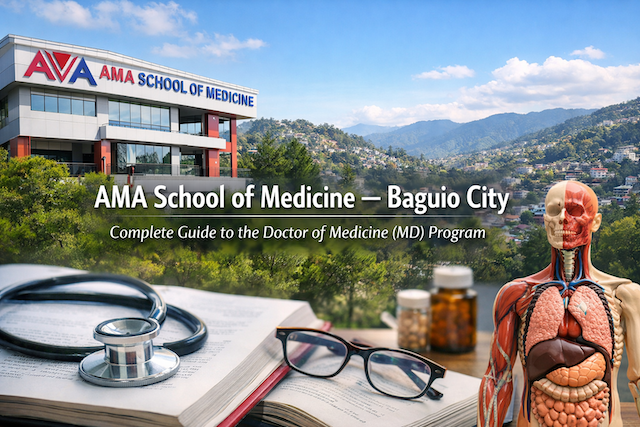
AMA School of Medicine – Baguio City: Complete Guide to the Doctor of Medicine (MD) Program
Contents
- AMA School of Medicine – Baguio City: Complete Guide to the Doctor of Medicine (MD) Program
- Quick Snapshot: AMA School of Medicine – Baguio City
- Why Study Medicine in Baguio City?
- MD Program Overview: What You Will Study
- Teaching Style and Learning Approach
- Admissions: Typical Requirements and Process
- International Students: What to Prepare For
- Tuition and Cost of Living in Baguio
- Baguio Campus Location and Daily Commute
- Student Life: What Your Week Actually Feels Like
- Clinical Training and Hospital Exposure
- Career Path After Graduation: Licensure and Next Steps
- How to Decide If AMASOM Baguio Is Right for You
- Practical Tips for Succeeding in Your First Semester
- How to Contact the Baguio Campus
- FAQs (Frequently Asked Questions)
- Is AMA School of Medicine – Baguio City officially recognized in the Philippines?
- What degree do students earn, and how long does the program take?
- What are the usual admission requirements for local applicants?
- What should international students prepare before applying?
- Is the MD program taught in English?
- What is Baguio City like for medical students?
- How much does tuition cost, and what other expenses should I expect?
- Where do students do clinical rotations and internship?
- Can graduates take the Philippine Physician Licensure Examination (PLE)?
- Is this school a good option if I want to work abroad after graduation?
- What are the biggest challenges students face in the first year?
- How can I increase my chances of success at AMASOM Baguio?
AMA School of Medicine – Baguio City: Complete Guide to the Doctor of Medicine (MD) Program
AMA School of Medicine (AMASOM) is part of the AMA Education System and offers a Doctor of Medicine (MD) program designed for students who want a structured, modern approach to medical education in the Philippines. While many medical schools are concentrated in Metro Manila, AMASOM’s Baguio City campus provides an alternative setting in Northern Luzon—appealing to students who prefer a cooler climate, a quieter study environment, and access to the broader Cordillera and Region I/II communities for learning and exposure.
This guide focuses specifically on AMA School of Medicine – Baguio City, covering what the MD program is like, how the admissions process typically works, what student life looks like, and how to think about clinical training and career planning after graduation.
Quick Snapshot: AMA School of Medicine – Baguio City
Location: Baguio City, Benguet (Northern Luzon)
Program Offered: Doctor of Medicine (MD)
Learning Style: Case-based / hybrid approach that connects basic sciences to clinical scenarios early
Who It Fits Best: Students seeking a structured MD path in a cooler city environment, including international students who want an accessible campus setting outside Metro Manila
Why Study Medicine in Baguio City?
Baguio City is often associated with a student-friendly atmosphere because of its long history as an education hub in Northern Luzon. Compared with larger cities, many students find Baguio more focused for studying: less commuting stress, generally cooler temperatures (which can make day-to-day life more comfortable), and a campus routine that feels more contained.
From a medical education perspective, Baguio’s location also places you near a diverse patient population across the Cordillera Administrative Region and neighboring provinces. This can be valuable once you begin clinical exposure because you may encounter a wide range of community health needs—rural and urban cases, preventative care challenges, lifestyle-related conditions, and referral-based hospital care.
MD Program Overview: What You Will Study
The MD program in the Philippines generally follows a progression from foundational sciences to clinical training, culminating in internship and preparation for physician licensure. At AMASOM, the program is commonly described as a case-based, hybrid curriculum—meaning students are not only memorizing concepts, but repeatedly asked to apply knowledge to patient cases and clinical scenarios.
In practical terms, you can expect the early years to focus on the medical sciences that support clinical decision-making, such as:
- Anatomy and Histology
- Physiology
- Biochemistry
- Microbiology and Parasitology
- Pathology
- Pharmacology
- Preventive and Community Medicine
As you progress, clinical subjects become heavier and more hands-on, typically including:
- Internal Medicine
- Surgery
- Pediatrics
- Obstetrics and Gynecology
- Psychiatry
- Family and Community Medicine
- Emergency-related rotations and clinical skills training (depending on hospital exposure)
The goal of this style is to help students bridge the gap between classroom learning and real patient care—so that by the time you enter clerkship and internship, you already have practice thinking like a clinician.
Teaching Style and Learning Approach
Many students struggle in medical school not because the topics are impossible, but because the volume is intense and the learning style is different from college. A case-based approach tends to reward students who build habits early: consistent review, active recall, and teamwork when appropriate.
In a case-based or hybrid curriculum, you should expect:
- Case discussions: Lessons anchored in patient scenarios to connect theory with clinical reasoning.
- Integration across subjects: Topics often overlap (e.g., anatomy + physiology + pathology tied to one organ system).
- Assessments that test application: Exams may emphasize interpretation and decision-making, not just memorization.
- Independent learning: You will likely need to read ahead and build your own study system.
If you prefer clear structure, checklists, and a schedule you can follow weekly, this learning environment can work well—especially if you treat medical school like a daily routine rather than a “cram before exams” program.
Admissions: Typical Requirements and Process
Admissions policies can change, but MD programs in the Philippines typically require a pre-med bachelor’s degree (or equivalent) and an application package showing academic readiness and eligibility.
Common items requested include:
- Application form
- College transcript of records and proof of graduation
- Identification documents
- Birth certificate and/or passport (for international applicants)
- Good moral character certificate and/or recommendation letters (varies by intake)
- Entrance exam and/or interview (depending on the school’s evaluation approach)
Tip: If you are an international student, start early. Document processing, credential evaluation, and visa coordination can take time. Treat admissions as a project with deadlines, not a last-minute task.
International Students: What to Prepare For
AMA School of Medicine has historically attracted international students, particularly those seeking an English-taught MD program and a more cost-accessible path compared with some other countries. If you are applying from overseas, focus on these practical steps:
- Academic equivalency: Ensure your degree and transcripts meet Philippine requirements.
- Immigration and student visa: Confirm the correct process and timelines for your nationality.
- Budgeting: Plan for tuition, school fees, housing, daily expenses, and paperwork costs.
- Living adjustment: Baguio’s climate is cooler than most Philippine cities—pack accordingly and plan for rainy season conditions.
International students often benefit from building a support system early: classmates, school coordinators, and a routine for food, laundry, transportation, and study spaces.
Tuition and Cost of Living in Baguio
Tuition can vary by academic year, payment scheme, and policy updates, so it’s best to confirm current figures directly with the admissions office. Beyond tuition, the real question is total cost of attendance.
Baguio City can be cost-efficient compared with Metro Manila in certain categories, but students should still plan carefully. Typical monthly expense categories include:
- Housing (room/condo/apartment, utilities)
- Food (cooking vs. eating out)
- Transportation (jeepney/taxi/ride-hailing where available, plus walking)
- Internet and mobile data
- Books, printing, and supplies
- Uniforms and clinical requirements (later years)
Practical budgeting advice: If you’re new to the Philippines, plan a buffer fund for the first 2–3 months. Your costs stabilize after you learn where to shop, how to commute, and what your daily routine looks like.
Baguio Campus Location and Daily Commute
AMA School of Medicine – Baguio City is located along Aspiras (Palispis) Highway area. When choosing housing, prioritize a commute that is stable during rainy season and peak traffic hours. In Baguio, short distances can still take time when weather and congestion hit.
Many medical students try to live within a predictable route to campus so they can protect study time. The “best” location is not always the cheapest—it’s the one that prevents daily friction and keeps you consistent.
Student Life: What Your Week Actually Feels Like
Medical school is not just classes—it’s time management. A typical week may include lectures, small-group activities, self-study, quizzes, lab sessions (depending on the term), and occasional school events. Your lifestyle becomes a cycle of study blocks and recovery.
In Baguio, student life often revolves around:
- Study-friendly cafes and quiet spaces
- Walking as part of daily routine
- Simple social circles (classmates become your main network)
- Weather-conscious planning (rain gear matters)
The healthiest students tend to build a routine that includes sleep, movement, and at least one non-academic activity each week. You don’t need a “perfect balance,” but you do need something sustainable.
Clinical Training and Hospital Exposure
Clinical training is where everything becomes real. In the later phase of the MD program, students typically enter clinical rotations (clerkship) and then internship. Your experience is shaped by hospital volume, case variety, supervision quality, and your own attitude toward learning.
When evaluating any medical school, ask yourself these practical questions:
- Where do students complete clinical rotations?
- What is the patient volume like?
- How structured is supervision and feedback?
- How early do students practice history-taking and physical exam skills?
Regardless of the setting, your habits matter: be present, volunteer for learning opportunities, and keep a clinical notebook of patterns (symptoms, differentials, labs, management steps).
Career Path After Graduation: Licensure and Next Steps
After completing the MD program and required internship components, graduates typically aim to take the Philippine Physician Licensure Examination (PLE). Your pathway afterward may include:
- General practice (depending on eligibility and plans)
- Residency training in the Philippines
- International pathways (which may require additional exams, credential verification, and country-specific processes)
If your long-term goal is to practice outside the Philippines, plan early. Each destination country has its own requirements, timelines, and costs. The smartest approach is to map your target country’s pathway during your first or second year, then align your documentation and exam schedule accordingly.
How to Decide If AMASOM Baguio Is Right for You
AMA School of Medicine – Baguio City can be a good fit if you:
- Prefer a cooler, more study-focused environment than a large metro setting
- Want an MD program with early case integration and practical application emphasis
- Are comfortable with structured routine and independent study
- Want access to Northern Luzon living and community context
It may be a weaker fit if you:
- Need a highly research-intensive environment with extensive lab infrastructure as your top priority
- Strongly prefer a single mega-campus university ecosystem with many non-medical student activities
- Want a city lifestyle that matches Metro Manila’s pace (Baguio has its own energy, but it’s different)
Practical Tips for Succeeding in Your First Semester
- Build a daily system: Study every day, even if it’s only 2–3 focused hours outside class.
- Use active learning: Practice questions, teach-back, flashcards, and concept mapping beat rereading.
- Protect sleep: Consistency matters more than occasional all-nighters.
- Track weak areas: Keep a list of topics you repeatedly miss and review weekly.
- Find your “minimum viable routine”: A routine you can do on bad days is what carries you through.
How to Contact the Baguio Campus
If you want current admissions steps, tuition structure, and intake schedules, contact the AMA School of Medicine admissions team and specify that you are asking about the Baguio City campus. Having your documents and questions prepared (requirements, timelines, fees, and foreign student process if applicable) will make your inquiry faster and more productive.
Common questions to ask admissions:
- What are the next intake dates and deadlines?
- What is the latest tuition and fee breakdown?
- What are the exact document requirements for local vs. international applicants?
- Where are clinical rotations conducted for Baguio campus students?
- What are the payment options and installment policies?
AMA School of Medicine – Baguio City can be a practical option for students who want an MD program in Northern Luzon, with a study-friendly environment and a curriculum designed to connect medical science to patient care. As with any medical school decision, the best next step is to confirm the latest policies directly with the school, then compare your personal learning style, budget, and long-term career plan before committing.
FAQs (Frequently Asked Questions)
Is AMA School of Medicine – Baguio City officially recognized in the Philippines?
In the Philippines, medical schools operate under national education and regulatory frameworks, and recognition status can change depending on compliance and updated government listings. The safest way to confirm the most current status is to check the school’s latest disclosures and verify through official Philippine agencies that oversee higher education and medical education standards. If you are an international applicant, you should also confirm whether your home country or target country for future practice accepts an MD degree earned in the Philippines, since recognition and licensing pathways differ by country.
What degree do students earn, and how long does the program take?
Students typically pursue the Doctor of Medicine (MD) degree. The length of the MD program in the Philippines commonly spans several years and includes both pre-clinical and clinical phases, followed by internship requirements prior to taking the Physician Licensure Examination (PLE). Exact timelines can vary depending on the academic calendar, curriculum structure, and whether a student needs to repeat subjects or take leaves. For the most accurate program timeline, request a curriculum outline and academic progression plan from the admissions office for the Baguio City campus.
What are the usual admission requirements for local applicants?
Most Philippine MD programs require an undergraduate degree (or equivalent) and a set of documents such as transcripts, proof of graduation, identification documents, and character or recommendation documents. Some schools require an interview and/or an entrance exam as part of the evaluation. The Baguio campus may have specific submission steps, so applicants should ask for an updated checklist, deadlines, and the expected format for documents. It also helps to ask about payment schedules, reservation fees, and whether conditional acceptance is offered for applicants who are still completing final documents.
What should international students prepare before applying?
International applicants should plan for three areas: academics, immigration, and logistics. Academically, you will need to prepare official transcripts, proof of degree completion, and sometimes authentication or verification depending on your home country. Immigration requirements typically involve a student visa process, medical clearance, and other documents requested by Philippine authorities. Logistically, plan housing, budgeting, and time to adjust to the local environment. Ask the admissions team how they support international students, which documents must be prepared before arrival, and what can be completed after you land in the Philippines.
Is the MD program taught in English?
Medical education in the Philippines is commonly delivered in English, especially for lectures, textbooks, and clinical documentation. However, clinical communication may require interaction with patients who speak local languages. Students usually learn basic conversational phrases and patient-interview routines that work in real settings, sometimes with assistance from staff or classmates. If you are not confident in English, the academic load can feel heavier because medicine requires reading quickly, summarizing accurately, and presenting cases clearly. If English is a concern, strengthening medical vocabulary and communication skills before the semester starts can make a major difference.
What is Baguio City like for medical students?
Baguio is known for its cooler climate compared with most Philippine cities. Many students find the environment more comfortable for studying and daily routines. That said, Baguio also has seasonal rain and periods of heavy traffic, which can affect commutes and schedules. Practical planning helps: choose housing that keeps your travel time predictable, invest in rain gear, and build buffer time into your day. Student life is usually centered around study spaces, simple social circles, and routines built with classmates. It can be a good city for students who prefer fewer distractions and a more consistent lifestyle.
How much does tuition cost, and what other expenses should I expect?
Tuition and fees depend on the academic year and the school’s policies, so you should request an official breakdown from the admissions office. Beyond tuition, plan for housing, utilities, food, transportation, mobile/internet, and learning materials. In medicine, you should also budget for printing, lab-related requirements (if applicable), uniforms, and clinical tools during later years. International students should include additional buffers for visa processing, document authentication, travel, and initial setup costs. A realistic monthly budget is important because medical school workloads make it difficult to rely on last-minute financial fixes.
Where do students do clinical rotations and internship?
Clinical exposure typically expands during the later years of the MD program, when students rotate through key departments such as Internal Medicine, Surgery, Pediatrics, Obstetrics and Gynecology, and others. The specific hospitals used for clerkship and internship can vary. Because clinical training quality heavily influences your skills and confidence, you should ask direct questions: which hospitals are affiliated, what the usual patient volume is, how supervision works, and how students are evaluated. If possible, speak with current students or alumni about the real day-to-day learning experience in rotations.
Can graduates take the Philippine Physician Licensure Examination (PLE)?
Graduates who complete the required MD program components and internship requirements typically aim to take the PLE, which is a key step toward medical practice in the Philippines. However, eligibility depends on meeting regulatory requirements, document completion, and compliance with applicable rules at the time of application. If your plan is to practice in the Philippines, confirm the school’s guidance on the licensure pathway and ask how they support graduates with PLE preparation. If your plan is to practice outside the Philippines, also research your target country’s licensing requirements early.
Is this school a good option if I want to work abroad after graduation?
It can be, but it depends on your destination. Different countries have different licensing exams, credential verification processes, and required clinical experience. Some paths require additional exams during or after medical school, and many require careful documentation from the beginning (course descriptions, hours, clerkship records, and official transcripts). If you already know where you want to practice—such as the US, UK, Australia, or elsewhere—map the pathway during your first year. That way you can plan exam timelines, strengthen English and clinical communication, and keep your documents organized for future applications.
What are the biggest challenges students face in the first year?
The first year is often challenging because students underestimate the daily workload. The content volume is high, and you need consistent study habits. Many students struggle with time management, sleep discipline, and ineffective study methods such as rereading without active recall. Another challenge is stress—medicine demands performance under pressure, and students sometimes isolate themselves. The best solution is to build a simple routine: daily review, weekly consolidation, practice questions, and a small support network. If you treat the first semester like a marathon rather than a sprint, you are more likely to stay stable and improve steadily.
How can I increase my chances of success at AMASOM Baguio?
Start by building a predictable weekly schedule and protecting your study time. Use active learning strategies: practice questions, flashcards, and short teach-back sessions. Track weak topics and revisit them every week. Keep your notes organized around organ systems and clinical cases so you can connect basic science with symptoms and management. Also prioritize health basics—sleep, nutrition, and movement—because cognitive endurance matters in medicine. Finally, communicate early when you struggle: talk to classmates, seek academic guidance, and adjust your methods quickly rather than waiting until exams force a crisis.
Complete List of Medical Schools in the Philippines (All 78 MD Programs)
Best Medical Schools in the Philippines (Local & International Rankings)
Recommend
2026年1月23日
Sultan Kudarat State University College of Medicine: Complete Guide for Aspiring MD Students
2026年1月23日
University of Southern Mindanao College of Medicine: Complete Guide for Aspiring MD Students
2026年1月23日
Mindanao State University – General Santos College of Medicine: Complete Guide for Future MD Students

How to Register for eTravel Philippines (2025 Guide)
Step-by-step guide to completing your eTravel registration before arriving in the Philippines, with images and tips.

Night Market in Cebu – Things You Don’t Know About Cebu Life
Discover the hidden charm of Cebu’s night markets, from street food stalls to local life tips you won’t find in tourist guides.

How to Use ChatGPT for IELTS Preparation: A Complete Guide
Learn how to prepare for IELTS using ChatGPT — including strategies for Writing, Reading, Listening, Speaking, and grammar support.

How to Build a Website Without Coding Using ChatGPT
Discover how to build your own website using AI—no coding skills needed. From structure planning to SEO and design, let ChatGPT guide you.