2026年1月23日
3D ACADEMY offers affordable English study programs in Cebu, Philippines – perfect for beginners, professionals, and exam takers.

3D UNIVERSAL ENGLISH INSTITUTE INC
info.3d-universal.com
8:00-17:00(Mon-Fri)
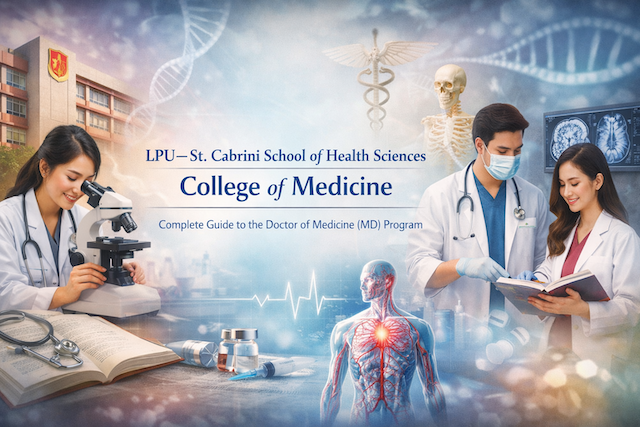
LPU–St. Cabrini School of Health Sciences College of Medicine: Complete Guide to the Doctor of Medicine (MD) Program
Contents
- LPU–St. Cabrini School of Health Sciences College of Medicine: Complete Guide to the Doctor of Medicine (MD) Program
- Quick Overview: What LPU–St. Cabrini College of Medicine Is Known For
- Background and Institutional Context
- Campus Location and Learning Environment
- MD Program Structure in the Philippines: What to Expect
- Teaching Approach: What “Good Medical Education” Looks Like
- Clinical Training and Hospital Exposure
- Facilities and Student Support
- Admissions: Typical Requirements and How to Prepare
- Tuition, Scholarships, and Financial Planning
- Student Life, Culture, and What Day-to-Day Training Feels Like
- After Graduation: Licensure, Residency, and Career Paths
- How to Contact the School and Confirm Official Details
- Final Thoughts: Is LPU–St. Cabrini a Good Fit for You?
LPU–St. Cabrini School of Health Sciences College of Medicine: Complete Guide to the Doctor of Medicine (MD) Program
LPU–St. Cabrini School of Health Sciences (often shortened as LPU–SC) is part of the Lyceum of the Philippines University–Laguna (LPU Laguna) ecosystem and is known for health-sciences education that is closely linked to a hospital training environment. The institution traces its roots to the early 2000s, when its establishment was approved by the Commission on Higher Education (CHED), and it was built around a partnership model that connects academic training with real-world healthcare delivery. This is an important point for prospective medical students: when a medical program is designed alongside a clinical partner, it can strongly shape how early you see patients, how hands-on your learning becomes, and how integrated your clerkship and internship planning can be.
This guide explains what the LPU–St. Cabrini College of Medicine aims to offer, how the MD journey is typically structured in the Philippines, what you can expect from training and campus life, and how to prepare a strong application. If you are comparing multiple medical schools, you can use this article as a checklist-style overview before you confirm the latest official admissions requirements and timelines directly with the school.
Quick Overview: What LPU–St. Cabrini College of Medicine Is Known For
LPU–St. Cabrini School of Health Sciences was formed to combine the educational tradition of LPU Laguna with healthcare capabilities connected to St. Frances Cabrini Medical Center, creating a health-sciences learning environment anchored in clinical realities. Over time, the institution expanded beyond undergraduate health programs and moved into offering a Doctor of Medicine track, with public communications around the MD program and leadership engagement such as dean’s meetings for applicants. In practical terms, LPU–St. Cabrini positions itself as a school where professional formation (discipline, ethics, service orientation) is developed alongside skills training and community-relevant healthcare exposure.
For many applicants, the main appeal is straightforward: you want medical education that feels “close to the hospital,” where the leap from classroom to wards is not treated as a distant future, but as a continuous pathway.
Background and Institutional Context
LPU–St. Cabrini School of Health Sciences emerged from a CHED-approved establishment in the early 2000s, and its structure reflects a healthcare-education partnership model. That model is common internationally in health professions education, but it is not always executed well. A strong partnership is usually visible in three areas: (1) access to clinical instructors and mentors who actively practice, (2) sufficient patient exposure and case diversity, and (3) a learning culture where professionalism is trained as intentionally as academic performance.
In LPU–St. Cabrini’s case, the school emphasizes values formation as part of its mission, aiming to shape students for both gainful employment and responsible citizenship through knowledge infusion, skills development, and value formation. For medical students, those words matter because medicine is not only about passing exams; it is also about how you communicate with patients, work with teams, and serve communities with empathy and accountability.
Campus Location and Learning Environment
Prospective students commonly encounter LPU–St. Cabrini through its Laguna presence (Calamba / Makiling area) and its broader footprint tied to LPU Laguna systems. When you evaluate “location,” think beyond convenience: consider access to hospitals, the pace of city life, housing options, transport routes, and the types of patients you might see during training. A medical school connected to a clinical environment can give you earlier and more consistent exposure to patient care settings—an advantage if you learn best by seeing, doing, and reflecting with mentors.
Also pay attention to practical details like office hours, admissions contact channels, and the responsiveness of administrative support. Medical school is intense; a well-run support system helps you handle documentation, rotations, and requirements without unnecessary stress.
MD Program Structure in the Philippines: What to Expect
While each institution designs its own curriculum, the Doctor of Medicine (MD) pathway in the Philippines generally follows a four-year medical proper program, followed by a post-graduate internship (PGI) year. Your experience typically moves through these phases:
1) Foundational Sciences (usually Years 1–2): You focus on anatomy, physiology, biochemistry, histology, pathology, microbiology, pharmacology, and other core disciplines. Even in schools that still use traditional subject-based teaching, there is often a growing emphasis on integrated learning—connecting concepts across systems (cardiovascular, respiratory, etc.) and introducing clinical context early.
2) Clinical Sciences and Early Patient Exposure (often overlaps Years 2–3): As you progress, you begin to apply foundational knowledge to clinical reasoning. You encounter internal medicine, pediatrics, surgery, obstetrics and gynecology, psychiatry, family and community medicine, and related fields. Case discussions, OSCE-style skills checks, and structured clinical encounters become more frequent.
3) Clerkship / Clinical Rotations (often Year 4, depending on school design): This is where the hospital partnership becomes very real. You rotate through major departments, participate in ward rounds, assist in procedures appropriate to your level, complete case write-ups, and learn how to function as part of a healthcare team. The quality of this year strongly influences your confidence going into internship and board preparation.
4) PGI (Post-Graduate Internship): After finishing medical proper, graduates typically complete an internship year in an accredited hospital. Internship is where you consolidate daily clinical habits—history taking, physical exams, progress notes, order writing under supervision, and patient communication—before you take licensure exams and pursue residency training.
If you are choosing a school today, your key question should be: “How well does the program prepare students to move from classroom learning to safe, supervised clinical action?” A school that aligns academic teaching with clinical realities can reduce the shock that many students feel when they first enter wards.
Teaching Approach: What “Good Medical Education” Looks Like
Medical education quality is not only about textbooks or lecture slides. A strong program typically shows the following characteristics:
Integrated learning: You learn organ systems in a connected way, linking anatomy and physiology with pathology and pharmacology, then applying them to patient cases.
Skills training with feedback: You practice history taking, physical examination, basic procedures, and patient communication—then receive direct feedback from faculty or clinical instructors.
Assessment that matches real practice: Beyond written exams, you see performance assessments such as OSCEs, case presentations, and clinical reasoning exercises.
Professional identity formation: The program takes ethics, communication, teamwork, and patient-centeredness seriously—because medical competence is not only “knowing,” but also “being” a physician-in-training.
When you speak with admissions or faculty, ask how early skills training begins, how students are coached on bedside manners, and how clinical mentors supervise students in real settings.
Clinical Training and Hospital Exposure
Because LPU–St. Cabrini’s institutional identity is tied to healthcare delivery capabilities, clinical exposure is likely to be a defining feature of the student experience. In evaluating any medical program with a hospital-linked background, you want to confirm details such as:
- Where clerkship rotations are conducted and what departments are available.
- Whether student case exposure includes both common conditions (hypertension, diabetes, pneumonia) and a range of urgent or complex cases.
- How supervision works—who signs off procedures, who grades performance, and how feedback is delivered.
- How patient safety and ethical standards are taught and enforced.
Even before clerkship, many programs integrate clinical case discussions and simulation-based learning. If LPU–St. Cabrini offers structured skills labs or simulation sessions, those can be a major advantage for students who want to build confidence before patient-facing responsibilities increase.
Facilities and Student Support
Facilities matter most when they directly support learning outcomes. For MD students, pay attention to:
- Library and learning resources: access to medical references, journals, and study spaces.
- Skills lab / simulation: mannequins, procedure trainers, OSCE rooms, and structured practice time.
- IT and learning platforms: online portals, LMS access, and reliable communication channels for schedules and requirements.
- Student services: guidance counseling, wellness support, mentoring systems, and remediation policies.
Medical school is academically demanding and emotionally taxing. A school that treats student wellness seriously—through mentoring, counseling, and supportive policies—can make a meaningful difference in performance and retention.
Admissions: Typical Requirements and How to Prepare
Admissions policies can change from year to year, so you should always verify current requirements with the admissions office. That said, applicants to MD programs in the Philippines commonly prepare the following:
- NMAT score: Many medical schools require the National Medical Admission Test (NMAT) with a specified percentile rank threshold.
- Undergraduate transcript: A completed bachelor’s degree (often with science prerequisites preferred, depending on policy).
- Good moral character documents: character references and institutional clearances.
- Application forms and interview: Schools often assess motivation, maturity, communication skills, and fit.
- Additional documents: birth certificate, ID photos, medical clearance, and other administrative items.
How to strengthen your application: focus on (1) a competitive NMAT score, (2) strong academic consistency or a clear improvement story, (3) meaningful healthcare exposure (volunteering, shadowing, research, community service), and (4) a personal statement or interview narrative that explains why you want medicine and what kind of physician you want to become.
If LPU–St. Cabrini offers applicant engagement activities (such as meetings with the college leadership), treat them seriously. Show preparedness, ask smart questions, and communicate clearly about your goals and readiness for rigorous training.
Tuition, Scholarships, and Financial Planning
Tuition and fees vary by academic year and may depend on laboratory use, clinical training costs, and institutional policies. If you are budgeting, request a full breakdown that includes:
- Tuition per semester/year
- Miscellaneous and laboratory fees
- Uniforms, equipment, and medical instruments
- Clerkship-related costs (transport, meals, possible rotation fees)
- Books and online resources
Ask about scholarship opportunities, academic grants, payment plans, and any performance-based financial support. Also consider cost of living if you plan to rent housing near campus or clinical sites.
Student Life, Culture, and What Day-to-Day Training Feels Like
Medical student life is built around routines: lectures, small-group discussions, lab work, self-study, examinations, and gradually increasing clinical responsibilities. The difference between schools is often not “how hard it is” (it is hard everywhere) but “how supported you feel while it is hard.”
When you evaluate the culture, try to learn:
- How approachable faculty and clinical instructors are.
- Whether there are mentoring systems for first-year students.
- How students collaborate (study groups, peer tutoring) versus compete.
- What student organizations exist for community medicine, research, outreach, or wellness.
A healthy medical school culture encourages professionalism without humiliation, excellence without burnout, and discipline without losing compassion.
After Graduation: Licensure, Residency, and Career Paths
After completing the MD program and internship, graduates typically prepare for the Physician Licensure Examination (PLE) and then pursue residency training in a chosen specialty (internal medicine, surgery, pediatrics, OB-GYN, psychiatry, family medicine, and many others). Some graduates pursue research, public health work, hospital administration, or teaching careers. A school’s long-term strength is often reflected in how well its graduates perform in licensure outcomes, how prepared they feel in internship, and how they transition into residency programs.
When researching LPU–St. Cabrini, ask about student advising for internship matching, board exam preparation support, and career guidance. Even if a school does not “spoon-feed” board review content, good academic planning and mentorship can help students build consistent preparation habits early.
How to Contact the School and Confirm Official Details
Because medical program requirements and schedules can change, your final step should always be direct confirmation with the admissions office. Prepare a short list of questions before you call or email, such as:
- Current NMAT cutoff (if any) and accepted test dates
- Application deadlines, interview schedule, and start of classes
- Full list of documentary requirements
- Tuition and fee breakdown, scholarships, and payment options
- Primary campus location for MD classes and clinical rotations
- Partner hospitals and rotation structure
This approach saves time and prevents confusion, especially if you are applying to multiple medical schools within the same admission season.
Final Thoughts: Is LPU–St. Cabrini a Good Fit for You?
LPU–St. Cabrini School of Health Sciences College of Medicine may be a strong option if you want medical education that emphasizes clinical relevance, values formation, and a training ecosystem connected to healthcare delivery. The best fit, however, depends on your learning style and life situation. If you thrive with structured support, consistent mentorship, and early clinical context, you may appreciate a program shaped by a health-sciences identity. If you are highly independent, you should still ensure the program offers enough flexibility and resources for self-directed study, research interest, and board-focused preparation.
Before you decide, do three things: (1) confirm the latest admissions requirements and program details directly with the school, (2) ask about clinical rotation sites and supervision structure, and (3) speak with current students if possible to understand the day-to-day reality behind the brochure. Medical school is a long commitment—choose the environment where you can grow into the kind of doctor you want to become.
Recommend
2026年1月23日
Sultan Kudarat State University College of Medicine: Complete Guide for Aspiring MD Students
2026年1月23日
University of Southern Mindanao College of Medicine: Complete Guide for Aspiring MD Students
2026年1月23日
Mindanao State University – General Santos College of Medicine: Complete Guide for Future MD Students

How to Register for eTravel Philippines (2025 Guide)
Step-by-step guide to completing your eTravel registration before arriving in the Philippines, with images and tips.

Night Market in Cebu – Things You Don’t Know About Cebu Life
Discover the hidden charm of Cebu’s night markets, from street food stalls to local life tips you won’t find in tourist guides.

How to Use ChatGPT for IELTS Preparation: A Complete Guide
Learn how to prepare for IELTS using ChatGPT — including strategies for Writing, Reading, Listening, Speaking, and grammar support.

How to Build a Website Without Coding Using ChatGPT
Discover how to build your own website using AI—no coding skills needed. From structure planning to SEO and design, let ChatGPT guide you.