2026年1月23日
3D ACADEMY offers affordable English study programs in Cebu, Philippines – perfect for beginners, professionals, and exam takers.

3D UNIVERSAL ENGLISH INSTITUTE INC
info.3d-universal.com
8:00-17:00(Mon-Fri)
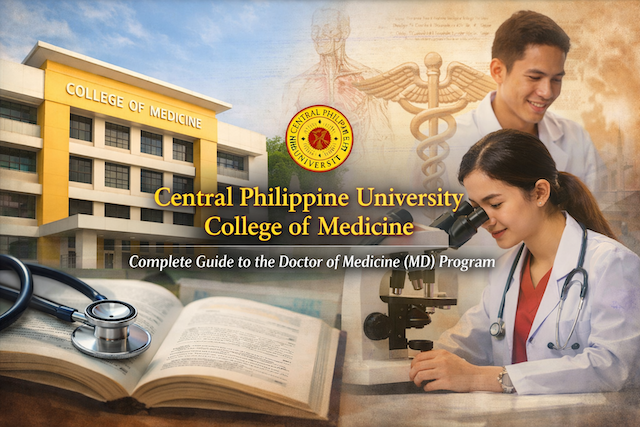
Central Philippine University College of Medicine: Complete Guide to the Doctor of Medicine (MD) Program
Contents
- Central Philippine University College of Medicine: Complete Guide to the Doctor of Medicine (MD) Program
- Overview of Central Philippine University College of Medicine
- MD Program in the Philippines: How the Training Typically Works
- Curriculum and Academic Subjects You Should Expect
- Clinical Training and Clerkship: What “Hospital Life” Feels Like
- Admissions Preparation: What a Strong Applicant Usually Has
- International Students: Practical Considerations Before Applying
- Tuition, Fees, and Cost of Living in Iloilo
- Scholarships and Financial Planning Strategies
- Student Life, Support Systems, and Staying Mentally Strong
- How to Decide If CPU College of Medicine Is Right for You
- Next Steps: A Practical Action Plan for Applicants
- FAQs (Frequently Asked Questions)
- What program does Central Philippine University College of Medicine offer?
- Where is CPU College of Medicine located?
- Is the MD program at CPU suitable for international students?
- Do I need to take the NMAT to apply to CPU College of Medicine?
- What documents are typically required for medical school applications?
- How long is medical school in the Philippines?
- What is the difference between pre-clinical years and clinical years?
- Where do students complete clinical rotations and clerkship?
- How much does it cost to study medicine at CPU?
- Are there scholarships for MD students at CPU?
- What is a realistic application timeline for CPU College of Medicine?
- What should I consider when choosing housing in Iloilo City?
- Can I practice abroad after graduating from CPU?
- How can I improve my chances of success once I’m accepted?
Central Philippine University College of Medicine: Complete Guide to the Doctor of Medicine (MD) Program
Central Philippine University (CPU) is a long-established private university in Iloilo City, and its College of Medicine (often referred to as CPU ColMed) offers a Doctor of Medicine (MD) program for students who want to become physicians in the Philippines. For many applicants, CPU stands out because it is based in a full university campus environment—meaning you are not only entering a medical school, but also joining a larger academic community with student services, campus facilities, and a broad university culture.
This guide explains what to expect from CPU College of Medicine, how the MD program generally works in the Philippines, what admissions preparation looks like, and how to plan your budget and timeline. Even if you already know you want to study medicine, choosing a school is a practical decision: you want strong clinical training, a learning environment that fits your study style, and a location that supports your daily routine through demanding years.
Overview of Central Philippine University College of Medicine
CPU College of Medicine is located in Iloilo City, in the district of Jaro. Iloilo is a regional center in Western Visayas and is often considered a student-friendly city with a relatively manageable pace compared to larger metropolitan areas. That matters more than many applicants expect. Medical school is not just about lectures and exams—it is also about the rhythm of your daily life: commuting, sleeping enough, finding a reliable study environment, and staying healthy while your schedule tightens each semester.
As part of a university setting, CPU medical students often benefit from a campus system that includes student support offices, libraries, and opportunities to connect with peers across other programs. Even if your medical workload is intense, being surrounded by a wider student community can help you feel grounded and supported.
MD Program in the Philippines: How the Training Typically Works
The Doctor of Medicine program in the Philippines is a professional graduate program. Most students enter after completing an undergraduate degree. The MD curriculum generally progresses through three broad stages:
- Pre-clinical training focused on foundational medical sciences and early skills building
- Clinical classroom-to-hospital transition where you learn clinical medicine alongside structured patient exposure
- Clerkship-style rotations where hospital training becomes the core of your education
Within these stages, you can expect a shift from studying “what the body is” and “how disease works” to learning “how to evaluate a patient,” “how to decide the next step,” and “how to communicate safely and professionally within a healthcare team.”
After completing the MD, graduates typically pursue licensure and then postgraduate training such as residency. Your school’s training culture—how it teaches, supervises, and evaluates students—can influence how prepared you feel for board exams and clinical practice.
Curriculum and Academic Subjects You Should Expect
While every medical school has its own structure, MD curricula usually share a common core. Pre-clinical years are designed to build a scientific foundation and introduce clinical reasoning. You can expect subjects such as:
- Anatomy, histology, and embryology
- Physiology
- Biochemistry
- Microbiology and parasitology
- Pathology
- Pharmacology
- Preventive and community medicine concepts
- Basic clinical skills, patient interviewing, and physical examination
As you progress, learning becomes more clinically oriented. Programs often shift into system-based modules or integrated blocks (for example, cardiovascular, respiratory, gastrointestinal, and so on), where you study the normal system, disease mechanisms, diagnosis, and treatment approaches together. The goal is to help you connect basic science to real clinical decision-making.
Assessment is typically continuous and intense. Expect written exams, practical or laboratory exams, oral recitations, case reports, skills checks, and structured clinical performance evaluations. Learning is cumulative: what you learn early becomes the building block for clinical rotations later.
Clinical Training and Clerkship: What “Hospital Life” Feels Like
The most transformative part of medical school is clinical training. This is where you learn to function as part of a clinical team and apply your knowledge to real patients. In clerkship-style rotations, your schedule is often based on hospital service needs, not on classroom convenience.
Rotations usually include core departments such as:
- Internal Medicine
- Surgery
- Pediatrics
- Obstetrics and Gynecology
- Family Medicine or Community Medicine
- Psychiatry (commonly included in clinical training)
In clerkship, you are evaluated on more than test scores. You are judged on professionalism, work habits, teamwork, communication, clinical reasoning, and your ability to learn from feedback. You also learn the reality of healthcare: limited resources, complex social factors, and the importance of clear clinical documentation and safe decision-making.
When you evaluate a medical school, ask the practical questions: How early do students see patients? How are students supervised? What is the patient volume like? Are there structured teaching rounds? Is there a strong culture of mentorship?
Admissions Preparation: What a Strong Applicant Usually Has
Medical school admissions is not only about being “smart.” Schools want students who can handle responsibility, stress, and ethical decision-making. A strong application typically includes:
- Solid undergraduate academic performance (especially in science prerequisites)
- A competitive admissions test score if required (commonly NMAT in the Philippines)
- Recommendation letters that speak to your character and ability to learn
- A clear personal statement that explains why you want to become a physician
- Interview readiness and professional communication
Your personal statement should not be a generic “I want to help people.” It should be specific. What experiences shaped your goal? What kind of doctor do you want to become? How do you handle setbacks? What does service mean to you in real-life terms?
Interviews are often designed to test maturity and communication. Schools may ask about your motivation, stress management, academic challenges, teamwork experiences, and ethical scenarios. Prepare by practicing structured answers and learning to communicate calmly under pressure.
International Students: Practical Considerations Before Applying
If you are a foreign applicant, you should plan earlier than local students. International application processes often include additional steps such as credential evaluation, document authentication, and visa processing. Even when admission policies are welcoming, the paperwork can be time-consuming.
Key preparation steps include:
- Organizing official academic records and verifying whether they require authentication
- Ensuring your passport is valid for the duration of the program plus processing buffers
- Planning for student visa processes and timelines
- Budgeting for initial relocation costs, deposits, and document processing fees
International students should also consider cultural adaptation in clinical settings. Communication styles, patient expectations, and hospital workflows differ across countries. If you commit to respectful learning and adaptability, this becomes an advantage rather than a barrier.
Tuition, Fees, and Cost of Living in Iloilo
Budget planning for medical school should be realistic and detailed. Your costs are not only tuition. You also need to account for:
- Miscellaneous and laboratory fees
- Uniforms and clinical attire
- Medical instruments (stethoscope, BP apparatus, diagnostic tools depending on requirements)
- Books and learning resources (including online question banks if you use them)
- Transportation to campus and clinical sites
- Daily living expenses (rent, food, utilities, internet)
Iloilo can be more manageable than larger cities, but your actual expenses will depend on your housing choice and lifestyle. Many students prefer housing that reduces commuting time, especially once clinical duties start. Long hospital days plus long commutes can be exhausting and can affect performance and well-being.
To build a realistic budget, separate your expenses into: fixed monthly costs (rent, utilities), variable costs (food, transport), and academic costs (fees, supplies). Then add an “unexpected” buffer for emergencies and schedule changes.
Scholarships and Financial Planning Strategies
Scholarships can be available through university channels or external organizations, but you should not rely on scholarships as your only plan unless you have confirmation in writing. Instead, treat scholarships as one part of a financial strategy.
Practical strategies include:
- Applying early and preparing complete documentation
- Maintaining strong grades, as academic standing often affects eligibility
- Clarifying scholarship conditions (grade requirements, service obligations, renewal rules)
- Planning for partial coverage (for example, tuition covered but not living expenses)
If you are financing your education through family support, loans, or sponsors, it helps to create a semester-by-semester cost projection so you can plan cash flow. Medical school costs often increase in later years when clinical and rotation-related expenses rise.
Student Life, Support Systems, and Staying Mentally Strong
Medical school will test your time management and resilience. The students who succeed long-term are not always the ones who study the most hours—they are the ones who study consistently, recover effectively, and build sustainable routines.
Healthy strategies that are common among strong medical students include:
- Active learning (practice questions, spaced repetition, explaining concepts aloud)
- Weekly planning (setting goals per subject and tracking weak areas)
- Peer support (study groups, shared accountability, emotional support)
- Wellness habits (sleep, exercise, and a realistic rest schedule)
When you enter clinical years, communication becomes just as important as knowledge. You will interact with patients, nurses, residents, consultants, and hospital staff. Professionalism is not optional. Your reputation as a dependable, respectful trainee can open doors to mentorship and strong recommendations later.
How to Decide If CPU College of Medicine Is Right for You
Choosing a medical school is a match between your goals and the school’s training environment. CPU College of Medicine may be a strong fit if you value a university campus experience, want to train in Iloilo City, and prefer an environment that supports both academic intensity and a manageable daily lifestyle.
When deciding, focus on evidence-based questions:
- Do you learn best in structured teaching environments or more self-directed ones?
- Do you want early patient exposure and hands-on practice?
- Does the school’s clinical training setup match your learning needs?
- Can you sustain the financial and lifestyle requirements for the full program?
- Do you have a support system in Iloilo, or can you build one quickly?
If possible, attend an orientation, speak with current students, and ask about the reality of weekly schedules, exam frequency, and the availability of faculty mentorship.
Next Steps: A Practical Action Plan for Applicants
If you are planning to apply, move step-by-step rather than relying on motivation alone. Here is a practical plan:
- Step 1: Confirm admissions requirements and deadlines for the next intake.
- Step 2: Prepare your documents and create a checklist with submission dates.
- Step 3: Schedule required entrance tests early if applicable.
- Step 4: Draft your personal statement and collect recommendation letters.
- Step 5: Build a realistic budget for tuition, fees, and living costs in Iloilo.
- Step 6: Plan housing options and transportation routes before enrollment.
Medical school is a demanding journey, but with strong preparation and a realistic plan, you can reduce uncertainty and focus your energy on learning and growth. If CPU College of Medicine aligns with your goals and preferred environment, careful planning now will make your first year far smoother—and will set the foundation for your success in clinical training and beyond.
FAQs (Frequently Asked Questions)
What program does Central Philippine University College of Medicine offer?
Central Philippine University (CPU) College of Medicine offers the Doctor of Medicine (MD) program for students preparing to become licensed physicians in the Philippines. The MD is a professional graduate program that combines classroom-based medical sciences with skills training and supervised clinical exposure. As you move forward in the curriculum, you typically transition from pre-clinical coursework into hospital-based rotations where you learn patient care in real clinical settings. For the most accurate, updated program information, applicants should confirm current details directly through CPU’s official College of Medicine channels.
Where is CPU College of Medicine located?
CPU College of Medicine is based in Iloilo City, Philippines, within the Central Philippine University campus. Iloilo is a major city in Western Visayas and is known for being a student-oriented environment with many universities and training institutions. Location matters because it affects daily commuting, living costs, and your access to clinical training sites. Before enrolling, it’s smart to map your likely routes between your housing, campus facilities, and the hospitals where rotations may take place, so you can plan a sustainable schedule during demanding clinical years.
Is the MD program at CPU suitable for international students?
CPU provides admissions guidance for foreign students at the university level, which indicates that international applicants may apply if they can meet documentation, credential, and immigration requirements. However, suitability depends on your academic background, your ability to adapt to local healthcare systems, and your long-term career plan. International students should also consider visa processing timelines, document authentication steps, and whether they can comply with on-campus or face-to-face requirements if these are part of the current academic policy. Always confirm the latest rules and procedures with CPU before submitting your application.
Do I need to take the NMAT to apply to CPU College of Medicine?
In the Philippines, many medical schools use the National Medical Admission Test (NMAT) as a standard admissions requirement or evaluation factor. Whether CPU requires a specific NMAT score threshold or uses the NMAT as part of a broader holistic review can vary by admissions cycle. Your best approach is to prepare as if NMAT is required: schedule the test early, aim for a strong percentile ranking, and keep your results ready before the application deadline. Then verify CPU’s current NMAT policy directly with the College of Medicine or admissions office.
What documents are typically required for medical school applications?
While exact requirements differ per school, applicants generally submit academic transcripts, proof of graduation from a bachelor’s program, standardized test results (often NMAT), recommendation letters, and a personal statement or application essay. Some schools also request certificates of good moral character and may require an interview. If you are an international applicant, additional documents can include passport information, authenticated academic records, and other immigration-related paperwork. The key is completeness: missing documents can delay evaluation, so create a checklist and submit early.
How long is medical school in the Philippines?
Medical education in the Philippines typically includes several years of MD training followed by intensive clinical rotations, and then a post-graduation pathway that includes the Physician Licensure Examination (PLE). The MD curriculum itself commonly spans multiple academic years with a progression from foundational sciences to clinical medicine and clerkship-style hospital rotations. The exact structure and timing can differ by institution, but you should expect a long-term commitment. After earning the MD and passing the licensure exam, many graduates continue to residency training to specialize.
What is the difference between pre-clinical years and clinical years?
Pre-clinical training focuses on the scientific foundations of medicine—subjects such as anatomy, physiology, biochemistry, pathology, pharmacology, and microbiology—plus introductory clinical skills like history taking and basic physical examination. Clinical years emphasize direct patient care through supervised rotations in departments such as Internal Medicine, Surgery, Pediatrics, and Obstetrics-Gynecology. Your learning shifts from primarily classroom-based to hospital-based, and performance evaluation often includes clinical assessments, case discussions, and professionalism within healthcare teams. Both phases are essential for developing safe clinical judgment.
Where do students complete clinical rotations and clerkship?
Clinical rotations are typically completed in affiliated teaching hospitals and partner clinical sites. Your exposure will depend on the school’s network: patient volume, case diversity, and the teaching culture of each department can shape your experience. When comparing schools, ask about the base hospital, rotation schedule, and how students are supervised and evaluated during clerkship. Also ask whether community medicine or public health fieldwork is integrated into training, because community-based exposure can strengthen your understanding of healthcare realities in the Philippines.
How much does it cost to study medicine at CPU?
Costs usually include tuition plus miscellaneous fees such as laboratory and clinical fees, library fees, learning resources, uniforms, equipment, and exam-related expenses. Living costs—housing, transport, food, and internet—can be significant as well, especially during clinical years when schedules become more demanding. CPU posts tuition and fee information by school year at the university level, but medical program costs can involve additional clinical-related charges. For accurate budgeting, request an estimated total per semester from CPU’s College of Medicine and confirm payment options and schedules.
Are there scholarships for MD students at CPU?
CPU maintains scholarship information through official university channels, and scholarships can come from the institution, donors, or external organizations. Availability, eligibility rules, and coverage vary—some are merit-based, some are need-based, and others may require specific service commitments or academic standing. If scholarships are part of your plan, apply early and prepare strong supporting documents such as transcripts, recommendation letters, and a clear personal statement. International students should verify whether particular scholarships are open to non-Filipino applicants, as some funding programs may have citizenship requirements.
What is a realistic application timeline for CPU College of Medicine?
A practical timeline is to start preparation 6 to 12 months before your target intake. During that period, you can take the NMAT (if applicable), collect transcripts and recommendations, and draft your personal statement. In the 3 to 6 months before application deadlines, you should finalize paperwork, prepare for interviews, and plan finances. Submitting early is recommended because it gives you time to address missing requirements and reduces stress. Since deadlines can change, follow CPU’s official announcements and confirm dates directly with the College of Medicine.
What should I consider when choosing housing in Iloilo City?
Choose housing that supports your medical school routine. Prioritize a short and reliable commute to campus and clinical sites, a quiet environment for studying, stable internet, and access to essentials like groceries, pharmacies, and transportation. During clerkship, early call times and long shifts can make commuting difficult, so living closer to training sites can improve your quality of life. Safety and comfort matter too, because medical school is demanding and you’ll need a space that helps you recover and stay focused.
Can I practice abroad after graduating from CPU?
Possibly, but the pathway depends on the country where you want to practice. Many countries require additional licensing exams, credential verification, and specific postgraduate training. Some may require you to complete residency locally, while others may recognize certain parts of your training but still require equivalency steps. If practicing abroad is your goal, research your target country’s rules early, because timelines can be long and requirements can change. Regardless of destination, building strong clinical skills, professionalism, and communication ability during medical school will help you in any system.
How can I improve my chances of success once I’m accepted?
Medical school success comes from consistent habits rather than last-minute cramming. Use active learning methods such as practice questions and spaced repetition, and review clinically relevant material regularly. Form a supportive peer network for study and wellness, and develop routines for sleep, exercise, and stress management. During clinical training, focus on patient communication, thorough history and physical exams, and clear clinical reasoning. Also seek mentorship from faculty and residents, because guidance from experienced clinicians can accelerate your growth and help you navigate rotations confidently.
Complete List of Medical Schools in the Philippines (All 78 MD Programs)
Best Medical Schools in the Philippines (Local & International Rankings)
Recommend
2026年1月23日
Sultan Kudarat State University College of Medicine: Complete Guide for Aspiring MD Students
2026年1月23日
University of Southern Mindanao College of Medicine: Complete Guide for Aspiring MD Students
2026年1月23日
Mindanao State University – General Santos College of Medicine: Complete Guide for Future MD Students

How to Register for eTravel Philippines (2025 Guide)
Step-by-step guide to completing your eTravel registration before arriving in the Philippines, with images and tips.

Night Market in Cebu – Things You Don’t Know About Cebu Life
Discover the hidden charm of Cebu’s night markets, from street food stalls to local life tips you won’t find in tourist guides.

How to Use ChatGPT for IELTS Preparation: A Complete Guide
Learn how to prepare for IELTS using ChatGPT — including strategies for Writing, Reading, Listening, Speaking, and grammar support.

How to Build a Website Without Coding Using ChatGPT
Discover how to build your own website using AI—no coding skills needed. From structure planning to SEO and design, let ChatGPT guide you.