2026年1月23日
3D ACADEMY offers affordable English study programs in Cebu, Philippines – perfect for beginners, professionals, and exam takers.

3D UNIVERSAL ENGLISH INSTITUTE INC
info.3d-universal.com
8:00-17:00(Mon-Fri)
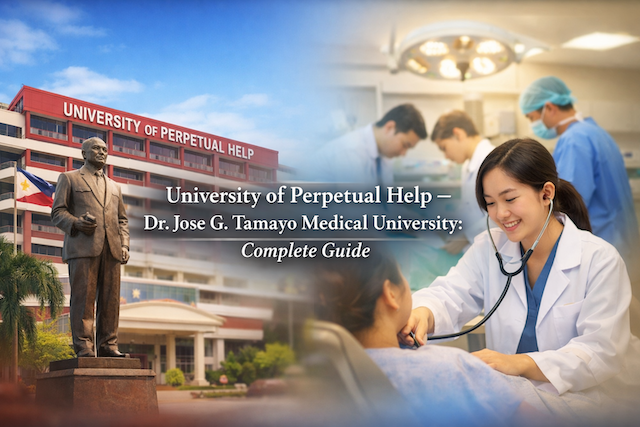
University of Perpetual Help – Dr. Jose G. Tamayo Medical University: Complete Guide
Contents
- University of Perpetual Help – Dr. Jose G. Tamayo Medical University: Complete Guide
- Quick Profile and Location
- What Students Typically Look for in a Medical School
- Learning Environment and Health-Sciences Focus
- Hospital Exposure and Clinical Training Opportunities
- Doctor of Medicine Program Structure (What to Expect)
- Admissions: What Applicants Usually Need to Prepare
- Tuition, Fees, and Cost Planning
- Student Life in Biñan, Laguna
- Academic Support, Mentoring, and How to Succeed
- Research, Community Health, and Professional Development
- International Students and Credential Considerations
- How to Evaluate Fit Before You Enroll
- Official Contacts and Admissions Notes
- FAQs (Frequently Asked Questions)
- Where is University of Perpetual Help – Dr. Jose G. Tamayo Medical University located?
- What degree does the school offer for aspiring physicians?
- How long does the MD program usually take?
- What are the typical phases of learning in medical school?
- Does the school provide clinical training in an affiliated hospital?
- What are the common admission requirements for an MD program?
- Is NMAT required, and what score should I aim for?
- When should I apply, and are there multiple intake periods?
- How much does it cost to study medicine, and what expenses should I budget for?
- Are scholarships or financial assistance available?
- Can international students apply to the MD program?
- Does graduating from an MD program automatically allow me to practice medicine?
- What is student life like, and where do most students live?
- What study habits help students succeed in the first year?
- How can I contact the school for the most updated admissions details?
University of Perpetual Help – Dr. Jose G. Tamayo Medical University: Complete Guide
The University of Perpetual Help – Dr. Jose G. Tamayo Medical University (often shortened as UPH-DJGTMU) is a health-sciences-focused institution located in the City of Biñan, Laguna, Philippines. :contentReference[oaicite:0]{index=0} If you are comparing medical schools and want a clear, practical overview—what the learning environment is like, how the Doctor of Medicine (MD) path typically works, how clinical exposure is usually structured, and what to prepare for in admissions—this guide walks you through the essentials in a structured way.
Because medical programs can adjust policies, requirements, and timelines from one academic year to the next, treat this as a planning guide and always verify details (deadlines, documents, fees, and procedures) through official channels before submitting anything. The school’s official site indicates admissions updates for upcoming academic terms. :contentReference[oaicite:1]{index=1}
Quick Profile and Location
UPH-DJGTMU is situated in Biñan, Laguna—an area with direct road access to Metro Manila and neighboring provinces, which can be helpful for students who want a campus environment outside the densest parts of the capital while still staying connected to major transport routes. The school’s published contact details and address information reflect its Biñan, Laguna location. :contentReference[oaicite:2]{index=2}
The medical university is part of the wider “University of Perpetual Help System” ecosystem, which includes multiple campuses and institutions. :contentReference[oaicite:3]{index=3} In practice, being part of a broader system often means students may see shared academic culture, alumni networks, and institutional partnerships across related units—though the day-to-day experience will still depend most on your specific program, faculty, and affiliated training sites.
What Students Typically Look for in a Medical School
When you evaluate a medical school, it helps to look beyond branding and focus on the factors that influence your learning outcomes and your readiness for clinical practice. These are practical criteria that applicants commonly use:
- Clinical training access: proximity to hospitals/medical centers, variety of cases, exposure to community health, and supervised patient contact.
- Teaching approach: balance of lectures, small-group sessions, labs, simulation, case-based discussions, and independent study.
- Faculty support: availability for mentoring, feedback culture, and structure for remediation if you struggle in a subject.
- Board exam preparation culture: study resources, internal assessments, and how strongly the program builds habits for long-term retention.
- Student environment: workload management, mental health support, professional conduct standards, and community.
- Logistics: living costs, commuting, safety, and overall sustainability for 4+ years of intense training.
If your goal is to practice in the Philippines, your priority is graduating with strong foundations in basic sciences, clinical reasoning, and patient communication, followed by effective review and preparation for the Physician Licensure Examination (PLE). If you are also exploring international pathways, it becomes even more important to confirm recognition and eligibility requirements for your target country (for example, how a school appears in international directories used by licensing or credentialing bodies). :contentReference[oaicite:4]{index=4}
Learning Environment and Health-Sciences Focus
UPH-DJGTMU is positioned as a medical and health-sciences-oriented institution, which generally means you can expect a campus culture that is aligned with clinical professionalism: structured schedules, skills-based training, and early emphasis on patient-centered thinking. While each medical school has its own style, health-science-focused campuses often provide a setting where allied health programs exist alongside medicine, which can support inter-professional exposure (for example, learning to communicate clearly with nurses, therapists, and other health professionals).
A useful step before you apply is to map what you personally need to succeed. Some students do best in a highly structured environment with frequent quizzes and clear weekly targets. Others thrive with more independent study time and fewer but deeper assessments. Knowing your learning style helps you interpret what you see during interviews, campus visits, or orientation materials.
Hospital Exposure and Clinical Training Opportunities
Clinical training is where “medical knowledge” becomes “medical judgment.” Applicants should look for clarity on where students typically train and how clinical responsibilities expand over time. In Biñan, UPH is associated with Perpetual Help Medical Center – Biñan, which is presented publicly as part of the same broader institutional ecosystem. :contentReference[oaicite:5]{index=5}
In general, your best clinical learning happens when:
- You have consistent supervision and feedback from clinicians who actively teach (not only “allow you to observe”).
- You see enough patient volume to practice history-taking and physical exam skills repeatedly.
- You rotate through core services (internal medicine, surgery, pediatrics, OB-GYN, psychiatry, and community medicine) with structured learning objectives.
- You learn professional habits: charting, case presentation, handoff communication, and teamwork.
When you talk to a school (or current students), ask specific questions: “How early do students get patient contact?” “How are clerkship schedules arranged?” “What is the student-to-preceptor ratio?” “How are competencies evaluated?” These questions often reveal more than general marketing language.
Doctor of Medicine Program Structure (What to Expect)
While program designs vary by school, the MD pathway in the Philippines typically moves through stages: foundational sciences, organ-system or integrated modules, then clinical clerkships and internship-style exposure (depending on how the school structures the latter years). Your first years are often intensive and classroom-based, covering anatomy, physiology, biochemistry, pathology, pharmacology, microbiology, and more—then shifting into integrated clinical reasoning and case discussion.
Here is a practical way to think about your development over time:
- Stage 1: Foundations – build the “language” of medicine and understand normal vs. abnormal body function.
- Stage 2: Integration – apply concepts to patient cases, strengthen diagnostic thinking, and learn evidence-based habits.
- Stage 3: Clinical immersion – develop bedside skills, patient communication, clinical responsibility, and professional workflow.
- Stage 4: Licensure preparation – consolidate knowledge, practice test-taking strategies, and address weak areas systematically.
If you are choosing among schools, ask how they support transitions between stages. Many students struggle most at the “jump” from theory-heavy learning into real patient care. Strong programs prepare you with skills labs, simulation, and structured case presentations before your first heavy clinical rotations.
Admissions: What Applicants Usually Need to Prepare
The school’s official website notes that admissions for upcoming academic terms are ongoing, which indicates an active recruitment cycle. :contentReference[oaicite:6]{index=6} For medical school applications, you should typically plan your preparation in three layers:
- Academic readiness: transcripts, prerequisite subjects (where applicable), and consistent performance in science-heavy coursework.
- Entrance assessments: common exams may include NMAT and/or internal screening steps depending on the institution.
- Professional readiness: interview preparation, recommendation letters, and a coherent personal statement or narrative that explains your motivation and resilience.
Even strong applicants underestimate how important documentation and timing can be. Create a checklist early and track every requirement with dates. Medical admissions offices often process large volumes of applications, and delays usually happen because of missing forms, incomplete submissions, or unclear scanned documents.
Also consider preparing a short “proof of fit” summary for yourself: why this location, why this environment, what support system you have, and how you handle high workload. Medicine is academically demanding, but it is also emotionally demanding—admissions teams often look for applicants who can maintain professionalism under stress.
Tuition, Fees, and Cost Planning
Medical education is a multi-year investment, so it is wise to plan beyond the first semester. Even without quoting exact figures (which can change), you can still build a realistic budget framework:
- Direct school costs: tuition, laboratory fees, miscellaneous fees, ID and uniform costs, and potential technology fees.
- Learning resources: books, digital subscriptions, question banks, printing, and devices (laptop/tablet).
- Clinical costs: transportation to training sites, clinical tools (stethoscope, BP set), and possible rotation-related expenses.
- Living costs: rent, utilities, food, commuting, and emergency buffer.
In your planning, always include a “buffer fund.” Medical school schedules can change, and unexpected costs happen—extra lab requirements, review resources, or commuting increases when rotations move across sites.
Student Life in Biñan, Laguna
Biñan offers a different pace compared with central Metro Manila, and that can be a major advantage if you learn best with fewer daily stressors. Many medical students prioritize stable housing, predictable commuting, and access to affordable food options. The right living setup can directly affect your grades and wellbeing.
Here are practical living considerations:
- Housing strategy: choose quiet, study-friendly housing over “nice but noisy.” Sleep quality matters.
- Commute design: minimize transfer points; the less complex your commute, the more energy you keep for studying.
- Study environment: ensure you have a reliable internet connection and a dedicated desk space.
- Support system: identify people you can call during high-stress exam weeks.
If you can, visit the area at least once before committing. Do a “test day”: travel to the campus area, check your possible route, try studying for two hours in your potential housing area, and note what distracts you.
Academic Support, Mentoring, and How to Succeed
In medicine, success is rarely about raw intelligence alone. It is about consistency, repetition, and good systems. Regardless of where you study, these habits tend to produce results:
- Active recall: use questions to test yourself rather than re-reading notes repeatedly.
- Spaced repetition: revisit core concepts multiple times across weeks and months.
- Case linking: connect basic science facts to clinical presentations so you remember “why it matters.”
- Weekly rhythm: set a weekly review day to consolidate content before it piles up.
- Study groups with rules: keep it small, structured, and outcome-focused (avoid “social study” that becomes unproductive).
One of the best questions you can ask current students is: “What do you wish you had done in first year?” Their answers usually revolve around better time management, earlier use of question-based learning, and smarter prioritization of high-yield topics.
Research, Community Health, and Professional Development
Modern medical education often includes research exposure and community medicine. Research training builds critical thinking: how to interpret evidence, evaluate bias, and apply guidelines responsibly. Community exposure builds perspective: how social factors, access barriers, and health education affect outcomes.
If research is important to you (for residency applications or personal interest), ask about typical student research opportunities, mentorship availability, and whether students present work at conferences or campus forums. If community medicine is a priority, ask how fieldwork is supervised and how learning outcomes are assessed.
International Students and Credential Considerations
Some applicants consider medical schools in the Philippines as part of a broader plan that may include further training or licensure abroad. If that is your situation, confirm how the school appears in international medical school directories used by credentialing organizations. For example, the World Directory of Medical Schools entry for this institution is relevant for certain certification pathways. :contentReference[oaicite:7]{index=7}
Important: being listed in a directory is not the same as being guaranteed eligibility for every country or training route. Requirements can include exam pathways, internship structure, language proficiency, and additional documentation. If you have a target country in mind, check that country’s latest rules and build your plan early so you do not face surprises after graduation.
How to Evaluate Fit Before You Enroll
Before committing, do a final “fit check” using questions that reflect your real day-to-day life:
- Can I realistically maintain my health and study routine in this location for 4+ years?
- Do I learn best with this school’s teaching style and assessment frequency?
- Will I have enough clinical exposure and feedback to grow?
- Do I have a financial plan that does not rely on constant last-minute borrowing?
- Can I see myself working with the culture of this institution—faculty, classmates, and training environment?
Medical school is a marathon. Choosing a place where you can be consistent is often more important than choosing a place that merely sounds impressive on paper.
Official Contacts and Admissions Notes
For the most accurate, up-to-date information (application steps, timelines, and official announcements), refer to the school’s official channels. The university’s official website publishes admissions updates for upcoming academic terms and provides contact details. :contentReference[oaicite:8]{index=8}
When you contact admissions, you will usually get faster answers if you send a short, specific message that includes:
- Your full name and intended intake term
- Your educational background (degree, year graduated)
- Your specific question (documents, deadlines, steps, or interview process)
- A clear request for the appropriate link or official checklist
With the right preparation and realistic expectations, you can make your application process smoother and choose a medical school environment that supports your long-term success.
FAQs (Frequently Asked Questions)
Where is University of Perpetual Help – Dr. Jose G. Tamayo Medical University located?
The medical university is located in Biñan, Laguna, Philippines. Many students choose the area because it is outside the busiest parts of Metro Manila while still being accessible by major roads and public transport. When planning your move, consider commute time, traffic patterns, and whether you will live near campus or closer to affiliated training sites.
What degree does the school offer for aspiring physicians?
The main professional degree for future doctors is the Doctor of Medicine (MD) program. Like other MD programs in the Philippines, it is designed to build a strong foundation in basic medical sciences before moving into more clinically focused learning and supervised patient-care exposure.
How long does the MD program usually take?
In the Philippines, the MD proper commonly takes four years, followed by a required post-graduate internship (PGI) in an approved hospital setting before taking the Physician Licensure Examination (PLE). Exact sequencing can vary by institution and policy changes, so applicants should confirm the latest structure and timeline through official announcements.
What are the typical phases of learning in medical school?
Most students experience medical education in stages: foundational/basic sciences (heavy on concepts and memorization), integrated clinical learning (linking symptoms to mechanisms and diagnosis), then clinical clerkships (hospital-based rotations with real patients and supervision). Success often depends on adapting your study style as the program shifts from theory to application.
Does the school provide clinical training in an affiliated hospital?
Medical schools typically partner with hospitals or medical centers for clerkship and clinical exposure. For applicants, the key questions are: where rotations occur, how early patient contact begins, what the student-to-preceptor ratio looks like, and how competencies are evaluated. During interviews or inquiries, ask for a clear outline of training sites and expected responsibilities by year level.
What are the common admission requirements for an MD program?
Requirements usually include an undergraduate degree (often science-related but not always), academic transcripts, a completed application form, and additional documents such as identification, certificates, and recommendation letters. Many Philippine medical schools also require NMAT results or an equivalent entrance assessment, plus an interview and/or school screening. Always follow the school’s current checklist and deadlines.
Is NMAT required, and what score should I aim for?
Many MD programs in the Philippines use the NMAT as part of admissions. Score expectations vary by school and by year, and some applicants are considered holistically beyond the test alone. A practical goal is to aim as high as possible while ensuring your overall application is strong: academic record, interview performance, and clear motivation for medicine.
When should I apply, and are there multiple intake periods?
Most medical schools have an annual intake aligned with the academic calendar, but timelines for application submission, interviews, and enrollment can differ. It’s best to prepare documents several months in advance and monitor official updates so you can apply early and avoid last-minute issues like missing paperwork or delayed releases of certificates and test results.
How much does it cost to study medicine, and what expenses should I budget for?
Costs include tuition and school fees, but students should also budget for laboratory expenses, uniforms, medical tools (stethoscope, BP apparatus), transportation to clinical sites, and learning resources (books, online references, question banks). Living costs—rent, utilities, food—often become the biggest long-term variable, so build a realistic monthly plan plus an emergency buffer.
Are scholarships or financial assistance available?
Scholarship availability depends on institutional policies, partner organizations, and academic performance criteria. Some schools offer merit-based discounts, needs-based assistance, or limited grants. If finances are a major factor, ask admissions specifically about scholarship types, eligibility, required documents, maintaining grade thresholds, and whether support continues across all years.
Can international students apply to the MD program?
International applicants may be accepted depending on institutional policy and Philippine regulations. If you are an international student, confirm document requirements (passport, visa process, authentication of transcripts), language expectations, and any additional screening steps. If you plan to practice outside the Philippines after graduation, research the licensing and credential rules of your target country early.
Does graduating from an MD program automatically allow me to practice medicine?
No. Graduation is a major milestone, but you must also complete the required internship pathway and pass the Physician Licensure Examination (PLE) to practice as a licensed physician in the Philippines. If you plan to practice abroad, you will likely need additional exams, verification steps, and supervised training that varies by country.
What is student life like, and where do most students live?
Many students prioritize quiet housing with reliable internet and a low-stress commute. Some live close to campus for convenience, while others choose areas that balance rent costs with accessibility to clinical sites. Before committing, visit the neighborhood if possible, test your commute route, and check whether your housing setup supports long study hours and proper rest.
What study habits help students succeed in the first year?
Successful students rely on active recall (self-testing), spaced repetition, and consistent weekly review. Instead of re-reading notes repeatedly, use practice questions and case-based summaries to connect concepts to real clinical scenarios. Protect your sleep, manage burnout early, and seek help quickly if you fall behind—medical content accumulates fast.
How can I contact the school for the most updated admissions details?
The most reliable approach is to contact the school through its official website and published contact channels. When messaging admissions, keep it short and specific: your intended intake term, your background, and the exact question (requirements, NMAT, deadlines, interview process). This usually leads to faster, clearer replies.
Complete List of Medical Schools in the Philippines (All 78 MD Programs)
Best Medical Schools in the Philippines (Local & International Rankings)
Recommend
2026年1月23日
Sultan Kudarat State University College of Medicine: Complete Guide for Aspiring MD Students
2026年1月23日
University of Southern Mindanao College of Medicine: Complete Guide for Aspiring MD Students
2026年1月23日
Mindanao State University – General Santos College of Medicine: Complete Guide for Future MD Students

How to Register for eTravel Philippines (2025 Guide)
Step-by-step guide to completing your eTravel registration before arriving in the Philippines, with images and tips.

Night Market in Cebu – Things You Don’t Know About Cebu Life
Discover the hidden charm of Cebu’s night markets, from street food stalls to local life tips you won’t find in tourist guides.

How to Use ChatGPT for IELTS Preparation: A Complete Guide
Learn how to prepare for IELTS using ChatGPT — including strategies for Writing, Reading, Listening, Speaking, and grammar support.

How to Build a Website Without Coding Using ChatGPT
Discover how to build your own website using AI—no coding skills needed. From structure planning to SEO and design, let ChatGPT guide you.