2026年1月23日
3D ACADEMY offers affordable English study programs in Cebu, Philippines – perfect for beginners, professionals, and exam takers.

3D UNIVERSAL ENGLISH INSTITUTE INC
info.3d-universal.com
8:00-17:00(Mon-Fri)
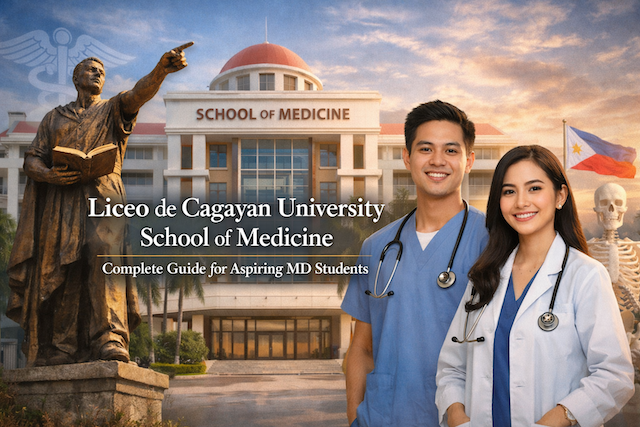
Liceo de Cagayan University School of Medicine: Complete Guide for Aspiring MD Students
Contents
- Liceo de Cagayan University School of Medicine: Complete Guide for Aspiring MD Students
- Overview of Liceo de Cagayan University School of Medicine
- Why Study Medicine in Cagayan de Oro
- Doctor of Medicine (MD) Program Structure in the Philippines
- Curriculum Focus: What You Will Likely Learn
- Clinical Training and Hospital Exposure
- Admissions: Who Can Apply
- Typical Requirements and Documents
- NMAT: How to Prepare Strategically
- Interviews and Screening: What to Expect
- Tuition, Fees, and Budget Planning
- Scholarships and Financial Support
- Student Life and Support Systems
- How to Decide if Liceo School of Medicine Is Right for You
- Practical Preparation Tips Before Starting MD School
- Career Path After Graduation: Licensure and Beyond
- Final Thoughts
- FAQs (Frequently Asked Questions)
- Is Liceo de Cagayan University School of Medicine recognized in the Philippines?
- What are the usual admission requirements for the MD program?
- How important is the NMAT for admission?
- How long does the Doctor of Medicine program take?
- When do students start hospital rotations and clinical exposure?
- What is student life like in Cagayan de Oro for medical students?
- How much should I budget beyond tuition?
- Are there scholarships or financial aid options?
- Can international students apply to Liceo de Cagayan University School of Medicine?
- How do I know if this medical school is the right fit for me?
Liceo de Cagayan University School of Medicine: Complete Guide for Aspiring MD Students
Overview of Liceo de Cagayan University School of Medicine
Liceo de Cagayan University (often called “Liceo”) is a well-known private university in Cagayan de Oro City, Northern Mindanao, Philippines. Its School of Medicine (Doctor of Medicine program) is designed for students who want to pursue clinical training, patient-centered care, and professional practice in the Philippine healthcare system. For many applicants, Liceo offers an appealing option outside Metro Manila because Cagayan de Oro is a major regional hub with a growing medical ecosystem, a diverse patient population, and a cost of living that can be more manageable than larger metropolitan areas.
This guide explains how the MD program is typically structured in the Philippines, what to expect from training in a regional medical school environment, the usual admissions steps and requirements you should prepare, and practical tips for deciding whether Liceo de Cagayan University School of Medicine fits your goals.
Why Study Medicine in Cagayan de Oro
Cagayan de Oro (CDO) is often described as the “City of Golden Friendship,” and it functions as a gateway city for Northern Mindanao. For medical students, studying in a regional center can have real advantages:
- Broad clinical exposure: Regional hospitals and partner facilities often handle a wide range of cases, from primary care to complex referrals.
- Diverse patient population: You may encounter cases from urban districts, nearby provinces, and rural communities, helping you develop adaptable clinical thinking.
- Lower daily expenses: Compared with larger cities, students may find more budget-friendly housing and transportation options (depending on your lifestyle).
- Community-based learning opportunities: Many Philippine medical programs emphasize community medicine, public health, and outreach work, which can be strong in regional settings.
If you are aiming to practice in Mindanao or want clinical experience that includes regional health challenges, training in CDO can be especially relevant.
Doctor of Medicine (MD) Program Structure in the Philippines
While details vary by school, the Philippine MD pathway generally follows a similar format. Most programs are completed in four years after finishing a pre-med bachelor’s degree, followed by postgraduate steps (like internship and licensure) depending on your plans.
- Years 1–2 (Basic Medical Sciences): Focus on foundational subjects such as anatomy, physiology, biochemistry, histology, pathology, pharmacology, microbiology, and related lab work.
- Year 3 (Clinical Sciences / Clerkship Preparation): Transition into clinical subjects such as internal medicine, surgery, pediatrics, obstetrics and gynecology, psychiatry, family and community medicine, and diagnostic disciplines.
- Year 4 (Clinical Clerkship): Hospital-based rotations where students participate in patient care under supervision, develop clinical reasoning, and practice professional skills.
Your learning experience typically combines lectures, small-group discussions, case-based learning, laboratory sessions, skills training (often in simulation or clinical skills labs), and clinical exposure through partner hospitals and clinics.
Curriculum Focus: What You Will Likely Learn
A modern MD curriculum usually aims to build three core areas: knowledge, clinical skills, and professional behavior. At Liceo de Cagayan University School of Medicine, you can generally expect training that supports the following:
- Strong foundation in medical sciences: Understanding how the human body works, what happens in disease, and how therapies interact with physiology.
- Clinical reasoning and diagnosis: Interpreting symptoms, forming differential diagnoses, selecting appropriate tests, and making safe treatment plans.
- Communication and patient-centered care: Interviewing patients, explaining options clearly, and handling sensitive situations with empathy.
- Ethics and professionalism: Respecting patient rights, privacy, informed consent, and clinical responsibility.
- Community medicine and public health: Understanding health systems, prevention, epidemiology basics, and community-oriented practice.
In the Philippine context, community engagement is often an important part of medical education. Students commonly participate in outreach activities, health education, and community-based clinical learning that connects classroom concepts to real public health needs.
Clinical Training and Hospital Exposure
Clinical training is where many students decide whether a school “fits” their learning style. In general, medical schools partner with hospitals and clinics for clerkship rotations. During these rotations, students learn by doing: taking patient histories, performing physical exams, assisting in procedures (as appropriate), presenting cases, and participating in rounds under supervision.
When evaluating Liceo de Cagayan University School of Medicine, focus on the following practical factors:
- Clinical rotation sites: Ask where clerkships take place and what specialties are available during rotations.
- Case volume and variety: More varied cases can strengthen your clinical confidence.
- Supervision and teaching culture: A supportive environment with structured feedback can accelerate growth.
- Scheduling and workload expectations: Clerkship is demanding; understanding the structure helps you prepare mentally and logistically.
A good clinical environment should balance responsibility with safety, ensuring students learn actively while remaining supervised and supported.
Admissions: Who Can Apply
In the Philippines, applicants to an MD program usually need:
- A bachelor’s degree (any course may be accepted, but many students come from biology, nursing, pharmacy, psychology, or related fields).
- NMAT (National Medical Admission Test) score meeting the school’s minimum requirement.
- Academic transcripts and relevant documents.
Some schools may also consider work experience (for non-traditional applicants) and co-curricular involvement, but academics and NMAT performance are typically central.
Typical Requirements and Documents
Exact requirements can change by intake, but applicants commonly prepare the following:
- Completed application form
- Official transcript of records (TOR) and proof of graduation
- NMAT result (official copy)
- Birth certificate or government-issued identification
- Certificate of good moral character
- Recommendation letters (often from professors or supervisors)
- Medical certificate or health clearance (sometimes required later in the process)
- Application fee payment proof (if applicable)
If you are applying as an international student, you may need additional documents such as passport copies, proof of English proficiency (sometimes requested), and student visa-related requirements depending on your status.
NMAT: How to Prepare Strategically
NMAT performance is often a key filter in medical school admissions. To improve your chances:
- Start early: Give yourself at least 6–10 weeks of consistent preparation.
- Know the test format: Practice using timed mock exams to improve pacing.
- Focus on weak areas: Allocate more time to topics where your scores are lowest.
- Build test endurance: The ability to concentrate for long periods matters.
A strong NMAT score can also help you qualify for scholarships or improve your standing in competitive applicant pools.
Interviews and Screening: What to Expect
Many medical schools conduct interviews to assess readiness for medical training. Common interview themes include:
- Motivation for studying medicine
- Understanding of the workload and responsibilities
- Communication skills and maturity
- Ethical thinking and decision-making
- Long-term career goals (clinical practice, specialization, public health, research, etc.)
A good approach is to be honest and specific. Instead of generic answers (“I want to help people”), explain your experiences, what you learned from them, and why medicine is the right path for you.
Tuition, Fees, and Budget Planning
Medical school is a major financial commitment. Beyond tuition, students should plan for:
- Laboratory fees and materials
- Books and digital resources
- Medical instruments (stethoscope, sphygmomanometer, etc.)
- Uniforms and clinical attire
- Transportation and daily living costs
- Board review expenses later in the program
If you are comparing schools, evaluate the total cost across all years, not just the first-year tuition. Also consider your housing options, commute time, and whether you will need additional spending for clinical rotations.
Scholarships and Financial Support
Scholarship availability depends on institutional policies and may vary year to year. In many Philippine medical schools, scholarship support may be offered through:
- Academic merit (high NMAT and strong grades)
- Need-based assistance (subject to documentation)
- External foundations or local government programs
- Service-oriented programs (sometimes linked to return service requirements)
If financial support is important for your decision, it is best to prepare early: keep certified copies of documents, develop a clear budget, and maintain strong academic performance to remain eligible.
Student Life and Support Systems
Medical school is intense, so support systems matter. A healthy environment usually includes:
- Academic advising: Guidance on study strategies, scheduling, and progression.
- Mentorship: Faculty mentors or senior students who help you navigate clinical training.
- Student organizations: Interest groups in specialties, community outreach groups, and leadership opportunities.
- Wellness resources: Counseling, mental health support, and policies that encourage safe learning.
When researching Liceo de Cagayan University School of Medicine, ask about the academic calendar, exam frequency, remediation policies, and how the school supports students who struggle. This information helps you avoid surprises after enrollment.
How to Decide if Liceo School of Medicine Is Right for You
Choosing a medical school is not only about rankings or popularity. It is about fit. Consider these questions:
- Where do you want to practice? If you aim to work in Mindanao or Northern Mindanao, studying in CDO can build relevant networks and local clinical familiarity.
- What learning environment helps you thrive? Some students prefer large institutions; others prefer programs that feel more community-oriented.
- How important is clinical exposure early? Ask about when patient contact begins and how skills training is structured.
- What is your budget and lifestyle? Consider total costs and your personal support system.
- Do you prefer a strong community medicine component? If public health and outreach interest you, evaluate how seriously the program invests in these areas.
If possible, attend an orientation, request a campus visit, or speak with current students and alumni. Their experience can help you understand the real day-to-day culture: how professors teach, how exams are handled, and what clerkship feels like.
Practical Preparation Tips Before Starting MD School
If you plan to enroll, the best preparation is not “memorizing medicine” early, but building habits that will support you long-term:
- Improve study systems: Learn active recall, spaced repetition, and efficient note-taking.
- Strengthen foundational sciences: Basic anatomy and physiology familiarity helps you ramp up faster.
- Upgrade communication skills: Medicine requires clear patient communication and teamwork.
- Manage time and health: Sleep, exercise, and stress management are not optional in medical training.
- Organize documents early: Keep multiple certified copies of requirements and digital backups.
Medical school becomes more manageable when you enter with strong routines, realistic expectations, and a willingness to ask for help when needed.
Career Path After Graduation: Licensure and Beyond
After completing the MD program, graduates in the Philippines typically pursue licensure through the Physician Licensure Examination (PLE). Many also complete internship requirements and proceed to residency training if they want to specialize (e.g., internal medicine, surgery, pediatrics, OB-GYN, family medicine, radiology, and more).
Your medical school experience will influence how ready you feel for the PLE and residency. Look for a program that provides consistent assessment, solid clinical supervision, and opportunities to develop your professional identity early.
Final Thoughts
Liceo de Cagayan University School of Medicine can be a strong option for students who want to study medicine in Cagayan de Oro and develop clinical competence in a regional healthcare environment. The best way to evaluate the school is to look beyond the name and examine practical details: curriculum approach, clinical training sites, student support, and total costs. If those align with your goals, learning style, and long-term plan, Liceo may be a meaningful stepping stone toward becoming a physician in the Philippines.
FAQs (Frequently Asked Questions)
Is Liceo de Cagayan University School of Medicine recognized in the Philippines?
Liceo de Cagayan University School of Medicine operates within the Philippine medical education system and follows the national framework required for Doctor of Medicine (MD) programs. In the Philippines, the key practical point for students is whether graduates can proceed toward licensure. In general, graduates from recognized medical programs pursue the usual pathway that includes completing required clinical training and taking the Physician Licensure Examination (PLE). If you are verifying recognition for a specific purpose (employment, immigration, residency abroad, scholarship, or credit evaluation), confirm the school’s current status through official Philippine education and regulatory sources and request written confirmation from the admissions office to match your intended use.
What are the usual admission requirements for the MD program?
Most Philippine medical schools require a completed bachelor’s degree and an NMAT (National Medical Admission Test) score that meets the institution’s minimum percentile rank. You should also expect to submit academic transcripts (TOR), proof of graduation, identification documents, and a certificate of good moral character. Some applicants may be asked for recommendation letters, a medical certificate, and other supporting documents depending on the school’s screening process. Because requirements can change by intake period, it is smart to prepare a complete document folder early and keep both printed and digital copies, especially if you are applying from outside Cagayan de Oro or from overseas.
How important is the NMAT for admission?
The NMAT is typically one of the most important components of a Philippine medical school application because it provides a standardized measure alongside your university grades. A higher NMAT score can strengthen your application and may help you compete for limited slots or qualify for merit-based financial support when available. If your NMAT score is close to the minimum requirement, other strengths—such as strong academic records, relevant healthcare exposure, or an excellent interview—may still help, but you should treat the NMAT as a priority. Many applicants prepare through timed practice tests, targeted review of weak areas, and consistent study over several weeks.
How long does the Doctor of Medicine program take?
In the Philippines, the MD program is commonly structured as a four-year professional program after completion of a bachelor’s degree. The first half usually focuses on basic medical sciences, while later years transition into clinical sciences and hospital-based clerkship rotations. After graduation, students typically proceed to the next steps required for licensure and clinical practice, which can include internship requirements and the Physician Licensure Examination (PLE). Timelines can vary depending on academic progression, institutional scheduling, and the student’s chosen pathway after graduation.
When do students start hospital rotations and clinical exposure?
Clinical exposure generally increases as you progress through the program. Many students begin with early skills training (such as history-taking, physical examination practice, and simulation-based learning) before moving into more direct patient contact. Hospital clerkship is typically a major component of the later years, where students rotate through core departments such as internal medicine, surgery, pediatrics, obstetrics and gynecology, and other required areas. To understand what your experience will look like at Liceo, ask about the school’s rotation sites, supervision structure, case exposure, and how performance is evaluated during clinical training.
What is student life like in Cagayan de Oro for medical students?
Medical school schedules are demanding anywhere, but studying in Cagayan de Oro can offer a balanced environment for students who want city conveniences without the intensity and cost of larger metropolitan areas. Many students choose housing based on commute time, safety, and access to food and daily necessities. Your routine may revolve around lectures, labs, study groups, and clinical requirements, so proximity to campus and rotation sites can matter more than “lifestyle” factors. Students who thrive usually build a support system—friends, mentors, and healthy routines—to manage the pace of exams and clinical responsibilities.
How much should I budget beyond tuition?
Beyond tuition and standard school fees, medical students should plan for recurring academic and clinical expenses. These can include books and digital subscriptions, laboratory materials, printing and supplies, uniforms or clinical attire, and essential instruments like a stethoscope. Transportation costs may increase during clerkship if rotation sites are farther from your housing. It is also wise to reserve funds for unexpected requirements such as additional medical clearances, extracurricular training, or review resources. A practical approach is to create a monthly budget and an annual “buffer fund” so you are not forced to compromise your studies due to financial surprises.
Are there scholarships or financial aid options?
Scholarships and financial support vary by institution and year. Many medical schools offer some form of assistance based on academic merit, financial need, or external sponsorship. In some cases, local government programs or foundations may support students, sometimes with service commitments after graduation. If financial aid is important to your decision, ask the admissions office for the most current list of scholarship types, eligibility requirements, deadlines, and renewal conditions. Also clarify whether scholarships cover partial tuition, full tuition, or selected fees only, so you can plan accurately.
Can international students apply to Liceo de Cagayan University School of Medicine?
International applicants may be accepted depending on the school’s policies and Philippine immigration and education requirements. International students often need additional documentation such as a valid passport, authenticated academic records, and visa-related paperwork. Some applicants may also be asked for proof of English ability or other documents depending on their background. If you are applying from abroad, start early because document authentication and processing can take time. You should also confirm how clinical training, hospital exposure, and post-graduation licensure steps would work for your nationality and long-term career plan.
How do I know if this medical school is the right fit for me?
A good fit depends on your learning style, budget, location preference, and professional goals. Ask about curriculum approach, exam frequency, remediation policies, student support, and the quality of clinical supervision. If possible, speak with current students or alumni to understand the daily reality of workload, teaching style, and clerkship expectations. Also consider your long-term plan: where you want to practice, whether you intend to specialize, and what kind of clinical environment you learn best in. When your goals align with the program’s structure and support systems, you are more likely to succeed.
Complete List of Medical Schools in the Philippines (All 78 MD Programs)
Best Medical Schools in the Philippines (Local & International Rankings)
Recommend
2026年1月23日
Sultan Kudarat State University College of Medicine: Complete Guide for Aspiring MD Students
2026年1月23日
University of Southern Mindanao College of Medicine: Complete Guide for Aspiring MD Students
2026年1月23日
Mindanao State University – General Santos College of Medicine: Complete Guide for Future MD Students

How to Register for eTravel Philippines (2025 Guide)
Step-by-step guide to completing your eTravel registration before arriving in the Philippines, with images and tips.

Night Market in Cebu – Things You Don’t Know About Cebu Life
Discover the hidden charm of Cebu’s night markets, from street food stalls to local life tips you won’t find in tourist guides.

How to Use ChatGPT for IELTS Preparation: A Complete Guide
Learn how to prepare for IELTS using ChatGPT — including strategies for Writing, Reading, Listening, Speaking, and grammar support.

How to Build a Website Without Coding Using ChatGPT
Discover how to build your own website using AI—no coding skills needed. From structure planning to SEO and design, let ChatGPT guide you.