2026年1月23日
3D ACADEMY offers affordable English study programs in Cebu, Philippines – perfect for beginners, professionals, and exam takers.

3D UNIVERSAL ENGLISH INSTITUTE INC
info.3d-universal.com
8:00-17:00(Mon-Fri)
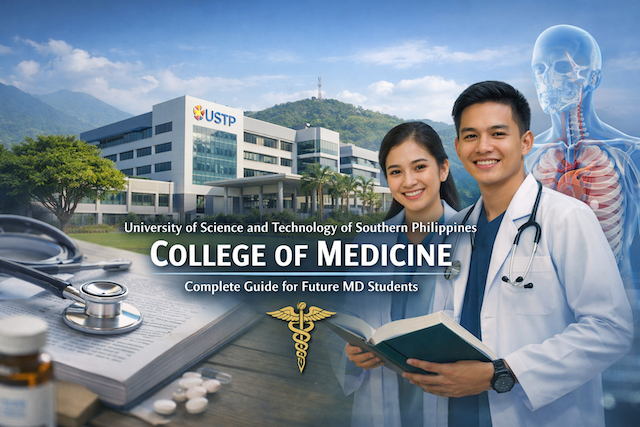
University of Science and Technology of Southern Philippines (USTP) College of Medicine: Complete Guide for Future MD Students
Contents
- University of Science and Technology of Southern Philippines (USTP) College of Medicine: Complete Guide for Future MD Students
- Quick Overview
- Why USTP Opened a College of Medicine
- Vision, Mission, and What the School Is Trying to Produce
- MD Curriculum Structure and Teaching Style
- Learning Activities You Should Expect
- Assessment and Grading: How Performance Is Measured
- Program Outline: What You Study Each Year
- Admissions Requirements: Who Can Apply
- Application Process: A Typical Step-by-Step Flow
- Scholarships and “Doktor Para sa Bayan” Priorities
- Clinical Training and Partner Hospitals
- Research and Community Orientation
- How to Be a Strong Applicant
- Who USTP College of Medicine Is Best For
- Final Thoughts
- FAQs (Frequently Asked Questions)
- Is USTP College of Medicine a good choice for students who want to become doctors in Mindanao?
- What program does USTP College of Medicine offer?
- What is the “spiral” or SPIRAL learning model, and why does it matter in medical school?
- Does USTP use problem-based learning (PBL) and small-group discussions?
- What are the basic admissions requirements for USTP College of Medicine?
- Is NMAT required, and what score should I aim for?
- How important is the interview, and what do interviewers usually look for?
- Does USTP prioritize students under “Doktor Para sa Bayan” or similar public-service frameworks?
- What is the curriculum like in the first three years?
- What happens during the fourth year of medical school at USTP?
- How are students assessed—are there exams, practical evaluations, and portfolios?
- What study habits help students succeed in an integrated, community-oriented medical school?
- Where can I find the most accurate and updated admissions details?
University of Science and Technology of Southern Philippines (USTP) College of Medicine: Complete Guide for Future MD Students
The University of Science and Technology of Southern Philippines (USTP) College of Medicine in Cagayan de Oro City is one of the newer state-university medical schools in the Philippines, created with a clear public-health mission: train competent physicians and strengthen healthcare access—especially for communities that are underserved. If you’re an aspiring Doctor of Medicine (MD) student who wants an education designed around community impact, evidence-based learning, and strong academic structure, USTP College of Medicine is worth a serious look.
This guide explains what makes the program distinct, how the MD curriculum is structured, how admissions typically work, and what you should prepare to become a competitive applicant.
Quick Overview
USTP’s College of Medicine was conceived in response to long-term public health needs highlighted by the COVID-19 pandemic, with an emphasis on producing physicians who can serve communities effectively. The college is based in USTP Cagayan de Oro (CDO), a strategic location in Northern Mindanao where demand for healthcare professionals remains high.
- Location: USTP Cagayan de Oro City, Northern Mindanao
- Program: Doctor of Medicine (MD)
- Approach: Integrated and community-oriented, with spiral learning and structured clinical clerkship
- Admissions focus: NMAT + academic performance + interview
Why USTP Opened a College of Medicine
USTP established its College of Medicine to help address a practical challenge: regions need more doctors, and state-university medical education can widen access for qualified students who may not have the resources for private medical schools. USTP’s rationale also reflects the reality of Cagayan de Oro as a major regional hub—densely populated, fast-growing, and positioned as a gateway to Northern Mindanao. In this environment, developing a steady pipeline of physicians is not only an academic goal, but also a community necessity.
USTP also built its reputation over the years in science and technology fields, and the College of Medicine is designed to leverage that strength—producing future physicians with solid scientific grounding, research orientation, and a practical mindset toward systems and community health.
Vision, Mission, and What the School Is Trying to Produce
USTP College of Medicine’s identity is strongly defined by its vision and mission. In simple terms, the college aims to train medical scholars who connect healthcare with the community, and who can deliver quality care for populations that need it most.
Its goals commonly emphasize the following outcomes for students:
- Competent clinical practice: Knowledge, skills, and values aligned with professional, legal, and ethical standards
- Research capability: Ability to evaluate evidence and conduct ethical research to advance medicine
- Strong clinical learning environments: Networking with partner institutions and hospitals
- Community-oriented practice: Culturally sensitive programs focused on primary healthcare needs
- Lifelong learning: Continuous growth to keep up with advances in medicine and patient safety
In practice, this means you should expect a program that blends classroom learning with real-world context—where medical knowledge is repeatedly linked back to patient care, community realities, professionalism, and evidence-based decision-making.
MD Curriculum Structure and Teaching Style
USTP describes its medical curriculum as integrated, using both horizontal and vertical integration:
- Horizontal integration (early phase): Basic sciences are taught alongside clinical applications so concepts don’t remain purely theoretical.
- Vertical integration (middle years): Clinical sciences are taught with continuing review of foundational sciences, plus training in communication, ethics, professionalism, and population health.
- Clinical clerkship (fourth year): Hands-on hospital rotations where students apply knowledge and skills in real care settings.
A major feature is the SPIRAL Model, where topics are revisited over time at increasing levels of complexity. Instead of learning a topic once and moving on permanently, you repeatedly return to concepts with deeper clinical relevance as you progress. This can be helpful for long-term retention and for building clinical reasoning.
USTP also aligns its learning strategies with the SPICES Model:
- Student-centered
- Problem-based / case-based
- Integrated / interprofessional
- Community-oriented
- Elective-driven
- Systematic
So if you learn best through active reading, case discussions, group problem-solving, and guided self-study (not just passive lectures), you may find the structure a strong fit.
Learning Activities You Should Expect
Based on how the program describes its teaching methods, students can expect a mix of structured learning formats, including:
- Problem-based learning (PBL) modules using study guides
- Small-group discussions (which may include online discussions depending on logistics)
- Flipped classroom sessions where preparation happens before class and class time is used for application
- Laboratory sessions (virtual or in-person as needed)
- Concept mapping to organize and connect topics
- Reflection writing to strengthen professional formation
- Mentoring to support progress and accountability
This style tends to reward students who can manage their time well, prepare consistently, and participate actively. If you prefer to “cram” right before exams, an integrated PBL-heavy approach can be challenging—so it helps to build steady study habits early.
Assessment and Grading: How Performance Is Measured
USTP’s College of Medicine emphasizes that assessments are aligned with outcomes and teaching activities. Evaluation may include both formative and summative methods:
- Formative assessments: Frequent checks like quizzes and mentor feedback to identify learning gaps early
- Summative assessments: Major examinations given at the end of modules
- Structured exam design: Test blueprints and item construction standards
- Rubrics: Used for essays and skills assessments
- Portfolios: Collection of reflections and evidence of progress, reviewed periodically and assessed before final exams
Portfolio-based learning is especially important because it trains self-reflection, professionalism, and continuous improvement—skills that matter in clerkship and beyond.
Program Outline: What You Study Each Year
USTP’s prospectus shows a structured progression across the four-year program. While exact details may evolve, the broad framework typically looks like this:
- First year: Integrated Basic Sciences, Medical Humanities, Research, and Electives
- Second year: Integrated Clinical Sciences 1, Medical Humanities 2, Research 2, Electives 2
- Third year: Integrated Clinical Sciences 2, Medical Humanities 3, Research 3, Electives 3
- Fourth year: Clinical clerkship rotations across major medical specialties
Clerkship rotations include major fields commonly expected in Philippine medical education, such as Internal Medicine (with related subspecialties), Surgery (and surgical subspecialties), Obstetrics and Gynecology, Pediatrics, Preventive/Community Medicine, Family Medicine, Radiology, Neurology/Psychiatry/Rehabilitation, ENT/Ophthalmology, and Pathology. This is the year where students move from primarily classroom-based learning into daily clinical responsibilities within the training environment.
Admissions Requirements: Who Can Apply
USTP College of Medicine follows a selective admissions process. Requirements can change across application cycles, but based on published criteria, common baseline requirements include:
- Citizenship and residency: Filipino citizen living in the Philippines (with PSA-authenticated birth certificate)
- Age requirement: Typically within a specific age range at the time of application
- Degree requirement: Holder of a bachelor’s degree recognized by CHED (often with a recency condition)
- NMAT requirement: A competitive NMAT percentile score (USTP indicates a high cutoff)
- Academic requirement: Strong General Weighted Average (GWA), often computed using specified subjects
- Interview: Must pass a panel interview conducted by the admissions committee
Applicants are commonly evaluated using a weighted system combining NMAT, GWA, and interview performance. This means you can’t rely on only one strength—you want to be solid across all three areas.
Application Process: A Typical Step-by-Step Flow
USTP outlines an application flow that usually includes an initial online submission, document evaluation, interview, and final approval steps. A common sequence is:
- Online application and upload of initial documents (often including transcript, NMAT results, and CV)
- Evaluation of initial documents
- In-person interview with the admissions committee
- Submission of complete documentary requirements (certified copies, GWA certificate, good moral character, IDs, PSA birth certificate, etc.)
- Final evaluation and approvals by college leadership
- Enrollment for accepted applicants
Because processes vary by year, treat the above as the “usual structure,” and always verify the exact checklist and deadlines for the current intake.
Scholarships and “Doktor Para sa Bayan” Priorities
USTP College of Medicine strongly aligns with national goals of producing doctors who can serve underserved areas. In admissions and selection, the program indicates that deserving students (as defined under the “Doktor Para sa Bayan” framework) may be prioritized. In practical terms, applicants who demonstrate both strong academic capability and a genuine intent to serve communities—especially those with limited access to healthcare—may be well-aligned with the school’s mission.
If you are aiming for scholarships or priority considerations, prepare evidence that you can succeed academically and that you have a clear service-oriented plan. This can include community involvement, volunteer experience, public health exposure, or a credible long-term commitment to return service.
Clinical Training and Partner Hospitals
Clinical clerkship is where medical school becomes real. USTP’s program indicates that the fourth year is dedicated to clerkship, where students rotate across specialties and participate as members of the healthcare team. You should expect hospital-based training that builds your ability to:
- Take patient histories and perform physical examinations
- Present cases clearly and professionally
- Develop differential diagnoses and management plans under supervision
- Work effectively with nurses, residents, consultants, and allied health staff
- Follow safety protocols and professional standards consistently
Clerkship is demanding, but it is also the most professionally transformative year. The better your foundation in the first three years, the more confident and capable you’ll feel during rotations.
Research and Community Orientation
USTP integrates research across multiple years, not as a one-time requirement, but as a developmental pathway. Research training supports critical appraisal skills—helping you evaluate studies, apply evidence responsibly, and contribute to improvements in healthcare delivery. Combined with the college’s community orientation, this creates an ideal framework for students interested in:
- Public health and population health solutions
- Community-based interventions
- Clinical research and outcomes studies
- Health systems improvement
Even if you do not plan to become a full-time researcher, the ability to interpret evidence is essential for modern medical practice.
How to Be a Strong Applicant
Because USTP uses a selective admissions approach, here are practical ways to improve your competitiveness:
- Raise your NMAT percentile: Plan early, take diagnostic exams, and allocate consistent study time.
- Strengthen your academic record: If your GWA is close to a cutoff, consider additional credentials or academic proof of readiness.
- Prepare for the interview: Be ready to explain why medicine, why USTP, and how you align with community-oriented healthcare.
- Build service credibility: Meaningful community work is stronger than “one-day volunteering.” Consistency matters.
- Organize documents early: Certification, official copies, and PSA documents can take time to secure.
During interviews, schools often look for maturity, professionalism, and resilience. If you can communicate your motivations clearly and show that you understand the realities of medical training (including workload and responsibility), you will stand out.
Who USTP College of Medicine Is Best For
USTP College of Medicine may be an especially strong fit if you are:
- Mission-driven and interested in community-oriented practice
- Comfortable with integrated and problem-based learning formats
- Interested in research skills as part of your medical foundation
- Open to clerkship environments that demand teamwork and professionalism
- Focused on becoming a physician who can serve beyond major city centers
It may be less ideal if you strongly prefer purely lecture-based learning with minimal group work, or if you struggle with self-directed study. However, many students adapt successfully once they commit to a consistent routine and active participation.
Final Thoughts
The University of Science and Technology of Southern Philippines College of Medicine is designed to produce physicians who can think critically, learn continuously, and serve communities with competence and compassion. Its integrated curriculum, spiral learning structure, and strong emphasis on professionalism and population health make it a compelling option—particularly for students who want a medical education grounded in real-world needs.
If USTP’s mission aligns with your goals, your next best step is to track the latest application announcements, review the current admissions checklist, and prepare early—especially for NMAT and interview readiness. With the right preparation, USTP College of Medicine can be a strong pathway toward becoming the kind of doctor the Philippines urgently needs.
FAQs (Frequently Asked Questions)
Is USTP College of Medicine a good choice for students who want to become doctors in Mindanao?
Yes—USTP College of Medicine is designed with regional health needs in mind, especially for Northern Mindanao and nearby areas. Its community-oriented approach and emphasis on primary healthcare can be a strong fit if you plan to practice in Mindanao after graduation. Many applicants are attracted to the school’s public-service direction, research training, and integrated learning design. However, “good” also depends on your learning style. If you prefer active participation, case discussions, and structured self-study rather than purely lecture-based learning, you may adapt well to the program.
What program does USTP College of Medicine offer?
USTP College of Medicine offers the Doctor of Medicine (MD) program. The MD program typically follows the standard Philippine medical education timeline: three years of integrated academic and clinical science learning, followed by a fourth year dedicated to clinical clerkship rotations. The school highlights integrated learning and spiral progression, meaning key concepts are revisited over time at deeper levels of clinical complexity.
What is the “spiral” or SPIRAL learning model, and why does it matter in medical school?
A spiral model means you don’t study a topic once and leave it behind. Instead, you revisit important concepts multiple times throughout the program, and each time you return, the topic becomes more clinically advanced. For example, a first-year understanding of physiology may later be revisited through internal medicine cases, diagnostics, and treatment planning. This approach supports long-term retention and clinical reasoning because you keep connecting theory to actual patient care scenarios as your knowledge grows.
Does USTP use problem-based learning (PBL) and small-group discussions?
USTP’s College of Medicine describes learning methods that commonly include problem-based or case-based modules, small-group discussions, and guided self-directed learning. In these formats, you are expected to prepare, participate, and learn actively with your group. Students who thrive usually have consistent study habits and are comfortable asking questions, presenting ideas, and learning from feedback. If you are new to PBL, the adjustment period is normal, and the key is to treat preparation as a daily routine rather than an occasional task.
What are the basic admissions requirements for USTP College of Medicine?
Admissions requirements can change depending on the intake year, but applicants generally need a recognized bachelor’s degree, a competitive NMAT score, and strong academic performance. There is also typically an interview stage. Some application cycles include additional conditions such as citizenship/residency requirements and document authentication. Because the school may update cutoffs and document checklists, applicants should verify the official admissions announcement for the current year before finalizing their submission.
Is NMAT required, and what score should I aim for?
Yes, the NMAT is generally required for Philippine medical school admissions, and USTP indicates a competitive percentile requirement. If you want to maximize your chances, aim higher than the minimum cutoff rather than targeting the bare minimum. A strong NMAT score is also helpful because selection often considers NMAT alongside GWA and interview performance. If your undergraduate grades are not perfect, a higher NMAT percentile can strengthen your overall profile.
How important is the interview, and what do interviewers usually look for?
The interview is very important because it helps the school assess qualities that grades and test scores cannot fully show. Interviewers often look for maturity, professionalism, communication skills, ethical judgment, resilience, and clear motivation for studying medicine. For a mission-driven program, they may also pay attention to your willingness to serve communities, your understanding of medical training demands, and your long-term plans. A practical way to prepare is to practice explaining your “why medicine,” “why this school,” and “how you handle pressure” in clear, specific examples.
Does USTP prioritize students under “Doktor Para sa Bayan” or similar public-service frameworks?
USTP’s College of Medicine aligns with public-service goals and may prioritize deserving students who match “Doktor Para sa Bayan” directions, depending on how the school implements the policy in a given year. In general, mission alignment matters: students who demonstrate both academic readiness and a credible intention to serve underserved communities may be more aligned with the program’s purpose. If you are applying under service-oriented priorities, include meaningful evidence of community involvement, leadership, and commitment rather than superficial participation.
What is the curriculum like in the first three years?
The first three years are commonly described as integrated learning that combines basic sciences, clinical sciences, medical humanities, research, and electives. “Integrated” means subjects are connected rather than taught as isolated silos. You may study anatomy and physiology while also learning how those concepts relate to patient cases, communication skills, and ethical issues. Research training is typically distributed across multiple years so students progressively develop competence in evidence-based medicine and scientific thinking.
What happens during the fourth year of medical school at USTP?
The fourth year is usually dedicated to clinical clerkship. Students rotate through major hospital departments such as internal medicine, surgery, pediatrics, obstetrics and gynecology, community or preventive medicine, and other required areas. Clerkship is where students develop practical clinical habits: history taking, physical examinations, case presentations, teamwork, and professionalism. It is also physically demanding, often requiring early schedules and long days, so preparation in time management and personal discipline is essential.
How are students assessed—are there exams, practical evaluations, and portfolios?
USTP’s approach commonly includes both formative and summative assessments. Formative assessments help you identify learning gaps early through quizzes, feedback, and mentor input. Summative exams evaluate your mastery at the end of modules. Skills may be assessed using rubrics and structured practical evaluations. Some programs also require portfolios that include reflections and evidence of learning progress. If portfolios are part of the system, treat them seriously—regular reflection and documentation can improve your performance and show professionalism.
What study habits help students succeed in an integrated, community-oriented medical school?
Consistency is the biggest advantage. Build a daily routine that includes pre-reading for group sessions, active recall (practice questions, flashcards, or self-quizzing), and weekly review to connect concepts across subjects. Because integrated programs revisit topics repeatedly, it helps to keep organized notes that link anatomy, physiology, pathology, and clinical management. Also, take mentoring and feedback seriously—students who improve fastest are those who accept correction and adjust early rather than waiting until major exams.
Where can I find the most accurate and updated admissions details?
The most accurate information will always come from USTP’s official announcements and the College of Medicine’s admissions posts for the current intake year. Medical school requirements can change—cutoffs, deadlines, and document lists may be updated—so avoid relying only on older summaries. If you are preparing early, it’s still helpful to gather documents and plan NMAT timing in advance, but confirm the final checklist and timeline before submitting your application.
Complete List of Medical Schools in the Philippines (All 78 MD Programs)
Best Medical Schools in the Philippines (Local & International Rankings)
Recommend
2026年1月23日
Sultan Kudarat State University College of Medicine: Complete Guide for Aspiring MD Students
2026年1月23日
University of Southern Mindanao College of Medicine: Complete Guide for Aspiring MD Students
2026年1月23日
Mindanao State University – General Santos College of Medicine: Complete Guide for Future MD Students

How to Register for eTravel Philippines (2025 Guide)
Step-by-step guide to completing your eTravel registration before arriving in the Philippines, with images and tips.

Night Market in Cebu – Things You Don’t Know About Cebu Life
Discover the hidden charm of Cebu’s night markets, from street food stalls to local life tips you won’t find in tourist guides.

How to Use ChatGPT for IELTS Preparation: A Complete Guide
Learn how to prepare for IELTS using ChatGPT — including strategies for Writing, Reading, Listening, Speaking, and grammar support.

How to Build a Website Without Coding Using ChatGPT
Discover how to build your own website using AI—no coding skills needed. From structure planning to SEO and design, let ChatGPT guide you.