2026年1月9日
3D ACADEMY offers affordable English study programs in Cebu, Philippines – perfect for beginners, professionals, and exam takers.

3D UNIVERSAL ENGLISH INSTITUTE INC
info.3d-universal.com
8:00-17:00(Mon-Fri)
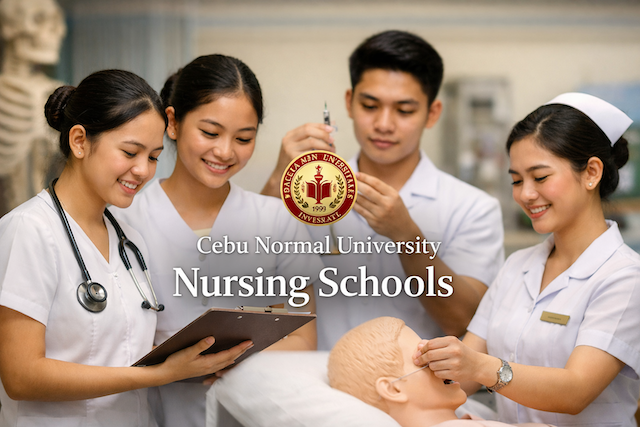
Cebu Normal University (CNU): Nursing Schools
Contents
- Cebu Normal University (CNU): Nursing Schools
- Overview of Cebu Normal University as a Nursing Institution
- History and Reputation of CNU Nursing
- The College of Nursing and Allied Health Sciences
- Nursing Programs Offered at CNU
- Curriculum Structure and What Students Usually Learn
- Clinical Training and Hospital Partnerships
- Facilities, Skills Labs, and Student Support
- Admissions and What Competitive Applicants Should Prepare For
- Tuition, Fees, and Financial Considerations
- Student Life, Culture, and the Reality of Nursing Training
- Career Outcomes and Opportunities After Graduation
- Practical Tips for Future CNU Nursing Students
- How CNU Compares With Other Nursing Schools in Cebu
- Bottom Line: Is CNU a Good Choice for Nursing?
- FAQs (Frequently Asked Questions)
- Is Cebu Normal University (CNU) a good choice for studying nursing?
- What nursing program is offered at CNU?
- How competitive is admission to CNU Nursing?
- What should I prepare before applying to CNU Nursing?
- What is clinical training like in a program such as CNU Nursing?
- Does CNU Nursing provide skills labs or simulation training?
- How much does it cost to study nursing at CNU?
- How can I succeed academically in a rigorous nursing environment?
- Is nursing at CNU only about passing the licensure exam?
- What career paths are possible after graduating from CNU Nursing?
- What is the best way to compare CNU Nursing with other nursing schools in Cebu?
Cebu Normal University (CNU): Nursing Schools
Overview of Cebu Normal University as a Nursing Institution
Cebu Normal University (CNU) is widely recognized as one of the Philippines’ most respected public universities for nursing education. While CNU’s historical identity is strongly connected to teacher education, its nursing programs have grown into a flagship strength—known for academic rigor, selective admissions, strong clinical exposure, and a culture that emphasizes discipline and professional readiness.
CNU’s nursing school is often discussed as a “training-ground” environment: structured learning, strong faculty guidance, and high expectations. For students who want a serious, competency-based nursing education—especially those aiming for licensure success and hospital readiness—CNU is frequently considered a top option in Cebu and beyond.
CNU is located along Osmeña Boulevard in Cebu City, placing it near major hospitals, government institutions, and commercial centers. This location is not just convenient; it supports clinical education because students benefit from access to high-volume healthcare environments and community settings where public health and nursing fundamentals are continuously practiced.
History and Reputation of CNU Nursing
CNU’s nursing college traces its formal establishment to the early 1980s, when the university strengthened its role in producing healthcare professionals through structured academic development and clinical partnerships. Over time, the nursing program became deeply associated with CNU’s institutional brand—serious training, strong board performance reputation, and a consistent pipeline of graduates who pursue hospital careers, community health work, and international opportunities.
A key element behind CNU’s reputation is its relationship with large public medical centers, where patient diversity and case exposure can be extensive. In many nursing schools, students worry about limited clinical cases, restricted ward access, or observational-only rotations. CNU’s training environment has historically been shaped to emphasize hands-on learning within supervised clinical frameworks.
Reputation matters in nursing because clinical supervisors, hospitals, and even fellow professionals often have expectations tied to the school a graduate came from. While an individual nurse’s competence ultimately matters most, graduating from a school with a strong training image can help during early career stages—especially for internships, entry-level hospital roles, and competitive training programs.
The College of Nursing and Allied Health Sciences
CNU’s nursing education is typically organized under a dedicated nursing college (often associated with allied health functions and extensions). This structure matters because it indicates the institution treats nursing as a specialized professional field, not simply a general academic department. In practical terms, this often means:
-
Nursing-focused faculty development and governance
-
Dedicated skills laboratories and simulation resources
-
Structured clinical placement coordination
-
Clear professional outcomes orientation (licensure and clinical readiness)
For students and parents, the best sign of a “real” nursing school is how well it integrates theory, skills, and clinical practice—not just classroom instruction. CNU’s reputation has been built around this integration.
Nursing Programs Offered at CNU
The core undergraduate pathway is typically the Bachelor of Science in Nursing (BSN). In the Philippines, BSN is the standard pre-licensure degree that prepares students for the Nurse Licensure Examination (NLE) and entry into professional nursing practice.
While specific program structures can evolve, a strong nursing school generally offers:
-
A comprehensive BSN curriculum aligned with national nursing education standards
-
Sequenced clinical exposure (from basic skills to advanced hospital rotations)
-
Community health nursing components
-
Leadership and management training for senior-level students
-
Research, evidence-based practice, and communication training
If you’re evaluating CNU or comparing it with other nursing schools in Cebu, don’t focus only on the program name (because most schools offer “BSN”). Instead, compare the training environment: clinical rotation quality, skills lab standards, and the school’s culture of discipline and performance.
Curriculum Structure and What Students Usually Learn
A BSN curriculum in a top nursing school typically follows a progression that moves from foundations to specialization and leadership. While course titles differ, students generally experience a pathway like this:
-
Foundational sciences and health concepts
Students begin with anatomy, physiology, microbiology, basic pharmacology concepts, and introductory nursing theories. These subjects build the scientific thinking that later supports clinical decision-making. -
Core nursing skills and patient care fundamentals
Skills training usually covers vital signs, basic assessments, documentation, infection prevention, therapeutic communication, safe medication principles, and foundational bedside procedures—supported by return demonstrations and structured evaluations. -
Medical-surgical nursing and hospital exposure
As students advance, they enter heavier clinical domains such as adult health nursing, maternal and child nursing, pediatric nursing, mental health nursing, and emergency-related concepts. Clinical placement becomes more intensive, and expectations for competence rise. -
Community and public health nursing
A major strength of nursing education in the Philippines is its public health component. Students often engage in community assessments, health education projects, barangay health activities, and preventive care strategies—important for real-world nursing where community context affects outcomes. -
Leadership, research, and professional readiness
Senior-level nursing training usually includes leadership and management, nursing research methods, evidence-based practice, ethics, and preparation for professional roles. Students may also experience integrated review and readiness assessment activities that support NLE preparation.
The key point: the value of the curriculum depends heavily on execution. CNU is often associated with strict standards and structured evaluations, which can be challenging—but that challenge is also what many graduates credit for their readiness.
Clinical Training and Hospital Partnerships
Clinical training is the heart of nursing education. Students often choose a nursing school based on a simple question: “Where will I train, and how much real experience will I get?”
CNU nursing has historically been associated with clinical exposure in major hospital settings, including large public medical centers. Public hospitals can provide a wide range of cases, high patient volume, and exposure to complex conditions—valuable for developing assessment skills, prioritization, and confidence under pressure.
In a strong clinical program, students can expect rotations or exposure in areas such as:
-
Medical-surgical wards
-
Emergency and urgent care settings
-
Maternal and newborn units
-
Pediatrics and child health environments
-
Mental health settings
-
Community health and primary care contexts
-
Operating room or perioperative observations (varies by school and partner site)
A good nursing school also focuses on clinical supervision quality. The ideal setup includes:
-
Clear clinical objectives for each rotation
-
Clinical instructors who actively mentor, not just monitor
-
Skills checklists and competency validations
-
Professional behavior standards (communication, teamwork, documentation)
Students who thrive in CNU-like environments are those who accept structure, show consistency, and take feedback seriously.
Facilities, Skills Labs, and Student Support
Modern nursing education requires more than classrooms. Skills laboratories and simulation training help students develop competence before dealing with real patients. Even if a school has strong hospital access, students still need structured practice in:
-
Basic nursing procedures (hand hygiene, PPE, patient positioning)
-
Physical assessment and documentation
-
Medication administration principles and safety
-
Patient communication scenarios
-
Emergency response basics and prioritization drills
In a strong program, labs are not just “tour showcases.” They are used repeatedly for competency testing, practical exams, and remedial training for students who need more practice.
Student support also matters. Nursing can be emotionally intense and academically demanding. Useful support structures may include:
-
Academic advising and faculty consultation
-
Study groups and peer mentoring
-
Skills remediation sessions
-
Clear policies for clinical performance improvement
-
Mental health support access (varies across institutions)
If you’re applying to CNU nursing, assume the workload is real. The best strategy is to prepare early, build routines, and treat nursing school like professional training—not just a degree.
Admissions and What Competitive Applicants Should Prepare For
CNU is a public university, and its strong reputation can make nursing admission competitive. While exact requirements can change by academic year, competitive nursing admissions typically involve:
-
Academic screening (grades, especially in science and English)
-
University entrance testing or standardized admissions procedures
-
Document requirements (records, forms, identification)
-
Possible interviews or additional screening steps (varies by institution and year)
To prepare as an applicant, focus on these practical steps:
-
Strengthen your science fundamentals early
Anatomy and physiology concepts become easier when you already have a habit of science study. Even basic reading habits help. -
Improve English comprehension and communication
Nursing education and documentation often use English. Strong reading comprehension helps in exams, case studies, and clinical paperwork. -
Develop discipline and consistency
Nursing school is not only about intelligence; it’s about routine performance: showing up prepared, meeting deadlines, and staying stable under stress. -
Ask smart questions during inquiry
Instead of asking only “How much is tuition?” ask:
“How are clinical rotations assigned?”
“How is performance evaluated in duty?”
“What happens if a student needs remediation?”
“What support exists for board preparation?”
Tuition, Fees, and Financial Considerations
As a state university, CNU is generally viewed as more affordable than many private nursing schools, though students should still budget carefully. Nursing education often involves additional costs beyond basic tuition, such as:
-
Uniforms and clinical duty shoes
-
Supplies and equipment (stethoscope, BP apparatus in some cases, basic kits)
-
Books or digital resources
-
Transportation for clinical/community duties
-
Miscellaneous school and laboratory fees
-
Review materials (especially in senior year)
For many families, the advantage of a strong public nursing school is cost-to-quality value. If you can enter and you can handle the rigor, you may receive training comparable to top private programs—sometimes with a more intense public-hospital exposure environment.
Students should also explore scholarships, grants, and local government support programs when available. In the Philippines, scholarship opportunities can come from national government programs, local government units, or institution-based support depending on funding and eligibility.
Student Life, Culture, and the Reality of Nursing Training
Every nursing school has a “culture.” CNU’s nursing culture is often associated with high expectations, structured training, and a strong emphasis on professional behavior.
Typical realities nursing students face include:
-
Early mornings and long clinical duty hours
-
Detailed paperwork and documentation requirements
-
Skills check-offs that require repeated practice
-
Exams that test both memory and clinical judgment
-
Emotional intensity during patient exposure
-
Time management challenges across multiple subjects
Students who do well usually build systems:
-
A weekly schedule that protects study time
-
A small circle of serious classmates for group review
-
A habit of reading before lectures (not after)
-
Practical note-taking for skills and clinical checklists
-
Healthy routines for sleep, meals, and stress control
The goal isn’t to “survive”—it’s to become stable and reliable, because that’s what patients need from nurses.
Career Outcomes and Opportunities After Graduation
A BSN from a reputable school like CNU can support multiple career directions. Many graduates pursue:
-
Hospital nursing roles (public or private hospitals)
-
Specialized clinical areas after gaining experience (ICU, ER, OR support, dialysis, etc.)
-
Community health and public health nursing roles
-
Corporate health, occupational nursing, or clinic-based nursing
-
Research, academe, or training roles (with further study and experience)
-
International pathways (often requiring additional licensing steps depending on country)
It’s important to be realistic: your first job may be demanding, and the transition from student to staff nurse can be intense. However, students who trained in high-exposure environments often say they adapt faster because they learned prioritization and teamwork early.
Practical Tips for Future CNU Nursing Students
If you’re considering CNU nursing, these tips can help you prepare:
-
Treat admission preparation like a project
Gather documents early, track deadlines, and don’t rely on last-minute processing. -
Build your science habits now
Even 30 minutes per day of focused science reading can give you a major advantage later. -
Learn basic medical terminology early
Terminology is a “language barrier” for many first-year students. Early familiarity reduces stress. -
Practice communication and confidence
Nursing is patient-facing. Clear speech, respectful tone, and calm behavior matter in clinical settings. -
Prioritize fitness and stamina
Clinical duty can be physically tiring—standing for hours, moving patients safely, and staying alert. -
Develop a review system from day one
Don’t wait for exams. Nursing content stacks over time; what you learn early returns later in harder subjects.
How CNU Compares With Other Nursing Schools in Cebu
Cebu has many nursing schools—public and private—with different strengths. CNU is often positioned as a school that offers strong value (public education) combined with a reputation for serious training and strong clinical orientation.
When comparing options, focus on:
-
Clinical site quality and student access
-
How skills are validated (competency-based vs. mostly theoretical)
-
Faculty engagement and supervision style
-
Student support systems
-
The learning culture (structured and strict vs. flexible and self-directed)
A strict program is not “better” for everyone. But if your goal is to become highly prepared for real hospital work, and you perform well in structured environments, CNU can be a strong match.
Bottom Line: Is CNU a Good Choice for Nursing?
Cebu Normal University is commonly viewed as one of the strongest nursing education options in Cebu City, especially for students who want a high-standard training environment in a public university setting. The program’s strength is typically linked to discipline, structured learning, and serious clinical preparation.
If you’re motivated, consistent, and ready for a demanding but rewarding path, CNU nursing can provide a foundation that supports licensure success and long-term career flexibility.
FAQs (Frequently Asked Questions)
Is Cebu Normal University (CNU) a good choice for studying nursing?
Cebu Normal University (CNU) is often considered a strong option for students who want a disciplined, competency-focused nursing education in a public university setting. Many applicants are attracted to the program’s reputation for rigorous academics, structured training, and a learning environment that pushes students to develop clinical readiness and professional behavior. Like any nursing school, the “best” choice depends on your learning style, budget, and career goals. If you perform well with clear rules, frequent evaluations, and high expectations, CNU can be a good match. If you prefer a more flexible pace or smaller clinical groups, you may want to compare multiple nursing schools in Cebu City before deciding.
What nursing program is offered at CNU?
The primary undergraduate program associated with nursing schools in the Philippines is the Bachelor of Science in Nursing (BSN). This degree is designed to prepare students for professional nursing practice and for the Nurse Licensure Examination (NLE). A BSN curriculum typically includes foundational sciences, core nursing concepts, supervised clinical practice, community health nursing, research exposure, and leadership or management components in the later years. Keep in mind that program structures and course sequencing may change over time based on national standards and institutional updates, so applicants should review the latest curriculum details released by the university.
How competitive is admission to CNU Nursing?
Admission can be competitive because CNU is a well-known public university and nursing remains a high-demand course. Competitive programs often use a combination of academic screening, entrance examinations, and document requirements. In some cases, additional screening steps may exist depending on annual policies and the number of applicants. If you are aiming for CNU Nursing, it helps to strengthen your academic profile early, especially in science-related subjects and English. It also helps to develop strong study habits, because nursing programs that maintain high standards often move quickly once the semester begins.
What should I prepare before applying to CNU Nursing?
Start with practical preparation: gather your school records, identification documents, and any required forms early. Next, prepare academically by reviewing basic topics in biology and general science, and by improving reading comprehension in English, since many nursing materials and exams rely heavily on English. It is also helpful to build a personal system for time management—nursing students typically juggle lectures, lab return demonstrations, quizzes, case discussions, and clinical requirements. If you can train yourself to study consistently (even in small daily sessions), you will likely adjust faster once the workload increases.
What is clinical training like in a program such as CNU Nursing?
Clinical training is a central part of BSN education. In a typical nursing program, students progress from skills laboratory practice to supervised clinical duties in healthcare settings and community environments. Early exposure often focuses on fundamentals such as vital signs, patient communication, infection prevention, and basic assessments. Later years usually include more complex rotations such as adult health nursing, maternal and newborn care, pediatrics, and mental health nursing, depending on the school’s clinical partners and requirements. Strong programs emphasize competency checklists, supervised performance, and professional standards during duty.
Does CNU Nursing provide skills labs or simulation training?
Nursing education generally includes skills laboratories and, in many schools, simulation training that allows students to practice procedures in a controlled environment. Skills labs are important because they help students build confidence and accuracy before working with real patients. Training commonly includes hand hygiene protocols, basic nursing procedures, communication scenarios, safe documentation, and structured return demonstrations. If you are evaluating CNU or any nursing school, it is useful to ask how frequently labs are used for competency testing and remediation—not only whether facilities exist, but how they are integrated into the overall training plan.
How much does it cost to study nursing at CNU?
As a state university, CNU is often viewed as more affordable than many private institutions, but nursing students should still budget for course-related costs. Common expenses may include uniforms, duty shoes, transportation for clinical and community rotations, supplies such as basic nursing kits, books or learning resources, and miscellaneous school or laboratory fees. Costs can vary depending on the year level, required materials, and the specific policies of the program. Students should also look into scholarship opportunities and financial support programs when available, since these can reduce the overall burden.
How can I succeed academically in a rigorous nursing environment?
Success in nursing school is often built on consistency rather than last-minute studying. A practical approach is to read topics before lectures, review notes on the same day, and practice skills repeatedly until they feel natural. Many students benefit from small study groups focused on objective review and case-based discussions. Time management is critical: set weekly schedules, track deadlines, and protect sleep when possible because clinical duty and exams can be physically and mentally demanding. If you struggle with certain skills or subjects, seek early remediation rather than waiting until major assessments.
Is nursing at CNU only about passing the licensure exam?
Passing the Nurse Licensure Examination (NLE) is an important goal, but nursing education should also build real-world competence. A strong program develops clinical judgment, communication, teamwork, safe practice habits, and professional behavior. In clinical settings, nurses must interpret patient needs, prioritize tasks, document accurately, and coordinate care with doctors and other healthcare professionals. Board preparation matters, but it is most effective when paired with strong fundamentals and consistent skill development. Students should aim to become safe, reliable, and adaptable—not only test-ready.
What career paths are possible after graduating from CNU Nursing?
Graduates with a BSN can pursue entry-level roles in hospitals, clinics, and community health settings after meeting licensing requirements. Over time, nurses may move into specialized units such as emergency care, intensive care, pediatrics, dialysis, or perioperative support, depending on experience and additional training. Some nurses build careers in public health, corporate or occupational health, research support, or academe after gaining credentials. International pathways may also be possible, but they typically require country-specific licensing steps, language requirements, and experience benchmarks. Planning early helps you align your training with your long-term goals.
What is the best way to compare CNU Nursing with other nursing schools in Cebu?
When comparing nursing schools, focus on factors that affect training quality: clinical placement access, supervision style, skills validation methods, student support systems, and overall learning culture. Ask practical questions about how rotations are assigned, how competency is evaluated, and what happens if a student needs remediation. Also consider your own preferences: some students thrive in strict, structured programs, while others do better in environments that allow more flexibility. The best school is the one that matches your learning style while providing strong clinical preparation and professional development.
Cebu Universities: Nursing Degree – Top Nursing Schools, Tuition, and Board Exam Pass Rates

How to Register for eTravel Philippines (2025 Guide)
Step-by-step guide to completing your eTravel registration before arriving in the Philippines, with images and tips.

Night Market in Cebu – Things You Don’t Know About Cebu Life
Discover the hidden charm of Cebu’s night markets, from street food stalls to local life tips you won’t find in tourist guides.

How to Use ChatGPT for IELTS Preparation: A Complete Guide
Learn how to prepare for IELTS using ChatGPT — including strategies for Writing, Reading, Listening, Speaking, and grammar support.

How to Build a Website Without Coding Using ChatGPT
Discover how to build your own website using AI—no coding skills needed. From structure planning to SEO and design, let ChatGPT guide you.