
Two-Country Study Abroad
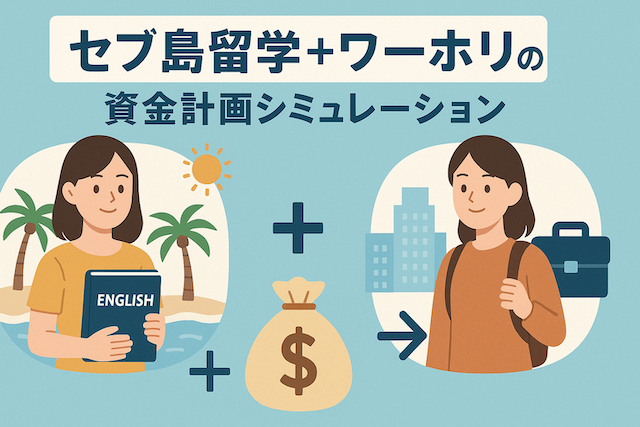
Cebu Study Abroad + Working Holiday: Budget Planning Simulation
01
Introduction
A working holiday is popular as "a valuable experience of living abroad while working," but the one thing that always stands in the way before departure is **financial planning**. If you are unsure about your English, finding work locally can be difficult, and it is not uncommon for living expenses to pile up as a result.
That is why more people are taking the step of **"Cebu study + working holiday."** By taking on a working holiday after a short, intensive language stay in Cebu, you can raise your English to a practical level, making job hunting and daily life locally much smoother.
This article runs a **financial planning simulation** for combining Cebu study with a working holiday, explaining in concrete terms the initial costs you will need and what income and expenses to expect locally.
02
Step 1: Costs Required for Cebu Study
When polishing your English in Cebu before a working holiday, the biggest question is "how much money will I need?" Compared with study in Western countries, Cebu study offers excellent value for money and is characterized by packages that **include dorm and meals**.
Monthly Guide
- **Including tuition, dorm and meals**: JPY 150,000 to 250,000 (generally includes one-on-one lessons, three meals a day and accommodation)
- **Flights (round trip)**: JPY 50,000 to 70,000
- **Local living expenses (pocket money)**: JPY 20,000 to 50,000
Simulation by Duration
- **1-month stay**: JPY 250,000 to 350,000
- **2-month stay**: JPY 400,000 to 600,000
- **3-month stay**: JPY 600,000 to 850,000
Stays of 2 to 3 months are the most commonly chosen, and **having JPY 1,000,000 ready before your working holiday should leave you comfortably covered**.
03
Step 2: Preparation Costs Before Departing for Your Working Holiday
After finishing your study in Cebu, the working holiday itself comes next. Before departure you will need funds for the visa application, insurance, flights, and the initial costs of starting life locally.
Main Cost Items
- **Working holiday visa application fee**: JPY 20,000 to 50,000 (varies by country)
- **Overseas insurance**: JPY 100,000 to 200,000 (for one year of coverage)
- **Flight (one way)**: JPY 60,000 to 100,000
- **Initial local living costs**: JPY 200,000 to 300,000 (rent deposit + furniture and daily necessities)
Estimated Total
- **Australia / New Zealand**: JPY 400,000 to 550,000
- **Canada / United Kingdom**: JPY 500,000 to 600,000
These preparation costs are unavoidable, so it is safest to set funds aside separately from your Cebu study costs.
04
Step 3: Income and Expense Simulation During the Working Holiday
On a working holiday, the basic approach is to cover your living expenses by working part-time locally. Let us simulate the balance of income and expenses.
Income Guide
- **Australia / New Zealand**: hourly wage of about JPY 1,600 to 2,200
- **Canada**: hourly wage of about JPY 1,300 to 1,800
- **United Kingdom**: hourly wage of about JPY 1,500 to 2,000
Working 20 to 30 hours a week, you can expect **an income of roughly JPY 200,000 to 250,000 per month**.
Expense Guide
- **Rent and utilities**: JPY 80,000 to 120,000 per month (a shared house is typical)
- **Food and transport**: JPY 50,000 to 70,000 per month
- **Socializing and sightseeing**: JPY 30,000 to 50,000 per month
In total, expect expenses of **roughly JPY 150,000 to 200,000 per month**.
Example of Monthly Income and Expenses
- **Income**: JPY 220,000
- **Expenses**: JPY 180,000
- **Difference**: +JPY 40,000
In other words, if you go on a working holiday after building up your English in Cebu, you are more likely to find work locally with ease, and **you can cover your living costs and even save money**.
05
Simulation Example: Person A
Let us look at a funding simulation for someone who chooses "2 months of Cebu study + 1 year of working holiday in Australia."
Study Costs
- Tuition, dorm and meals (2 months): about JPY 400,000 to 500,000
- Flights + living expenses: around JPY 100,000 **Total: about JPY 500,000**
Working Holiday Departure Preparation Costs
- Visa and insurance: JPY 200,000
- Flight (one way): JPY 80,000
- Initial living costs (rent deposit, daily necessities): JPY 200,000 **Total: about JPY 500,000**
Total Funds Prepared at Departure
**About JPY 1,000,000**
Income and Expenses During the Working Holiday (1 year)
- Income: JPY 220,000 per month x 10 months = **about JPY 2,200,000** (estimated conservatively for the first 2 months until life settles)
- Expenses: JPY 180,000 per month x 12 months = **about JPY 2,160,000**
Final Result
- Savings: +JPY 40,000 (a surplus after covering living costs)
- Even including the study costs, the experience and English ability you gain are of great overall value
In this way, combining Cebu study makes it possible to "improve your English and make your job search more efficient," which in turn brings peace of mind financially as well.
06
Benefits of Combining with Study in Cebu
1. Building up your English
Cebu study centers on one-on-one lessons and lets you develop practical English even in a short time. This makes job hunting and interviews during your working holiday go more smoothly and widens your chances of being hired.
2. Efficient use of funds
If you go on a working holiday without sufficient English, job hunting takes time and you have to draw down your savings in the meantime. By building your skills in Cebu beforehand, you can start working soon after arrival and avoid wasted spending.
3. Getting used to life abroad
For someone living abroad for the first time, starting life directly in a Western country is a heavy burden. Being able to do a "dress rehearsal for life abroad" in Cebu, where prices are low and support systems are well established, is a great reassurance.
4. Community and making friends
Language schools in Cebu gather people who are also aiming for a working holiday, as well as those with study-abroad experience. You can exchange information and build a network that is useful even after you leave for your working holiday.
07
Summary
Cebu study + working holiday is an efficient choice in terms of financial planning as well.
- **Cebu study costs (2 to 3 months)**: JPY 400,000 to 600,000
- **Working holiday preparation costs**: JPY 400,000 to 600,000 Preparing **a total of around JPY 1,000,000** should leave you secure
Part-time income locally is at a level that fully covers living expenses, and a major strength is that going after building your English can shorten the time spent job hunting.
In other words, **the money you invest in study turns into earning power locally and can ultimately be recovered**. You also gain "value beyond money" such as English ability and international experience.
By combining Cebu study, you can take on a working holiday with room to spare financially, linguistically and mentally.
08
Frequently Asked Questions
What is the total budget for Cebu study + working holiday?
A guide is to prepare **around JPY 1,000,000**. The basic breakdown is JPY 400,000 to 600,000 for 2 to 3 months of Cebu study, and JPY 400,000 to 600,000 for working holiday preparation (visa, insurance, flights, initial living costs).
How much cash should I take?
Keep cash to a minimum and supplement with an international debit or credit card. Secure **the equivalent of JPY 50,000 to 100,000** in local currency, or in a form you can withdraw, for immediate expenses on arrival, and transfer the rest after opening a bank account.
How much does study in Cebu cost?
**JPY 150,000 to 250,000 per month** (including tuition, dorm and meals) is the guide. Living expenses are JPY 20,000 to 50,000 per month and vary depending on your pocket money. Round-trip flights are generally around JPY 50,000 to 70,000.
How many months of study is best?
The most common choice is **2 to 3 months**. It makes it easier to build the practical skills needed for job interviews and offers a good balance of cost-effectiveness. One month suits a trial experience, and 3 months is advantageous for strengthening interview skills.
How much do initial costs differ by country?
**Australia / New Zealand:** JPY 400,000 to 550,000 / **Canada / United Kingdom:** JPY 500,000 to 600,000. Both assume initial costs including the visa, insurance, one-way flight, rent deposit and daily necessities.
How long does it take to find a job after arriving?
It varies with your English ability and choice of city, but **1 to 4 weeks** is one guide. Completing interview practice and resume preparation in Cebu beforehand makes it easier to shorten this.
What is the breakdown of monthly living costs?
**Rent and utilities:** JPY 80,000 to 120,000 (assuming shared housing) / **Food and transport:** JPY 50,000 to 70,000 / **Socializing and sightseeing:** JPY 30,000 to 50,000. A total of **JPY 150,000 to 200,000** is the standard range.
Can I save money locally?
Expecting **an income of JPY 200,000 to 250,000 per month** from working 20 to 30 hours a week, against living costs of JPY 150,000 to 200,000, a surplus of **+JPY 20,000 to 50,000 per month** is realistic (varies by industry and city).
Is Proof of Funds required? How much should I prepare?
Requirements vary by country and time. Be sure to check the latest official information. In practice, it is safest to **allow a margin of several hundred thousand yen above the required amount**. The model in this article recommends preparing **a total of around JPY 1,000,000**.
Is insurance necessary? How much does it cost?
For long stays, it is a prerequisite. **JPY 100,000 to 200,000 per year** is a guide. Check the scope of coverage (illness, injury, liability, personal belongings, rescue costs) and also check the deductible and your out-of-pocket share.
I am worried about my English. How far can study improve it?
One-on-one-centered study in Cebu makes it easy to secure plenty of speaking time, and in **2 to 3 months** you can aim to stabilize interview readiness and basic communication for work. We cannot guarantee numerical results, but the amount you speak and thorough review determine your outcome.
What procedures are needed after arrival (bank, tax number, phone)?
**Opening a bank account:** the foundation for deposits, withdrawals and receiving pay / **Obtaining a tax number:** e.g. AU = TFN, NZ = IRD, CA = SIN, UK = NINo / **SIM / transit IC card:** immediately useful for job-hunting contact and commuting / **Preparing your resume and references:** update them in the local format
What can I do if I cannot find a job?
Widen your range of cities and job types (including suburbs and resorts) / Optimize your resume to the local format and do more interview practice / Use referrals through your school and community, and bulletin boards / Build a track record through short trials or volunteering
What Are Some Tips for Saving Money?
Share houses / long-term contracts to lower rent / Use off-peak flights and early-booking discounts / Get daily necessities through second-hand purchases and flea markets / Cook for yourself, meal prep and optimize your commuting area / Aim for rent assistance by working in regional cities or resorts
What is the recommended preparation timeline?
**6 to 4 months before departure:** choose country and city, rough budget, tentatively decide on a language school / **4 to 2 months before:** apply to school and book flights, insurance, prepare resume / **2 to 0 months before:** study in Cebu (interview practice, workplace English, job search preparation) / **1 to 2 weeks after arrival:** bank, tax number, SIM, begin local applications
What Are Common Mistakes and How Can You Avoid Them?
**A long period without income after arriving:** complete interview practice and resume preparation in Cebu / **Underestimating initial costs:** estimate deposits and bonds in advance / **Slow progress in English:** make daily output plus recording and review a routine / **Ballooning living costs:** shorten the distance between home and work and optimize fixed costs
What are the guides for different model cases?
**1-month short stay + working holiday:** small initial investment, and you can take more time for job hunting locally / **Standard 2 months + working holiday:** easy to build an English and interview foundation, with good overall balance / **Intensive 3 months + working holiday:** advantageous for those aiming at specialist work or customer-facing jobs
How much money is expected to remain after returning home?
If you can keep up a surplus pace of +JPY 20,000 to 50,000 per month, a gain of **about JPY 240,000 to 600,000** over a year is a guide (varies with trips taken and periods between jobs). If you can turn your Cebu study costs into "earning power," a full recovery in total is well within reach.
09
Related article
10
Recommended Courses
Course
Around-the-World & Working Holiday English Course
A survival English course for English beginners heading off on a round-the-world trip or a working holiday. It costs the same as the Practical English (ESL) Course and builds the English you need through short, intensive study.
The first step in IELTS preparation is choosing the right environment
With one-on-one classes and real-format mock exams, we help you reach your target score by the most direct route.