
Two-Country Study Abroad
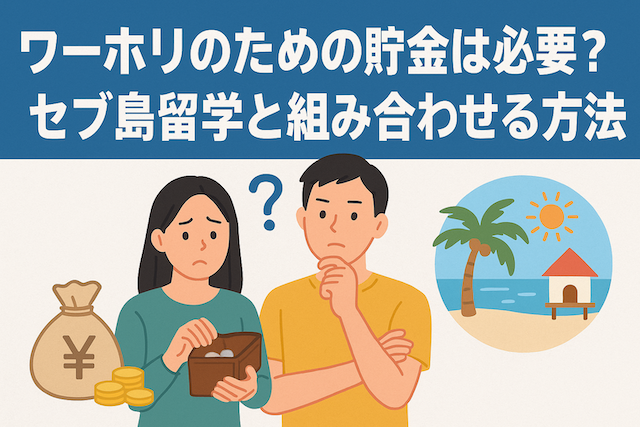
Do You Need Savings for a Working Holiday? How to Combine It with Study in Cebu
01
Introduction
Many people who want to take on a working holiday feel uneasy, wondering how much savings they need or whether they will be able to live there. Popular working holiday destinations such as Australia and Canada in particular have high prices, so financial planning before departure is the key to success.
One approach attracting attention is **combining it with study in Cebu**. By studying English in Cebu for a short period, building overseas experience while keeping living costs down, and then taking on your working holiday, you can start looking for work and living there smoothly.
This article explains in an easy-to-understand way the savings guidelines you need for a working holiday and the benefits of combining it with study in Cebu. We hope it gives people aiming for a working holiday some ideas for an efficient preparation plan.
02
Guidelines for the Savings You Need for a Working Holiday
When you leave for a working holiday, many countries require **proof of funds**. This is a condition to confirm that you can support yourself even if you cannot work for a while after arriving.
The guidelines for typical countries are as follows.
- **Australia**: AUD 5,000 to 6,000 (approx. JPY 500,000 to 600,000) + airfare
- **Canada**: CAD 2,500 (approx. JPY 250,000) + round-trip airfare
- **New Zealand**: NZD 4,200 (approx. JPY 380,000) + airfare
- **United Kingdom**: GBP 2,530 (approx. JPY 500,000) shown with a bank balance certificate
On top of that, you need to allow for living costs (rent and food) for 2 to 3 months until you find work.
It is safest to assume you will need **a total of roughly JPY 800,000 to 1,500,000 in savings**.
03
Why You Need Savings
Some people think a working holiday will be fine because they can work and live there, but in reality **it is essential to have sufficient savings before departure**. The reasons are as follows.
- **A condition for obtaining a visa** Many countries require proof of a certain amount of funds when you apply for a working holiday visa or when you enter the country. If you do not meet this, you may not be able to enter.
- **You may not find a job right away** Depending on your English and the local job market, it can take anywhere from a few weeks to a few months to get a part-time job. You need funds to support your living costs during that time.
- **There are initial costs** When renting a place, you need to pay a deposit and rent in advance. You also need a substantial amount of money at the start for things like a mobile contract and buying daily necessities.
- **Preparing for unexpected expenses** You need enough margin to handle unexpected costs such as medical bills, an emergency return home and trouble.
In other words, **funds to support a minimum standard of living + reserve funds for peace of mind** are the key to a successful working holiday.
04
Benefits of Combining with Study in Cebu
1. You Can Boost Your English in a Short Time
Study in Cebu is **centered on one-on-one lessons**, so you can efficiently build practical English ability. When looking for work on your working holiday, being able to go in with the ability to hold at least a minimum conversation in interviews and at work is a major strength.
2. You Can Study While Keeping Living Costs Down
The going rate for study in Cebu is **JPY 150,000 to 250,000 per month (including tuition, dorm and meals)**. This is about one-third to one-quarter of the cost of attending a language school in a Western country for the same period. The appeal is that you can learn English while saving your working holiday funds.
3. A Rehearsal for Life Abroad
If your first experience living abroad is straight into a working holiday, many people are bewildered by the change in environment. By **experiencing a different cultural environment, including food, safety and transport,** through study in Cebu, you improve your ability to adapt for the working holiday itself.
4. You Can Use Your Savings Efficiently
If you go straight on a working holiday with no English ability, finding work can take several months, and there is **a risk that your savings will shrink on living costs in the meantime**. If you prepare in Cebu first, you can start working smoothly there, which in the end keeps your spending down.
05
Model Case: Funding Simulation for Cebu Study + Working Holiday
Let us get a picture of how much money you would actually need if you combined study in Cebu with a working holiday.
Example case: 3 months of study in Cebu → working holiday in Australia
- **Study in Cebu (3 months)**: approx. JPY 600,000 (including tuition, dorm, meals and living costs)
- **Working holiday departure funds**: approx. JPY 1,000,000 (proof of funds, airfare, and 2 to 3 months of local living costs)
- **Total**: approx. JPY 1,600,000
At first glance this may seem like a heavy burden, but if you go straight on a working holiday with insufficient English and it takes 3 to 4 months to find a job, JPY 500,000 to 800,000 could disappear in living costs during that time.
**Leaving after building your English in Cebu beforehand is, in the end, more cost-efficient and lets you start with peace of mind.**
06
Summary
To take on a working holiday, you need **savings of at least about JPY 800,000 to 1,500,000** before departure. This serves as peace-of-mind funds for the visa conditions, living costs locally and unexpected expenses.
However, if you leave for a working holiday right away, there is a risk that a lack of English will prolong your job search and use up your hard-earned savings.
That is why we recommend **combining it with study in Cebu**.
- You can study English intensively for about JPY 150,000 to 250,000 per month
- You can get used to life abroad before taking on the real working holiday
- By leaving with solid English, finding work locally goes more smoothly
If you want to use your working holiday funds efficiently and raise your chances of success locally, please consider a plan that includes study in Cebu.
07
Frequently Asked Questions
Are savings really necessary for a working holiday?
Yes. Many countries require proof of funds, and on top of that there are initial costs such as living costs and advance rent until you find work locally. Prepare at least several months of living costs plus reserve funds for emergencies.
How much savings is a good guideline?
A guideline is **JPY 800,000 to 1,500,000**. The breakdown is proof of funds, airfare, initial housing costs, 2 to 3 months of living costs and a reserve. It goes up or down with the prices of the country and city and your style of stay.
How do I show proof of funds?
Generally, you show it with a bank balance certificate (in English) or a screenshot of your balance. The required amount and format change by country and by year, so be sure to check the latest information from each government and embassy.
Can a credit card limit count as proof of funds?
In many countries, **a credit limit is not accepted**. You need to show a cash balance (deposits). The balance of a debit card may be treated as a bank account balance, but check the official requirements.
Can I enter the country with a one-way ticket?
It depends on the country. A round-trip ticket or a ticket to a third country may be required. Trying to enter with a one-way ticket risks refusal or secondary inspection, so be sure to check the conditions beforehand.
How many months of living costs are needed until I find work locally?
**2 to 3 months** is reassuring. It varies with English ability, the job market and seasonal factors (busy and slow seasons). Be sure to include city rent and the bond (deposit) in your calculations.
What is the breakdown of initial costs?
Advance rent + deposit/bond (roughly 1 to 4 weeks) / initial setup fees that require no guarantor (key change, cleaning) / mobile phone, SIM, transport card and daily necessities / food and transport costs for the time being
Does combining it with study in Cebu really save money?
Yes. The going rate in Cebu is **JPY 150,000 to 250,000 per month (including lessons, dorm and meals)**, a fraction of Western language schools. By raising your English first, you can shorten your job search after arriving for your working holiday and reduce the drain on your living costs.
How many months of study in Cebu are effective?
It depends on your goal, but for building a foundation for interviews and workplace communication, **8 to 12 weeks (2 to 3 months)** is a guideline. Even a short stay (4 weeks) is effective for catching up on the basics and rehearsing life abroad.
What is and is not included in the cost of study in Cebu?
**Often included:** Tuition, dorm, meals (1 to 3 meals), cleaning and laundry, visa extension support / **Often not included:** Airfare, insurance, actual visa fees, weekend activities, pocket money
How much English is needed?
For entry-level jobs such as customer service, kitchen and cleaning, the first goal is **everyday conversation (equivalent to CEFR A2 to B1)**. For jobs involving phone calls and complaint handling, and for office work, B1 to B2 or higher is a guide.
What is the recommended schedule from Cebu to a working holiday?
Months 1 to 2: Choose a school and apply / plan savings and consider insurance / Months 3 to 5: Study in Cebu (2 to 3 months) for conversation and interview preparation / Month 6: Apply for the visa and prepare for departure after returning home or from Cebu / Month 7: Enter for the working holiday, short-term accommodation, then arrange housing and start job hunting
What are tips for reducing costs even further?
In Cebu, choose a school with a dorm and meals and eat out less / On arrival for the working holiday, take a short-term contract at a shared house, then a long-term one once you are settled / Study efficiently with one-on-one lessons plus self-study, and use used or electronic materials / Book flights early and fly on weekdays, and keep luggage to a minimum to avoid excess fees
Should I take out insurance?
**It is recommended.** Medical costs can be high. For your time in Cebu, consider overseas travel insurance, and for the working holiday destination compare country-designated insurance (for example, for students and workers) and private insurance.
How do I go about job hunting locally?
Prepare an English resume (Resume/CV) and cover letter while in Cebu / In the first week after arrival, hand out resumes in person and apply online in parallel / Role-play assumed interview Q&A (phone, in person, group) / For jobs that require qualifications (food hygiene, RSA, etc.), check the requirements before arrival
What Are Common Mistakes and How Can You Avoid Them?
**Mistake:** Leaving with no English → prolonged job hunting / savings drain **Avoidance:** Build conversation skills and practice interviews in Cebu beforehand / **Mistake:** Underestimating rent and bond **Avoidance:** Always include initial costs in your estimate / **Mistake:** No insurance, leading to a huge bill **Avoidance:** Always take out insurance and carry your certificate
What should I do about currency exchange and carrying funds?
Avoid carrying large amounts of cash; use an international cash card, debit and credit cards together for **spread-out management**. Also check beforehand the cash declaration thresholds for entering and leaving countries.
Where should I check for the latest information?
Visa conditions, the amount of proof of funds, insurance requirements and work rules change. Be sure to check the official information of **each government, embassy and immigration authority** before departure. It is also reassuring to consult school staff and a study-abroad agency about the latest practice.
08
Related article
09
Recommended Courses
Course
Around-the-World & Working Holiday English Course
A survival English course for English beginners heading off on a round-the-world trip or a working holiday. It costs the same as the Practical English (ESL) Course and builds the English you need through short, intensive study.
The first step in IELTS preparation is choosing the right environment
With one-on-one classes and real-format mock exams, we help you reach your target score by the most direct route.