
Two-Country Study Abroad
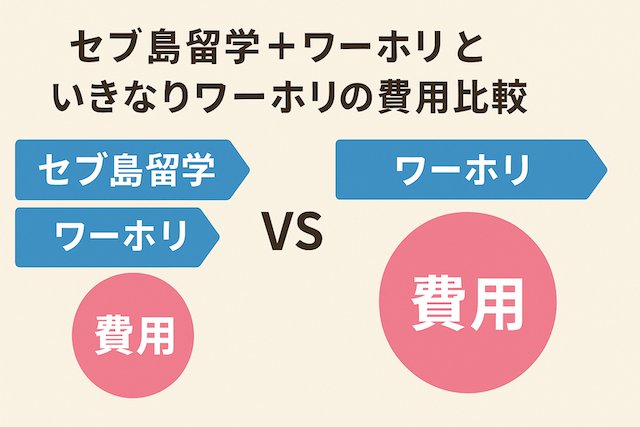
Cost Comparison: Cebu Study Abroad + Working Holiday vs. Going Straight to a Working Holiday
01
Introduction
When people decide to take on a working holiday, many struggle with one choice: head straight to the destination, or study English in Cebu first and then go? At first glance, going straight to the working holiday country seems to save time and money. In reality, though, differences in English ability and living preparations can change the total cost of your stay considerably.
In this article, we compare the costs of **“Cebu study + working holiday”** and **“going straight to a working holiday”** and explain the pros and cons of each. If you are planning a working holiday, it should help you find the starting method that suits you best.
02
Costs of Going Straight to a Working Holiday
Popular working holiday destinations such as Australia, Canada and New Zealand have tuition and living costs that are as high as or higher than in Japan. If you arrive without sufficient English, you may not find a job quickly and may end up attending a language school for longer, which leads to major expenses.
Approximate Costs
- **Language school (1 month)**: JPY 200,000-350,000
- **Living costs (rent, food, transport, etc. / 1 month)**: JPY 150,000-250,000
- **Total (1 month)**: JPY 350,000-600,000
If the job search takes a long time in particular, it is not unusual to spend close to JPY 1,000,000 within 2-3 months. In other words, going straight to a working holiday is likely to be the most financially demanding in the first few months.
03
Costs of Cebu Study + Working Holiday
Cebu has low prices and focuses on one-on-one lessons, making it an environment where you can improve your English efficiently even in a short time. By building a foundation in Cebu before your working holiday, you may be able to cut your living costs at the destination significantly.
Approximate Costs
- **Cebu study (1 month)**: JPY 150,000-250,000 (tuition, dorm fees and meals included)
- **Living costs at the working holiday destination (1 month)**: JPY 150,000-250,000
- **Total (2 months)**: JPY 300,000-500,000
In other words, even if you spend one month preparing properly in Cebu before your working holiday, in many cases the cost is lower than going directly to a working holiday.
Furthermore, if your English has improved, the job search at your destination also goes more smoothly, which has the added benefit of shortening the time until you start earning income.
04
Comparing Benefits Beyond Cost
Beyond cost, peace of mind and ease of career preparation are also important points.
Going Straight to a Working Holiday
- **Pros**: You can start life at your destination right away You dive straight into an English-speaking environment, which tests your initiative
- **Cons**: With insufficient English, you often cannot find part-time work The job search takes time and easily drains your savings It is mentally very stressful
Cebu Study Abroad + Working Holiday
- **Pros**: You can improve your English beforehand, so the job search at your destination goes smoothly You can learn efficiently through one-on-one lessons You can start life at your destination with confidence
- **Cons**: You need a preparation period of 1-3 months before departure There is an initial investment for studying in Cebu
05
Conclusion
At first glance, going straight to a working holiday seems to save both time and money. In reality, however, there is a risk that a lack of English prolongs the job search and ends up raising your living costs.
On the other hand, although “Cebu study + working holiday” involves some cost before departure, its great strength is that **you can travel after improving your English, so you can find a job quickly at your destination**. As a result, in many cases it keeps the total cost down in the long run and leads to a more fulfilling working holiday.
If you want your working holiday to succeed, including preparation in Cebu, even for a short period, leads not only to “cost savings” but also to “peace of mind and efficiency.”
06
Cost Comparison Summary
| Item | Going Straight to a Working Holiday | Cebu Study Abroad + Working Holiday |
|---|---|---|
| Language school costs | JPY 200,000-350,000 (at destination) | JPY 150,000-250,000 (Cebu) |
| Living costs (1 month) | JPY 150,000-250,000 | JPY 150,000-250,000 (at working holiday destination) |
| Initial total cost (1-2 months) | JPY 350,000-600,000 | JPY 300,000-500,000 |
| English Ability | Start with a low level | Strengthen the basics beforehand |
| Job search | Takes time due to insufficient English | Relatively likely to go smoothly |
| Mental burden | Large (anxiety, impatience) | Small (start with peace of mind) |
As you can see, in the short term “going straight to a working holiday” looks easier, but when you consider long-term costs and stability of life, “Cebu study + working holiday” is often the more advantageous option.
07
Frequently Asked Questions
Which is cheaper: Cebu study + working holiday, or going straight to a working holiday?
If you look only at short-term (1-2 month) spending, there is not much difference, but in terms of the **total amount** including the period until you start working, “Cebu study + working holiday” is often cheaper. Raising your English level beforehand speeds up the job search at your working holiday destination and reduces living costs during the period without income.
What is the estimated initial cost of going straight to a working holiday?
General estimates are as follows. Language school (1 month): JPY 200,000-350,000 / Living costs (rent, food, transport / 1 month): JPY 150,000-250,000 / **Total (1 month): JPY 350,000-600,000** If you do not find a job and the school period or the period without income is extended, spending can reach close to JPY 1,000,000 in 2-3 months.
What is the estimated cost of Cebu study + working holiday?
This is an estimate for the case where you build a foundation in English in Cebu before traveling. Cebu study (1 month, **dorm fees and meals included**): **JPY 150,000-250,000** / Living costs at the working holiday destination (1 month): JPY 150,000-250,000 / **Total (2 months): JPY 300,000-500,000** Even for the same two months, including Cebu may lower the total (or give you better English for the same amount).
Is one month in Cebu effective? How many months do you recommend?
Even one month is effective for “recovering the basics and building a foundation for conversation.” If you also want to cover job interviews and workplace communication, **1-3 months** is a good guideline for stable results.
What is included in the Cebu cost of “JPY 150,000-250,000”?
At many schools, tuition, dorm fees, meals (1-3 meals), water and utilities, and cleaning/laundry service are included. The registration fee, textbook fees, visa-related costs, airfare, insurance and local entertainment expenses may be charged separately.
How much living cost should I plan for until I find a job at the working holiday destination?
It is safest to prepare **at least 4-8 weeks** of living costs (also consider the rental deposit and the initial costs of finding a home). Preparing in Cebu makes it easier to shorten this period without income.
What hidden costs are there? (Easily overlooked expenses)
Airfare (seasonal fluctuations) / excess baggage / overseas insurance / out-of-pocket medical expenses / rental deposits, bonds and initial costs for buying household items / SIM and communication fees, miscellaneous costs for setting up your life (bedding, cookware, etc.) / currency exchange and remittance fees until your bank account is opened
What English level should I aim for?
Before departure, aim for a state where you can “exchange key points in slow conversation” (for example, roughly CEFR A2 to B1); this makes it easier to handle submitting a resume, interviews and trial shifts. The fastest route is to solidify everyday conversation and work phrases through one-on-one lessons in Cebu.
Do costs differ by country and city?
Yes. In Australia, Canada and New Zealand alike, rent, transport and eating out tend to be more expensive closer to the centers of big cities. If you are going to an area with high rent, secure **extra funds for the period without income**.
So how much should I save before going?
As a guideline, preparing the following total gives you some leeway. **3 months of living costs** (rent, food, transport) / **Language costs** (a local language school if going straight to a working holiday; Cebu tuition if combining with Cebu) / **Initial costs** (airfare, insurance, deposits, miscellaneous) The Cebu + working holiday combination makes it easier to **maximize the amount of study** even with the same savings.
What does a comparison with model cases look like? (Approximate)
{"type":"table","columns":["Case","Breakdown","Approx. total"],"rows":[["Straight to working holiday (1 month language school + 1 month living)","Language JPY 250,000 + living JPY 200,000 + initial costs JPY 150,000","About JPY 600,000"],["1 month in Cebu + 1 month working holiday","Cebu JPY 200,000 + living JPY 200,000 + initial costs JPY 150,000","About JPY 550,000"]]} Even with a similar total, the latter lets you arrive with better English, which tends to make the path to employment smoother.
What should I look for when choosing a school in Cebu?
One-on-one ratio (can you maximize speaking time?) / Curriculum (interview preparation, workplace English, pronunciation, writing) / Meals, dorm environment and location (daily routes, safety, nearby facilities) / Study support (self-study management, strengthening weak points, counseling)
Is an ultra-short stay of about 2 weeks still worthwhile?
Yes, it is effective enough for “warming up your English,” “correcting pronunciation and basic expressions,” and “establishing a study rhythm.” It lowers anxiety before the working holiday and makes early communication at your destination easier.
When should I start planning?
Ideally **3-6 months before departure**. Working in parallel on school and dorm availability, airfare, insurance and research on housing at your destination, and then planning the flow of 1-3 months in Cebu followed by moving to the working holiday country, makes things go smoothly.
What are the criteria for the final decision?
**How to use your budget**: invest in tuition to raise your English, or build up more savings to cover the period without income at your destination / **Timeline**: if you need to leave soon, a short stay in Cebu followed by immediate departure; if you have time, strengthen your foundation over 2-3 months / **Concerns**: if you feel strongly anxious about interviews, resume writing and phone calls, preparatory study is all the more valuable
08
Related article
09
Recommended Courses
Course
Around-the-World & Working Holiday English Course
A survival English course for English beginners heading off on a round-the-world trip or a working holiday. It costs the same as the Practical English (ESL) Course and builds the English you need through short, intensive study.
The first step in IELTS preparation is choosing the right environment
With one-on-one classes and real-format mock exams, we help you reach your target score by the most direct route.