
Nursing Study Abroad Guide
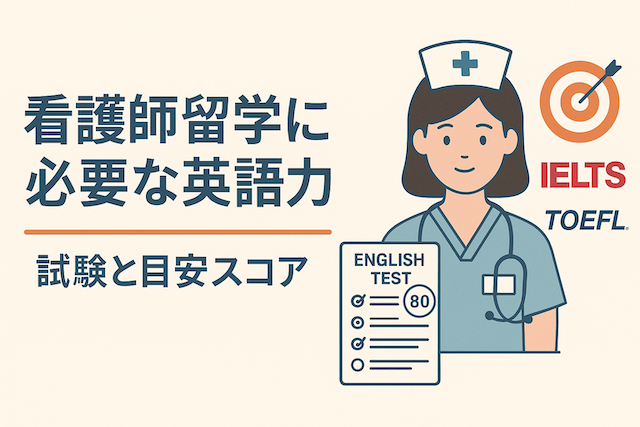
English Needed for Nursing Study Abroad: Exams and Score Guidelines
01
Introduction
To study or work abroad as a nurse, not only specialist knowledge but also “English ability” is a key factor. Especially if you aim to obtain a license or work locally, everyday conversational English is not enough, and you need to prove a certain score on an internationally recognized test such as IELTS, TOEFL or OET.
On the other hand, at the language study abroad or short-term training stage, high scores are not necessarily required. In reality, many people first build their foundation through language study abroad in places such as the Philippines (Cebu), and then move on to full-scale qualification courses.
This article explains in an easy-to-understand way the main English tests required for nursing study abroad, guideline scores, and realistic steps for preparation.
02
1. IELTS (Academic)
The test most widely required for nursing study abroad is the **IELTS Academic**. It is specified as a condition for nurse registration and university admission in many English-speaking countries, including the UK, Australia, Canada and New Zealand.
- **Features** Measures the four skills (Listening, Reading, Writing, Speaking) in good balance Emphasizes the English ability needed in real academic settings and daily life
- **Guideline scores** Philippines (language study abroad): not required to about 4.0 Australia / Canada / New Zealand: 6.5 to 7.0 or higher UK (NMC registration): 7.0 or higher (6.5 or higher in each skill) USA (university admission): 7.0 or higher
- **Key point** IELTS is recognized worldwide, and a score can be used in multiple countries, so we recommend it as the first benchmark test to aim for.
03
2. TOEFL iBT
The representative English test used mainly in the United States is the **TOEFL iBT**. It is often required for nursing study abroad when you are considering university admission, transfer or graduate study, in particular.
- **Features** Emphasizes the ability to use English in academic settings Measures the four skills of Listening, Reading, Writing and Speaking The test is taken entirely on a computer
- **Guideline scores** US university transfer / NCLEX preparation: 90 or higher Graduate school level: 100 or higher
- **Key point** The TOEFL is one of the most trusted tests at universities and graduate schools in North America. If you aim to earn a bachelor’s or master’s degree in the US, TOEFL is often requested rather than IELTS, so it is important to check your target school’s requirements in advance.
04
3. OET (Occupational English Test)
The **OET** is an English test developed specifically for healthcare professionals. Unlike general academic tests (IELTS and TOEFL), it measures the English ability actually used in nursing and healthcare settings.
- **Features** Dedicated to healthcare professions such as nurses, doctors and pharmacists Test content is practical, such as “interactions with patients,” “medical record entries” and “case explanations” Graded on a 5-level scale from A to E
- **Score standard** For nurses: B or higher is the passing standard Some countries require “B or higher in all sub-skills”
- **Countries that accept it** Australia New Zealand UK In addition, the number of countries adopting it as proof of English ability for healthcare workers is growing
- **Key point** Because the OET proves “English ability that makes you ready to work on the job,” it has drawn growing attention in recent years as an alternative to IELTS. It is especially recommended for nurses who want confidence in medical English.
05
4. Realistic Preparation Steps
The English ability required for nursing study abroad is realistically built up in stages rather than by aiming for a high score right away. Understand your current level and make a plan working backward from your goal.
- **Zero to beginner English** We recommend starting with language study abroad in places such as the Philippines (Cebu) Build everyday conversation, basic grammar and listening skills Aim to build a foundation at about IELTS 4.0 to 5.0
- **Intermediate (around IELTS 5.0)** Take six months to a year to aim for IELTS 6.5 Prepare to enter a bridging program or overseas training Focus on test preparation using mock tests and past papers
- **Advanced (IELTS 6.5 or higher)** Can connect directly to nursing qualification programs in each country, such as NCLEX / NMC / CAP Switch to OET or TOEFL and prepare score proof suited to your target country Also study the medical English needed in practice (patient care and documentation)
- **Guideline study period** Going from IELTS 5.0 to 6.5 requires 6 to 12 months of intensive study Even when aiming for TOEFL 90 or higher, preparation over a span of 1 to 2 years is realistic
06
Summary
The English ability required for nursing study abroad differs greatly depending on the purpose of your study and your path.
- **Language study abroad or short-term training**: No score to an intermediate level is sufficient
- **Obtaining a license or working locally**: IELTS 6.5 to 7.0 / TOEFL iBT 90 or higher / OET B or higher is the required standard
- **English preparation is a long game**: Rather than rushing just before departure, working on it systematically over 1 to 2 years is the key to success
First, objectively assess your current English ability, and proceed with test preparation suited to your target country and program. If you prepare step by step, it will be a big step toward studying abroad as a nurse and broadening your career.
07
Frequently Asked Questions (FAQ)
Q1. Is an English test score always required for nursing study abroad?
A1. It may not be needed for language study abroad or short-term training, but if you aim to obtain a license or work locally, an official score such as IELTS, TOEFL or OET is required.
Q2. Should I take IELTS or TOEFL?
A2. It depends on your destination. TOEFL is the mainstream in the US, while IELTS is common in the UK, Australia, Canada and New Zealand.
Q3. Who is the OET suited to?
A3. It suits people who value English for healthcare settings. Because the content is practical, such as patient care and case explanations, it leads to being evaluated as someone ready to work on the job.
Q4. What IELTS score is needed?
A4. For language study abroad, no score to about 4.0 is enough, but if you aim to obtain a license or work, 6.5 to 7.0 or higher is needed.
Q5. What are the guideline scores for TOEFL iBT?
A5. 90 or higher for US university admission and NCLEX preparation, and 100 or higher at graduate school level, are the usual standards.
Q6. What is the OET passing line?
A6. For nurses, B or higher is the passing standard. Depending on the country, B or higher is required in all skills.
Q7. Is nursing study abroad possible even from zero English ability?
A7. Yes. We recommend starting with language study abroad in places such as the Philippines (Cebu) to learn the basics, then gradually aiming for a score.
Q8. How long does it take to raise IELTS from 5.0 to 6.5?
A8. With intensive study, about six months to a year is a guideline. Using a language school or specialist course is more effective than self-study.
Q9. Should I study for the test before leaving?
A9. Yes. Right before departure there is not enough time. Preparing systematically over 1 to 2 years is realistic.
Q10. Should I prioritize medical English or everyday English?
A10. Build your foundation with everyday English first, then add medical English study afterward, and you can develop your skills in good balance.
Q11. Can I raise my score with self-study alone?
A11. You can improve through self-study, but there are limits. For Speaking and Writing in particular, feedback from a third party is essential.
Q12. What English materials are there for nurses?
A12. We recommend dedicated medical English materials such as “Cambridge English for Nursing” and “Oxford English for Careers: Nursing,” as well as the official OET practice books.
Q13. What is an effective way to improve Speaking?
A13. Conversation practice at a language school, online English conversation, and OET role-play practice are effective. Practice that imagines explaining things to patients and talking with colleagues is especially useful.
Q14. I am weak at Listening. How can I improve?
A14. Build a habit of listening every day to medical podcasts and overseas nursing documentaries. Repeatedly shadowing the parts you cannot catch is also effective.
Q15. Should I prioritize language study abroad or test preparation?
A15. If you are at zero to beginner level, prioritize building your foundation through language study abroad. If you are intermediate or above, it is efficient to shift to test preparation.
Q16. What are tips for staying motivated to keep studying English?
A16. Set small goals such as “raise IELTS by 0.5 in six months,” and take regular mock tests to confirm your growth.
Q17. What study methods do you recommend before going abroad?
A17. Firm up basic grammar and vocabulary in Japan, and strengthen Speaking and Listening locally or online for efficiency.
Q18. Which country is efficient for language schools?
A18. Considering the balance of cost and learning environment, it is common to first study intensively in the Philippines (Cebu) and then aim to obtain a qualification in Europe or the US.
Nursing Study Abroad Guide 2026: A Complete Roadmap to Working and Studying Overseas08
Related article
09
Recommended Courses
Course
IELTS Preparation Course
One-on-one lessons and exam-format mock tests build all four skills in a balanced way in a short time.
See moreCourseOET Preparation Course
With practical training specialized by profession, for doctors and nurses, you can raise your Writing and Speaking scores in the shortest time.
See moreThe first step in IELTS preparation is choosing the right environment
With one-on-one classes and real-format mock exams, we help you reach your target score by the most direct route.