
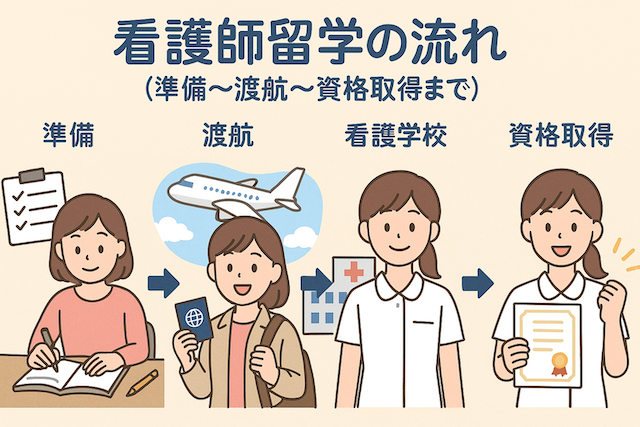
Nursing Study Abroad Guide
The Nursing Study Abroad Process (From Preparation to Departure to Obtaining Qualification)
01
1. Introduction
Nurse study abroad, aimed at studying and working overseas as a nurse, is quite different from simple language study abroad: it is a major challenge that is directly tied to your career. The requirements and qualification systems differ depending on the destination country, but in general the steps are **improving your language ability → studying and completing practicums in a specialist program → taking the licensing exam → obtaining your license**.
Nurse study abroad in particular involves a lot to do at the preparation stage, and after departure you need to pursue study and practicums in parallel, so it is very important to understand the whole flow.
This article is aimed at people considering nurse study abroad, and explains the whole process from preparation to departure, study and practicums, and obtaining your license. It will serve as a guideline for grasping the big picture, whether you are seriously considering study abroad or are still gathering information.
02
2. The Preparation Stage
Nurse study abroad does not begin when you leave the country: the preparation stage before departure is actually the most important. How well you handle this stage greatly affects how smoothly your later study and licensing go.
(1) Gathering Information
First, to find the destination that suits you, you need to thoroughly research each country's system and requirements.
- **Main destinations**: The United States, Canada, the United Kingdom, Australia, New Zealand, the Philippines, etc.
- **Points to check**: Required English ability, length of study, costs, type of visa, and the process for obtaining a license locally Because the requirements differ greatly from country to country, the first step is to choose the country that fits your goal (for example, working locally or advancing your career in Japan).
(2) Preparing Your English
Many countries require official scores such as **IELTS or TOEFL**. Nursing licensing exams and university nursing programs are all conducted in English, so a high level of English, including specialist terminology, is required.
- Raise your English quickly through intensive study at a language school (for example, studying in the Philippines)
- Prepare while still in Japan with online English conversation and medical English materials To make your study abroad a success, starting this language preparation early is the key.
(3) Preparing Documents
Nurse study abroad requires a large number of documents, and many cases require translation or notarization, so it is important to start early.
- Nursing license (translation and notarization required)
- Degree certificate and academic transcripts
- Passport (check the expiry date)
- The full set of documents required for the visa application
In particular, document authentication and translation take time, so plan your schedule with room to spare.
03
3. Procedures Before Departure
Once the preparation stage is finished, you move on to the actual procedures for studying abroad. By following this flow carefully, you can start studying smoothly after you arrive.
(1) Admission Procedures
You apply for admission to your chosen university, nursing program or language school.
- Submit the application form
- Provide proof of the required language scores
- Submit letters of recommendation and a statement of purpose (required depending on the country or school) Once you receive your acceptance notice, visa applications and departure preparations get fully under way.
(2) Visa Application
Obtaining a student visa is one of the major hurdles in nurse study abroad. In some countries processing can take several months, so apply early.
- Student visa
- Work visa (if work is involved)
- Check the permitted length of stay If the visa is not granted, studying abroad itself becomes difficult, so check carefully that there are no deficiencies in the required documents.
(3) Arranging Accommodation
It is also important to decide where you will live in advance. The options are as follows.
- Student dormitory (close to school, with the necessities provided)
- Homestay (makes it easier to learn the local culture)
- Apartment or shared house (suited to long stays and those who prefer independence) Some students choose a student dormitory or homestay with a support system at first, and then move later as needed.
(4) Taking Out Insurance
Medical costs overseas are often very high, so taking out insurance is essential.
- Overseas student insurance
- Local health insurance
- School-designated insurance (sometimes mandatory)
For peace of mind, check that your insurance covers not only treatment costs but also accidents, theft and emergency return home.
04
4. What Happens After You Arrive
After you complete admission and visa procedures and arrive safely, your study and life locally finally begin. After arrival, it is important to adapt to the change in environment while building up your language ability, specialist knowledge and practical experience.
(1) Study at a Language School or University
Many nursing students abroad start by strengthening their language skills.
- **Language school**: Learn everyday conversation, medical English and specialist terminology
- **University / specialist program**: Learn the basic knowledge needed for nursing, the local healthcare system and clinical theory For international students whose first language is not English in particular, building a foundation of learning in the initial language training is the key to success.
(2) Clinical Practicums and Hospital Training
To qualify as a nurse, clinical practicums at local hospitals are required.
- Experience the local healthcare setting through practicums at hospitals and clinics
- Learn communication skills and differences in cultural sensibilities
- Get used to handling medical equipment and to differences in how you interact with patients
At this stage, the important thing is not simply acquiring knowledge but developing skills you can actually use in the field.
(3) Adapting to Your Living Environment
As well as studying, it is important to get used to daily life.
- How to use public transport and everyday shopping
- Understanding local customs and culture
- Interacting with school classmates and local friends
Stability in daily life leads to better concentration on study and practicums.
05
5. The Licensing Process
One of the major goals of nurse study abroad is to obtain the qualification to work as a nurse in the country where you studied. The system and exams differ by country, but in general you follow these steps.
(1) Exam Preparation
Each country has its own national exam system.
- **United States**: NCLEX-RN (nursing licensing exam)
- **United Kingdom**: OSCE (Objective Structured Clinical Examination)
- **Australia / New Zealand**: Exams and practicum requirements set by the local nursing board
- **Canada**: Uses the NCLEX-RN The exams test advanced English and specialist knowledge, so it is common to prepare for several months to more than a year. Many international students also use preparatory schools and exam-prep courses.
(2) Taking the Exam
- There are various formats, including written exams, online exams and practical exams that measure clinical skills
- Questions are in advanced specialist English, so listening and reading ability are also essential
- In some countries you can retake the exam several times, so there is an environment in which you can keep trying until you pass
(3) After Passing
When you pass the national exam, you are granted the license to work officially as a nurse locally.
- Register your nursing license (apply to each country's nursing council or registration body)
- Some people go on to switch to a work visa or apply for permanent residency
- There is also the option of returning to Japan and using your study abroad experience to advance your career
Obtaining your license is both a goal and the start of a new career.
06
6. Career Paths After Study Abroad
After finishing nurse study abroad and obtaining your license, a variety of paths open up according to your goals. The options fall broadly into three: working locally, returning to Japan, and an international career.
(1) Working Locally
If you pass the national exam and obtain your license, you can work at local hospitals and clinics.
- In countries with serious staff shortages (for example, the United States and Australia), demand for international nurses is high
- You may receive high salary levels and good benefits
- There are also career paths leading to a work visa or permanent residency, allowing you to build a long-term base for life
(2) Returning to Japan to Advance Your Career
Many people use their study abroad experience and qualifications to expand their careers in Japan.
- Use your medical English to work at international hospitals or foreign-affiliated medical institutions
- Be recognized for your overseas experience and play an active role in education, research and management
- Some work as instructors of international nursing at nursing education institutions
(3) Working at International Medical Organizations and NGOs
The language skills and international outlook gained through study abroad can be used anywhere in the world.
- Volunteer work with international medical organizations and NGOs
- Medical support in developing countries
- Roles in the field of international medical tourism
The paths open to you after nurse study abroad are not limited to one, and they expand greatly depending on your own vision.
07
7. Summary
Unlike short-term language courses, nurse study abroad is a major challenge directly tied to your career. To summarize the flow,
- **Preparation stage**: Gathering information, language preparation and document preparation
- **Procedures before departure**: Admission application, obtaining a visa, and arranging accommodation and insurance
- **Study after arrival**: Language training, study in a specialist program and clinical practicums
- **Obtaining your license**: Pass each country's national exam and obtain your license
- **Career paths after study abroad**: Working locally, advancing your career in Japan, and international activities
is the process you will follow.
What matters most is **acquiring language skills and preparing in a planned way**. With sufficient English ability and an understanding of the system, your study and licensing locally will go more smoothly, and your career options afterward will expand greatly.
Nurse study abroad is by no means an easy path, but by taking on the challenge you can gain the potential to become a nurse who is recognized worldwide. Picture your own future clearly and prepare step by step.
08
Frequently Asked Questions (FAQ)
Q1. How long does it take to prepare for nurse study abroad?
A1. Generally, expect 6 to 12 months. Plan backward from the language exam (IELTS/TOEFL), translation and notarization of transcripts and licenses, credential evaluation, visa application, and arranging accommodation and insurance.
Q2. What is the guideline for the required English level (score)?
A2. It differs by country and school, but a rough guide is IELTS Academic 6.0 to 7.0 (with per-section requirements) or TOEFL iBT 80 to 100. Nursing programs and clinical practicums require specialist English, so it is safest to aim for ability above the required level.
Q3. What should I do if my English is not good enough?
A3. There are routes such as studying intensively at a language school beforehand (for example, in English-speaking countries or the Philippines), studying medical English online in parallel, or using a pre-entry term (Pathway/Bridging).
Q4. What education and nursing license do I need?
A4. The basics are a Japanese registered nurse license and a nursing degree (a bachelor's in nursing is preferable). Even for graduates of junior colleges or vocational schools, some countries may require additional credits or a bridging course.
Q5. What documents are needed? Are translation and notarization mandatory?
A5. License, degree and transcripts, proof of employment, passport, police clearance certificate, vaccination records, etc. Many countries require English translation and notarization (authentication/Apostille). Preparing them takes time, so start early.
Q6. What happens in a credential evaluation?
A6. A local evaluation body (for example, CGFNS or each country's nursing council) reviews your education, credits and work experience against local standards. Depending on the result, you may be instructed to complete additional study or practicums.
Q7. Are clinical practicums mandatory? How many hours are needed?
A7. They are mandatory in many countries. Set hours are specified for each area (adult, pediatric, maternal, mental health, etc.) and can run to several hundred hours. The school or nursing council sets the standard.
Q8. What types of exams are there (NCLEX, OSCE, etc.), and how do I prepare?
A8. The US and Canada use the NCLEX-RN; the UK uses the OSCE (practical) plus a CBT; Australia and New Zealand center on each nursing board's exams and clinical assessments. Standard preparation includes studying the official blueprint, mock exams and question banks, case study practice, and strengthening clinical English.
Q9. What are the approximate study and living costs?
A9. Tuition varies greatly by country, school and length of study (for example, from several hundred thousand to several million yen per year). Living costs are higher in cities. Also budget for insurance, visa fees, exam fees, translation and notarization fees, and exam-prep costs, and consider the risk of exchange rate fluctuations.
Q10. Can I work while studying? (part-time work)
A10. Some countries allow a set number of working hours per week on a student visa, but paid work in healthcare settings may be restricted. Always check the latest visa conditions for whether work is allowed, the maximum hours and any restrictions on type of work.
Q11. Are age limits or career gaps a disadvantage?
A11. Many countries set no clear upper age limit, but visa and work policies and employers' practical requirements may have an effect. If you have a gap in clinical work, plan to make up for it with recent practicums or training.
Q12. Are vaccination records and health checks required?
A12. It is common to be required to submit vaccination history (for example, HBV, MMR, Varicella and TB screening) for clinical practicums and employment. Also check the health requirements for entry and visas.
Q13. If I fail, can I retake the exam?
A13. Many exams allow retakes, but some countries impose waiting periods, limits on the number of attempts, or additional education and practicums. Design your study plan on the assumption that you will keep going until you pass.
Q14. How do I go about job hunting locally after obtaining my license?
A14. After license registration, use hospital programs for new graduates or overseas-trained nurses, job sites, job fairs and agencies. Preparing your resume, work history, letters of recommendation and interviews (responding to clinical cases) is key.
Q15. Can my overseas license be used as it is after I return to Japan?
A15. To work as a nurse in Japan, you need a Japanese nursing license. An overseas license is not a direct substitute, so check the latest procedures from the Ministry of Health, Labour and Welfare and other bodies. After returning, your language ability and international experience are likely to be valued as strengths.
Q16. I am unsure which country to choose. Any tips for deciding?
A16. Compare your goals (working locally / returning to Japan / research-oriented), required scores, costs, practicum requirements, visa and immigration policies, and living environment (safety, cost of living, climate), and narrow down by prioritizing 3 to 5 items.
Q17. What are the basics of making a schedule?
A17. Working backward from deadlines is the rule. Turn the tasks into a list in the order of start date, visa, acceptance notice, application, English exam, document preparation and study plan, and add a buffer (1 to 2 months) to prepare for delays.
Q18. Can I use scholarships or education loans?
A18. Options include scholarships from universities, local governments and private foundations, tuition reductions for international students, and education loans in Japan. Examine the application conditions (grades, household finances, major) and the repayment terms in advance.
Q19. Can I bring my family?
A19. Some visas offer an option to bring a spouse or children, but there are many things to consider, such as whether they can work, school enrollment procedures, health insurance and higher living costs, so check the rules and costs in detail.
Q20. What are common mistakes and how can I avoid them?
A20. (1) Delays in documents and notarization: start early and use a checklist. (2) Insufficient English: avoid applying before you reach the required score, and study specialist English in advance. (3) Outdated information: check the latest requirements from official bodies each time. (4) Underestimating costs: set aside a reserve that includes exchange rates, retake fees and travel costs.
Nursing Study Abroad Guide 2026: A Complete Roadmap to Working and Studying Overseas09
Related article
10
Recommended Courses
Course
IELTS Preparation Course
One-on-one lessons and exam-format mock tests build all four skills in a balanced way in a short time.
See moreCourseOET Preparation Course
With practical training specialized by profession, for doctors and nurses, you can raise your Writing and Speaking scores in the shortest time.
See moreThe first step in IELTS preparation is choosing the right environment
With one-on-one classes and real-format mock exams, we help you reach your target score by the most direct route.