2025年12月31日
3D ACADEMY offers affordable English study programs in Cebu, Philippines – perfect for beginners, professionals, and exam takers.

3D UNIVERSAL ENGLISH INSTITUTE INC
info.3d-universal.com
8:00-17:00(Mon-Fri)
How to Get Around Ortigas Without a Car: Manila Transportation Guide
Contents
- How to Get Around Ortigas Without a Car: Manila Transportation Guide
- Understanding Ortigas as a Walkable but Busy District
- Walking Around Ortigas: When It Makes Sense
- MRT-3: The Backbone of Ortigas Commuting
- Jeepneys: Affordable and Widely Available
- Modern Jeepneys and E-Jeepneys
- City Buses and EDSA Busway Access
- Ride-Hailing Apps: Grab and Alternatives
- Taxis: Use with Caution
- Cycling in and Around Ortigas
- Electric Scooters and Personal Mobility Devices
- Tricycles and Local Transport Options
- Combining Transport Methods for Efficiency
- Best Strategies for Daily Commuters
- Is Living in Ortigas Without a Car Practical?
- Final Thoughts
- Frequently Asked Questions (FAQs)
- Is Ortigas walkable for first-time visitors?
- What is the easiest way to commute to Ortigas without a car?
- How do I use the MRT-3 for Ortigas trips, and what should I expect?
- Are jeepneys safe and reliable around Ortigas?
- Do modern jeepneys or e-jeepneys operate in Ortigas?
- What is the EDSA Busway, and how does it help Ortigas commuters?
- When should I use Grab instead of public transport?
- Are taxis a good option in Ortigas?
- Can I cycle around Ortigas safely?
- What is the best “last-mile” option inside Ortigas?
- How can I avoid rush-hour stress when traveling around Ortigas?
- Is living in Ortigas without a car realistic long-term?
How to Get Around Ortigas Without a Car: Manila Transportation Guide
Ortigas Center is one of Metro Manila’s major business and commercial districts, spanning parts of Pasig, Mandaluyong, and Quezon City. It is home to large office towers, shopping malls like SM Megamall and Shangri-La Plaza, residential condos, hospitals, and schools. While traffic congestion is a well-known issue in this area, it is entirely possible—and often more practical—to get around Ortigas without owning or using a car.
This guide explains all the realistic transportation options available in Ortigas, how to use them efficiently, and which methods work best depending on your daily routine, budget, and time constraints.
Understanding Ortigas as a Walkable but Busy District
Ortigas is relatively compact compared to other central business districts such as Makati or BGC. Many offices, malls, and condos are clustered along Ortigas Avenue, Julia Vargas Avenue, Emerald Avenue, and ADB Avenue. This density makes short-distance travel feasible without a car, but the experience varies greatly depending on sidewalks, weather, and time of day.
Sidewalk quality is mixed. Some streets are pedestrian-friendly with wide pavements and crossings, while others are narrow or obstructed. Knowing when to walk and when to switch to public transport is key to moving efficiently around Ortigas.
Walking Around Ortigas: When It Makes Sense
Walking is often the fastest way to travel short distances within Ortigas, especially during rush hours when vehicles move slowly.
Most major landmarks are within 5 to 15 minutes of each other on foot. For example, SM Megamall, Shangri-La Plaza, and many nearby offices are easily walkable. Pedestrian bridges and underpasses connect key areas, allowing you to avoid crossing busy roads at street level.
However, walking is best suited for short trips. Heat, humidity, sudden rain, and uneven sidewalks can make longer walks uncomfortable. Early mornings and evenings are generally more pleasant for pedestrians.
MRT-3: The Backbone of Ortigas Commuting
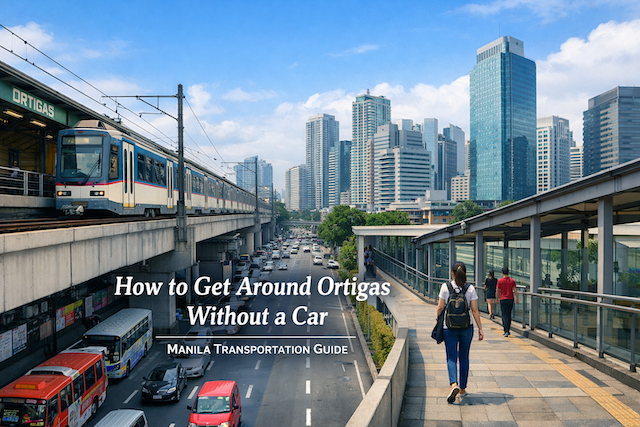
The MRT-3 line is the most important public transport option for Ortigas. Ortigas Station sits directly between SM Megamall and Shangri-La Plaza, making it extremely convenient for commuters.
Using the MRT allows you to travel quickly to nearby business districts such as:
-
Shaw Boulevard and Boni
-
Guadalupe
-
Buendia and Ayala
-
Cubao
-
North Avenue
During peak hours, trains are crowded, but travel time is still predictable compared to road-based transport. For daily commuters, the MRT is often the fastest way in and out of Ortigas.
If you work near Ortigas Center, combining MRT travel with short walking segments is one of the most efficient car-free strategies.
Jeepneys: Affordable and Widely Available
Jeepneys remain one of the most common ways to move around Ortigas and its surrounding areas. They operate along major roads such as Ortigas Avenue, Shaw Boulevard, and EDSA.
Jeepneys are inexpensive and frequent, making them ideal for short to medium distances. Routes connect Ortigas to nearby neighborhoods like Pasig Palengke, San Juan, Mandaluyong, and parts of Quezon City.
However, jeepneys can be confusing for first-time users. Route names are displayed on signboards, and understanding them takes some practice. They are also slower during peak traffic and less comfortable than modern transport options.
Jeepneys work best if you are traveling locally and are flexible with time.
Modern Jeepneys and E-Jeepneys
Modern jeepneys, sometimes air-conditioned and more spacious, are increasingly visible in Ortigas. These vehicles follow fixed routes and designated stops, offering a more organized experience than traditional jeepneys.
They are particularly useful along major corridors and are often preferred by commuters who want a balance between affordability and comfort. Payment systems may include cash or transport cards, depending on the operator.
City Buses and EDSA Busway Access
Ortigas has access to city buses and the EDSA Busway system, which runs along EDSA with dedicated bus lanes. The Ortigas Busway Station is accessible via footbridges and connects commuters to key points along EDSA.
Using the EDSA Busway allows faster north-south travel compared to regular buses stuck in mixed traffic. This option is ideal if you are commuting to or from areas like Cubao, Makati, or Quezon City without using the MRT.
Buses are generally more comfortable than jeepneys and suitable for longer distances.
Ride-Hailing Apps: Grab and Alternatives
Ride-hailing services like Grab are widely used in Ortigas, especially for trips during bad weather, late at night, or when carrying heavy items.
Grab offers predictable pricing and door-to-door convenience. However, fares can increase significantly during peak hours, rain, or high-demand periods. Booking times may also be longer during rush hours.
Ride-hailing works best as an occasional solution rather than a daily commuting method if you are trying to control costs.
Taxis: Use with Caution
Metered taxis are available in Ortigas, especially near malls and hotels. While they can be convenient, experiences vary. Some drivers may refuse short trips or attempt to negotiate fixed fares.
If you choose to use taxis, ensure the meter is used and avoid hailing during peak traffic if possible. Compared to ride-hailing apps, taxis are less predictable but may still be useful in certain situations.
Cycling in and Around Ortigas
Cycling is slowly becoming more viable in Ortigas, though infrastructure is still limited. Some roads have bike lanes, and certain office buildings and condos provide bike parking.
Cycling works best for experienced riders who are comfortable navigating traffic. It is not ideal for everyone due to road conditions, safety concerns, and weather.
For short commutes within Ortigas or to nearby districts, cycling can be efficient and cost-effective if you already have the necessary equipment and confidence.
Electric Scooters and Personal Mobility Devices
Personal mobility devices such as electric scooters are occasionally used within Ortigas, particularly inside private developments and office complexes.
While they can be convenient for short distances, regulations and enforcement vary. Sidewalk conditions and pedestrian traffic also limit where scooters can be used safely.
These devices are best suited for private roads or controlled environments rather than busy public streets.
Tricycles and Local Transport Options
In areas bordering Ortigas, especially near residential zones, tricycles may be available for short trips. They are useful for reaching places not directly served by jeepneys or buses.
Fares are typically negotiated, and availability depends on the specific neighborhood. Tricycles are most practical for last-mile connections rather than long journeys.
Combining Transport Methods for Efficiency
The most effective way to get around Ortigas without a car is often by combining multiple transport options. For example:
-
MRT for long-distance travel, then walking to your destination
-
Busway or jeepney for main routes, followed by short walks
-
Ride-hailing only when necessary
This flexible approach allows you to minimize travel time and cost while adapting to traffic conditions and weather.
Best Strategies for Daily Commuters
For office workers in Ortigas, timing is crucial. Leaving earlier or later than peak hours can dramatically improve your commute. Learning alternative walking routes and nearby transport stops also helps avoid congestion.
Using mobile apps for navigation, traffic updates, and ride-hailing improves decision-making throughout the day.
Is Living in Ortigas Without a Car Practical?
Living in Ortigas without a car is not only practical but often preferable. With access to malls, offices, medical facilities, and public transport, many residents find car ownership unnecessary.
Condos near MRT stations or major roads offer the best experience for car-free living. Proximity to daily necessities significantly reduces the need for motorized transport.
Final Thoughts
Ortigas may be known for traffic, but it is also one of the most accessible districts in Metro Manila without a car. By understanding available transport options and choosing the right combination for your needs, you can move around efficiently, save money, and reduce daily stress.
Whether you are a resident, office worker, or visitor, mastering car-free mobility in Ortigas is a practical skill that pays off every day.
Frequently Asked Questions (FAQs)
Is Ortigas walkable for first-time visitors?
Yes, many parts of Ortigas Center are walkable, especially around SM Megamall, Shangri-La Plaza, and the streets connecting major office towers and condos. Distances between key landmarks can be short, and you will find pedestrian bridges and crossings that help you move between blocks. That said, sidewalk quality is uneven. Some areas have wide, clear paths, while others have narrow sidewalks, obstacles, or crowding near entrances and construction zones. For first-time visitors, it helps to plan routes using a map app and to allow extra time for navigating footbridges and busy intersections.
What is the easiest way to commute to Ortigas without a car?
The MRT-3 is often the easiest and most predictable option for commuting to Ortigas because it avoids road traffic. Ortigas Station is directly connected to major malls and is close to many offices. If the MRT is too crowded or not near your origin point, the EDSA Busway can be a strong alternative for north-south travel along EDSA. For shorter connections, jeepneys and buses along Ortigas Avenue and Shaw Boulevard can work, but travel time varies depending on congestion.
How do I use the MRT-3 for Ortigas trips, and what should I expect?
To use the MRT-3, enter the station, purchase a ticket or use a stored-value card, pass through security, and follow platform signs. During rush hours, expect long lines and crowded trains, especially in the morning and late afternoon. Even when crowded, MRT travel is usually faster than driving or taking road-based transport across EDSA. If you are carrying luggage or traveling with kids, try to avoid peak times and consider ride-hailing for convenience. Also note that pedestrian access between the station and nearby destinations often involves footbridges, so comfortable shoes are important.
Are jeepneys safe and reliable around Ortigas?
Jeepneys are widely used and can be reliable because they run frequently on major corridors. They are also budget-friendly. Safety depends largely on basic precautions: keep valuables secure, avoid displaying phones or wallets, and be mindful in crowded conditions. Reliability is affected by traffic, so jeepneys can be slow during peak hours. If you are new to Manila transport, ask a local or a security guard near malls for route guidance, and confirm the route signage before boarding.
Do modern jeepneys or e-jeepneys operate in Ortigas?
In many Metro Manila corridors, modern jeepneys and e-jeepneys have been introduced to provide a more organized experience with better ventilation and sometimes air-conditioning. In and around Ortigas, you may see them on routes that connect major roads and nearby districts. Stops can be more structured than traditional jeepneys, and some operators use transport cards or cashless options, while others still accept cash. If you prefer comfort and clearer boarding behavior, modern jeepneys can be a good middle-ground between regular jeepneys and more expensive ride-hailing.
What is the EDSA Busway, and how does it help Ortigas commuters?
The EDSA Busway is a dedicated bus lane system that improves bus travel times along EDSA by reducing exposure to mixed traffic. For Ortigas commuters, it can be useful when the MRT is too crowded, disrupted, or inconvenient from your starting point. Busway stations typically require using footbridges for access, and boarding may involve queues similar to train stations. It is a practical option for people traveling between Ortigas and other key EDSA areas such as Cubao, Guadalupe, or Makati.
When should I use Grab instead of public transport?
Grab is best used when you need door-to-door convenience, when it is raining heavily, when you are traveling late at night, or when you have luggage or shopping bags. It can also be useful if you are visiting Ortigas for the first time and want a straightforward route without transfers. However, fares can surge during peak periods, holidays, or storms. If cost matters, consider using public transport for the main portion of your trip and booking Grab only for the final short distance.
Are taxis a good option in Ortigas?
Taxis can be convenient, especially near malls, hotels, and major pickup points. However, the experience is less predictable than ride-hailing. Some drivers may refuse short trips or prefer fixed fares. If you take a taxi, request the use of the meter and be clear about your destination. If the driver refuses to use the meter or seems unwilling to follow a reasonable route, it is better to exit safely and choose another taxi or use a ride-hailing app for clearer pricing.
Can I cycle around Ortigas safely?
Cycling is possible, but it is not equally comfortable on every street. Some roads have bike lanes or wider shoulders, and some buildings provide bike parking, but traffic volume and driver behavior can be challenging for beginners. If you choose to cycle, wear visible clothing, use lights, and plan routes on calmer streets when possible. Cycling can be efficient for short commutes within Ortigas or to nearby areas, but weather and road conditions are major factors in daily practicality.
What is the best “last-mile” option inside Ortigas?
The best last-mile option depends on distance, weather, and time of day. For short distances, walking is usually the fastest. If it is raining or you are carrying items, Grab or a taxi may be worth it for the final leg. In some bordering neighborhoods, tricycles may be available for short hops, but fares are often negotiated and availability can vary. A common strategy is to use MRT or Busway for the main commute, then walk the final 5 to 15 minutes.
How can I avoid rush-hour stress when traveling around Ortigas?
Rush-hour stress is largely managed by timing and route planning. If your schedule allows, commute earlier in the morning or after the peak period. Choose MRT or Busway for predictable travel times, then walk short distances within Ortigas. Keep a backup plan: if the train line is crowded or delayed, switch to Busway or ride-hailing. For short trips, walking can beat traffic. Finally, carry a small umbrella or rain jacket, because sudden rain can cause demand spikes for rides and slow down road transport.
Is living in Ortigas without a car realistic long-term?
Yes. Many residents live comfortably without a car because Ortigas has dense access to groceries, malls, clinics, gyms, and public transport connections. If you choose housing close to MRT stations, major roads, or central mall areas, your daily errands become easier on foot. Long-term success depends on choosing the right location, learning a few transport routes, and using ride-hailing strategically instead of daily. For many people, the money saved on car ownership can be redirected to occasional convenience rides when needed.

How to Register for eTravel Philippines (2025 Guide)
Step-by-step guide to completing your eTravel registration before arriving in the Philippines, with images and tips.

Night Market in Cebu – Things You Don’t Know About Cebu Life
Discover the hidden charm of Cebu’s night markets, from street food stalls to local life tips you won’t find in tourist guides.

How to Use ChatGPT for IELTS Preparation: A Complete Guide
Learn how to prepare for IELTS using ChatGPT — including strategies for Writing, Reading, Listening, Speaking, and grammar support.

How to Build a Website Without Coding Using ChatGPT
Discover how to build your own website using AI—no coding skills needed. From structure planning to SEO and design, let ChatGPT guide you.