
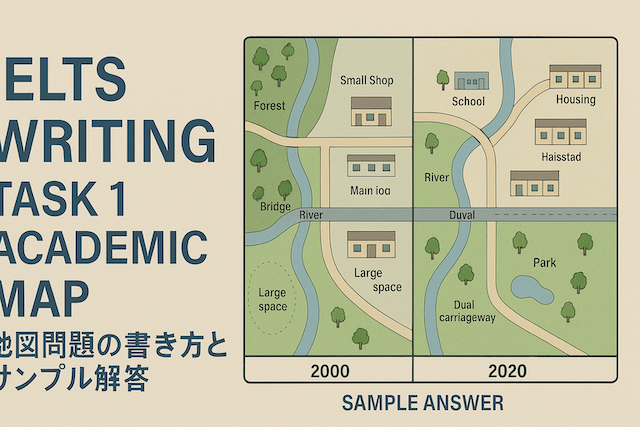
IELTS Writing Preparation
How to Write IELTS Writing Task 1 Academic Maps and a Sample Answer
01
Introduction
Among IELTS Writing Task 1 questions, map questions are the type that test takers find especially confusing. Instead of comparing numbers as in graphs and tables, you are asked to describe in words how places have changed and how an area has been developed. This requires the ability to organize visual information and express it accurately in English.
A typical question shows a comparison of a town or facility in the past and the present, or the present and a future development plan. You must clearly convey what has changed, what has been added or removed, and what the overall trend is.
This article introduces the features of map questions, the basic structure of an answer, useful expressions and a sample answer. By the time you finish reading, you should be able to approach map questions with confidence.
02
Basic Answer Structure (4 Paragraphs)
For IELTS Writing Task 1 map questions, you need to write a report of at least 150 words. To meet the marking criteria, it is important to organize the information logically and describe it in a suitable order. The recommended structure is the following 4 paragraphs.
1. Introduction
- Begin by paraphrasing the question.
- Example: The maps illustrate the changes in a town center between 1990 and 2020.
The key point is not to copy the question word for word. Use synonyms to rephrase it.
2. Overview
- Summarize the overall changes and trends in 1-2 sentences.
- Example: Overall, the area underwent significant modernization, with farmland replaced by residential and commercial facilities.
- You do not need detailed explanations here; what matters is showing the big changes from a bird's-eye view.
3. Details 1 (Details - Part 1)
- Choose one part of the map (e.g., the north side or the left side) and explain concretely the changes that happened there.
- Write about buildings added or removed and roads widened, together with location information.
4. Details 2 (Details - Part 2)
- Describe the remaining areas.
- Keeping contrast in mind and using phrases such as 'on the other hand' and 'in another area' will make your description cohesive.
Key points
- In each paragraph, describe location + change as a pair.
- Always write an overview (leaving it out tends to hold you to Band 6.0 or below).
- The focus is on describing change, not comparing numbers.
03
Frequently Used Expressions (Useful Phrases)
For map questions, vocabulary that accurately expresses location and change is essential. Frequently used expressions are organized below by category.
1. Expressions for change
- Addition and construction was built / was constructed was established / was introduced
- Removal and disappearance was removed / was demolished disappeared / no longer existed
- Replacement and conversion was replaced by was transformed into was converted into
- Extension and development was extended / was expanded was enlarged
- Staying the same remained unchanged stayed the same
2. Expressions for location
- Direction to the north/south/east/west of in the northern/southern part of
- Specifying a place in the center of / at the corner of along / beside / adjacent to near / next to
3. Expressions for comparison
- while / whereas / in contrast
- compared to / as opposed to
- on the other hand
4. Expressions you can use in the overview
- Overall, it can be seen that…
- In general, the area experienced dramatic changes…
- The most noticeable development is that…
- A significant transformation took place in…
Advice
- Combining change + location makes it easier to earn marks. Example: A new shopping mall was constructed in the northern part of the town.
- Avoid repeating the same verb and use synonymous expressions to make your English sound natural.
04
Sample Question and Model Answer
Sample question
The maps below show a town center in 1990 and after redevelopment in 2020.
(The maps below show the center of a town in 1990 and after redevelopment in 2020.)
Sample answer (about 170 words)
IntroductionThe maps illustrate the transformation of a town center between 1990 and 2020.
OverviewOverall, the area underwent major redevelopment, with farmland being replaced by housing and commercial facilities, while new transport infrastructure and green spaces were introduced.
Details 1In 1990, the northern part of the town was mainly occupied by farmland. By 2020, this land had been converted into a residential estate, significantly increasing the number of houses in the area. Moreover, the central marketplace was replaced by a modern shopping mall, becoming the focal point of the new layout.
Details 2In the southern section, the old school was demolished and a new university campus was built in its place. Additionally, the road network was expanded to improve access, and a bus station was constructed in the western part of the town. Furthermore, a large public park appeared in the east, providing more recreational areas for residents.
Key Points of the Answer
- Paraphrase the introduction Do not copy the question; rephrase it.
- Show the big picture in the overview Write the major changes first (farmland changed into residential areas, public facilities were added).
- Organize the details by area Dividing the description, for example into north and south, makes it logical.
- Use change verbs and location expressions as a pair such as was replaced by, was constructed in the northern area.
If you keep this flow in mind, you can write answers that consistently aim for Band 7.0 or higher even on map questions.
05
Summary
Unlike graph questions that compare numbers, IELTS Writing Task 1 map questions test your ability to put the changes on a map into words. The key points for scoring consistently are as follows.
- Always write an introduction and an overview Introduce by paraphrasing the question, and summarize the overall changes from a bird's-eye view.
- Organize the details by area Dividing them into north/south or center/outskirts makes your writing logical and easy to read.
- Combine location expressions and change expressions Example: A new shopping mall was constructed in the northern part of the town.
- Do not repeat the same expressions Besides 'was built', use 'was constructed', 'was established' and so on.
Map questions feel difficult until you get used to them, but once you master a patterned answer structure you can handle them consistently. Use the sample answer and phrases introduced in this article as a reference and practice with actual past papers and mock questions.
06
FAQ: How to Write Task 1 Academic Map Questions and a Sample Answer
What is an IELTS Task 1 map question? How is it different from graph questions?
Instead of comparing numbers, you describe changes in the layout on the maps (additions, removals, replacements, expansions and changes of use) in chronological order. The core is to make the comparison clear (past to present, or present to future plan) and to state location + change as a pair.
How many words should I write? How should I manage my time?
At least 150 words. As a guide, spend 20 minutes (3 for planning, 14 for writing and 3 for checking). Prioritize the overall picture and representative changes over lengthy details.
How should I structure the paragraphs?
We recommend 4 paragraphs: (1) introduction (paraphrase), (2) overview (big picture), (3) details 1 (area A), (4) details 2 (area B). Dividing the areas, for example into north/south or center/periphery, makes it logical.
How should I use tenses?
Past to present: past simple or present perfect passive (e.g., was replaced, has been converted). Future plans: passive + be going to / is planned to / will be. Parts that do not change take the present simple (remains unchanged).
What should I write in the overview?
Summarize the most noticeable changes in about 2 sentences (e.g., farmland to housing, expansion of transport infrastructure, new parks). The trick is to show the general trend without proper nouns or fine details.
How should I use location expressions? Are compass directions required?
Use to the north/south/east/west of, in the northern part, along, adjacent to and so on. Use compass directions if the map gives them; if not, relative expressions such as left/right, central, riverside and coastal are fine.
My vocabulary is monotonous with all the passives. How can I improve it?
Rotate synonymous expressions: was built/constructed/established, was removed/demolished, was converted/transformed into, was expanded/extended. Use collocations (the road network was expanded) to sound more natural.
How much detail should I write? I cannot cover everything.
You do not need to list every element. Prioritize representative changes, landmarks and main categories such as transport, green space and housing. Skip tiny moves of small shops and show the pattern (merging, expansion, relocation).
What are the tips for writing comparisons?
Build logic with contrast connectors (while, whereas, in contrast) and by dividing the map into areas. Example: While the northern farmland was converted into housing, the southern area saw the construction of a university campus.
What if the map orientation differs or the legend is unclear?
Describe based on the direction arrow given. If it is unclear, use neutral expressions such as center/edge/along the river. Avoid guessing purposes or intentions, and write only the facts shown in the maps.
How do I express 'no change'?
Use remained unchanged / stayed the same / was retained. Example: The bridge in the southeast remained unchanged. Showing whether something has changed or not through contrast makes it easier to read.
What are common mistakes? How can I prevent them?
Missing overview -> always summarize the big picture in 2 sentences Mere listing and missing directions -> organize by area + direction Subjective opinions and guessing reasons -> only facts shown in the maps Monotonous vocabulary -> rotate synonymous expressions
What grammar and expression points raise my score?
Varied passives, comparative structures, compound prepositions (adjacent to, in the vicinity of) and nominalization (redevelopment, extension). Create cohesion with Furthermore, Additionally, Meanwhile and so on.
Is the writing the same when there is only one map (a layout description)?
If there is no comparison, explain the spatial layout systematically by zoning (north/south/center). In the overview, summarize the distribution of the main functions (residential, commercial, educational, transport).
What templates can I use in a sample? (introduction/overview)
Introduction: The map(s) illustrate(s) the layout/changes of ... between YEAR and YEAR. Overview: Overall, the area experienced substantial redevelopment, with X being replaced by Y, and Z being introduced/expanded.
What should I watch out for when describing future plans (proposals)?
Avoid describing things as certain. Use planning and expectation expressions such as is planned to be built / is expected to see / will be constructed.
There are many place names and proper nouns. How should I organize them?
Avoid repetition: use a higher-level category (a retail complex) first, and add the proper name (Riverside Mall) only when necessary. Keep Cohesion with reference pronouns (it/the facility/the site).
How do I adjust if I am under or well over 150 words?
If short: add one more major change to the overview and a location phrase to each detail. If over: delete repetition, compress redundant explanations of proper nouns and narrow down to representative examples.
How should I practice? What should I check when studying alone?
Memorize the direction vocabulary list and use it right away In 3 minutes, divide the areas and note 3 main changes After finishing, check the consistency from overview to details by reading backward
Where do the differences between bands appear? (brief)
Band 6: There is an overview but the details are more of a list, with repeated vocabulary. Band 7: Clear overview, logical structure by area, variety of vocabulary and structures. Band 8+: Selective and consistent choice of information, precise location expressions and natural cohesion.
07
Related article
08
Recommended Course
The first step in IELTS preparation is choosing the right environment
With one-on-one classes and real-format mock exams, we help you reach your target score by the most direct route.