
IELTS Writing Preparation
IELTS Writing Task 1 General: Letter Structure and Samples (Formal / Informal)
01
Introduction
IELTS General Training Writing Task 1 sets a **letter-writing (Letter Writing) task. Candidates write at least 150 words in English and must switch between Formal and Informal styles depending on the situation. In some cases, a style in between, Semi-formal, is required.**
The point of this task is not simply writing a letter in English, but showing that you can choose an appropriate tone and expressions according to your relationship with the reader and the situation. For example, complaints or requests to a company should be written formally, while invitations to a friend or news updates should be written informally.
This article introduces the basic structure of Task 1 General, the differences between formal and informal letters, and actual sample answers. Understanding these will let you write natural letters suited to the situation on exam day.
02
Question Patterns
The letters set in IELTS General Writing Task 1 vary with the situation, but they can be broadly divided into the following patterns.
1. Formal
Letters to business or official recipients. Write in a respectful tone and avoid contractions (can't, don't, etc.).
- Making a complaint
- Making an inquiry to a company or government office
- Applying for a job or asking for a recommendation
2. Semi-formal
Letters to someone you don't know well or with whom there is some distance, such as a neighbor or a teacher. Write in a style that is less stiff than formal and less casual than informal.
- Greeting a new neighbor
- Making a request to a school teacher
- Asking a neighbor for help
3. Informal
Letters to close people such as friends and family. Actively use casual expressions and contractions.
- Inviting a friend
- Sharing your impressions of a trip
- Giving news about yourself
In the exam, the "recipient and situation of the letter" are always given, so the key to success is first judging the relationship with the recipient correctly and deciding whether to write formally or informally.
03
Basic Structure of a Letter
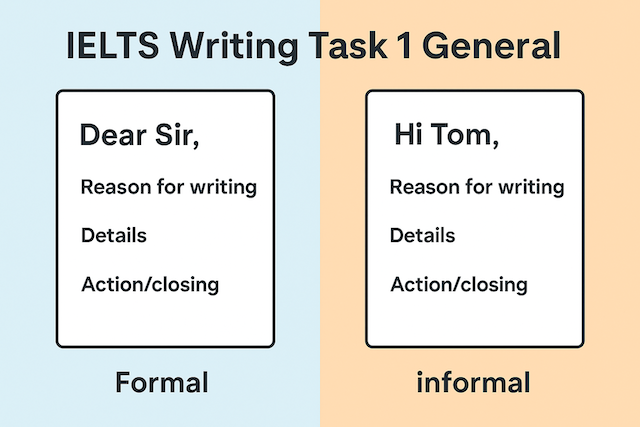
IELTS General Writing Task 1 requires not only the content of the letter but also a clear, easy-to-read structure. Keep the following three-part structure in mind.
1. Greeting
Choose the correct form of address according to the recipient.
- Formal: Dear Sir or Madam, / Dear Mr. Smith,
- Informal: Hi Tom, / Dear Anna,
2. Body
The body is easier to read if divided into two or three paragraphs. The question always gives "three points", so it is natural to cover one in each paragraph.
- Introduction: briefly state the purpose of the letter
- Details: specific explanation and description of the situation
- Request or closing: the action you want from the reader and a final remark
3. Closing
Choose an appropriate closing phrase to match the style.
- Formal: Yours faithfully, / Yours sincerely,
- Informal: Best regards, / Cheers, / Take care,
Key points
- Dividing and organizing your text into paragraphs makes it easier for the examiner to follow your content.
- Be careful: if you do not cover all three points given, marks will be deducted.
04
Differences in Style (Formal vs Informal)
The most important thing in IELTS General Writing Task 1 is to switch styles to suit the recipient. There are big differences in vocabulary and tone between formal and informal letters.
1. Greeting
- Formal: Dear Sir or Madam, / Dear Mr. Brown,
- Informal: Hi Mike, / Dear Emma,
2. Style of expression
- Formal: polite and proper expressions. Avoid contractions (cannot, do not, etc.).
- Informal: friendly and casual. Use contractions and everyday expressions (can't, don't, thanks).
3. Vocabulary differences
4. Closing
- Formal: Yours faithfully, / Yours sincerely,
- Informal: Best, / Cheers, / See you soon,
Marks are deducted if you get the style wrong, so the key to success is first to check carefully "who the recipient is" and choose expressions that suit them.
05
Sample Answer (Formal)
Example question: You are not satisfied with the service at a hotel. Write a letter to the manager. In your letter:
- Explain why you chose the hotel
- Describe the problem you had during your stay
- Say what actions you would like the manager to take
Sample answer (about 170 words)
Dear Sir or Madam,
I am writing to express my dissatisfaction with the service I experienced during my recent stay at your hotel.
I selected your establishment because of its excellent reputation and its convenient location near the city center. Unfortunately, the service did not meet my expectations. The room I was given was not properly cleaned, and the air conditioning unit did not function throughout my three-night stay. Although I reported the issue twice to the reception staff, no action was taken to resolve the matter.
This situation caused significant discomfort and inconvenience. I kindly request that you investigate the problem, ensure that such issues do not occur in the future, and consider offering a partial refund as compensation.
I look forward to receiving your response at your earliest convenience.
Yours faithfully,[Your Name]
This example consistently uses **formal expressions (no contractions, polite vocabulary)** and covers the three points specified in the question.
06
Sample Answer (Informal)
Example question: Write a letter to your friend inviting him/her to stay at your house. In your letter:
- Tell him/her about your new house
- Describe the neighborhood
- Invite him/her to stay with you
Sample answer (about 160 words)
Hi Sarah,
I hope you’re doing well! I just wanted to share some exciting news with you — I recently moved into a new house, and I think you would love it.
The place is much bigger than my old apartment, with two bedrooms, a cozy living room, and even a small garden where we can have coffee in the morning. The neighborhood is really nice too. It’s quiet and safe, with a supermarket, a park, and a lovely little café just around the corner.
I’d really like you to come and stay with me for a few days. It’s been such a long time since we last met, and this would be the perfect chance to catch up. Let me know when you’re free, and I’ll make sure the guest room is ready for you.
Take care,[Your Name]
This example uses **informal expressions (contractions and casual vocabulary)** and aims for a natural, friendly tone.
07
Summary
IELTS General Writing Task 1 tests your ability to write an appropriate letter according to the recipient and the situation. The key points are as follows.
- Choosing the style correctly is the most important thing Business or official recipients -> Formal Close recipients such as friends and family -> Informal Recipients with a little distance, such as teachers and neighbors -> Semi-formal
- The basic structure has three parts Greeting Body Closing
- Always cover the three points given in the question -> It is easier to write if you explain one point per paragraph.
- Keep vocabulary and tone consistent -> In formal letters, use polite expressions such as "cannot / request / inconvenience"; in informal letters, use casual expressions such as "can't / ask / trouble".
By repeatedly practicing switching styles, you will be able to write natural and appropriate letters on exam day too.
08
Sample Answer (Semi-formal)
Example question: You have recently moved to a new house and would like to introduce yourself to your new neighbor. Write a letter to your neighbor. In your letter:
- Introduce yourself and your family
- Describe your new house
- Invite your neighbor to come over
Sample answer (about 165 words)
Dear Mr. Johnson,
I hope this letter finds you well. My name is Emily Brown, and my family and I have just moved into the house next door at number 24. We are very excited to join the neighborhood and look forward to meeting the people who live around us.
Our new home has three bedrooms and a small backyard, which my children are especially thrilled about. We have already started to settle in, but we are still getting to know the area and would really appreciate any advice you could share about local shops or community activities.
I would also like to invite you to our home next weekend for a cup of tea. It would be a wonderful opportunity to get to know each other better. Please let me know if you are available.
Yours sincerely,Emily Brown
Key points of semi-formal
- Make the greeting and closing polite (leaning formal).
- However, make the body a little softer and show friendliness.
- Suitable for neighbors, teachers, host families, etc.
09
FAQ: Task 1 General Letter Structure and Samples (Formal / Informal)
How many words are required for IELTS General Writing Task 1, and what is the time limit?
The minimum is 150 words, and 160-190 words is recommended. Aim to spend around 20 minutes, and use the remaining 2-3 minutes for review.
What are the marking criteria?
Four criteria (25% each): Task Achievement (fully covering the three points in the instructions), Coherence & Cohesion (logic and paragraph structure), Lexical Resource (appropriateness and variety of vocabulary), Grammatical Range & Accuracy (range and accuracy of grammar).
How do I tell Formal / Semi-formal / Informal apart?
Judge by your relationship with the recipient. Companies and public bodies -> Formal; teachers and neighbors -> Semi-formal; friends and family -> Informal. Always check the recipient and situation in the question.
Can I use contractions (can't, don't)?
In Formal, avoid them and use cannot, do not. In Informal, contractions are fine. In Semi-formal, it is safer to avoid them.
Can I use bullet points?
Basically, a paragraph structure is preferable, and excessive bullet points risk losing marks. A short list for emphasis is acceptable, but do not make the whole letter bullet points.
What is the basic structure? How many paragraphs?
Four paragraphs are recommended: greeting + purpose, detail 1, detail 2, closing. Assigning the three points in the question to paragraphs helps you avoid leaving anything out.
What are the standard forms for greetings and closings?
Formal greeting: Dear Sir or Madam, / Dear Mr/Ms + surname, Informal greeting: Hi Tom, / Dear Anna, Closing (Formal): Yours faithfully, (name unknown) / Yours sincerely, (name known) Closing (Informal): Best regards, / Cheers,
What if the recipient's gender or name is unknown?
Use Dear Sir or Madam, and close with Yours faithfully,. Avoid guessing.
Should I write my address and the date?
They are not needed in the exam. Concentrate on the body, write at least 150 words, and make sure you cover the three points in the question.
How do I adjust the tone?
In Formal, use polite and objective vocabulary (request, inquire, inconvenience). In Informal, use natural and friendly expressions (tell, help, sorry). Keep the style consistent from the opening to the closing.
What are common penalty patterns?
Missing any of the three points in the question Style mismatch (e.g. being overly formal to a friend) Too few paragraphs, leaps in logic, too few linking words Excessive contractions or colloquial language, spelling mistakes
How wide a range of vocabulary is needed?
Avoid repetition with synonymous expressions, and use accurate collocations (e.g. file a complaint, request a refund, arrange an appointment). Prioritize accuracy over forced difficult words.
Which linking words should I use?
Formal: However, Furthermore, Consequently, Therefore. Informal: Anyway, Besides, So, etc. Choose according to the style.
British or American English?
British English is the safe choice for IELTS (colour, organise). You will not lose marks as long as you are consistent, but do not mix them partway through.
What are the tips for time allocation?
Planning (2-3 minutes): note the recipient, purpose and an outline of the three points Writing (14-15 minutes): develop it in four paragraphs Review (2-3 minutes): check word count, style, spelling and coverage of the three points
What are polite phrases for complaint and request letters?
Complaint: I am writing to express my dissatisfaction with... Request: I would appreciate it if you could... Proposing compensation: I would like to request a partial refund/replacement.
What are natural expressions in Informal letters?
Just wanted to let you know… It’d be great if you could… Let me know when you’re free.
Can I use templates?
Having a "pattern" is effective, but avoid copying it word for word; customize it with the specific information in the question (to whom, what, why, when). If you use only generic expressions, your Task Achievement score will not rise.
How specific should I be?
Make facts, reasons, results and requests specific (when/where/how long). However, leave out unnecessary proper names or addresses, and keep to details you can handle within the exam time.
How do I show a range of grammar?
Use consistent tenses, relative clauses, conditionals (If you could..., I would...) and modals (would, could, should) appropriately.
What is a review checklist?
At least 150 words? (neither too few nor too many) Full coverage of the three points in the question Consistent style (use of contractions, closing) Natural paragraphing and linking words Spelling, subject-verb agreement, articles
How do I write Semi-formal?
Make the greeting and closing lean formal (Dear Mr. ... / Yours sincerely,). Use polite but friendly vocabulary in the body, and basically avoid contractions.
How should I write numbers and dates?
Prioritize readability, and in Formal write dates like on 15 July. Avoid ambiguity.
Are marks deducted for going over the word count?
There is no clear penalty rule, but if you are wordy, the logic becomes scattered. Keeping to about 160-190 words is stable.
What is the recommended process for practice?
Decide the recipient and style immediately from the question Assign the three points to paragraphs and outline them Prepare one stock sentence each for the opening and the closing Practice from start to finish with a timer -> self-mark
What are frequently used functional expressions (reusable)?
Stating the purpose (Formal): I am writing to enquire about... / to request... Suggestion: Would it be possible to...? Thanks: I would be grateful for your assistance. Invitation (Informal): Why don't you come over this weekend?
10
Related article
11
Recommended Course
The first step in IELTS preparation is choosing the right environment
With one-on-one classes and real-format mock exams, we help you reach your target score by the most direct route.