
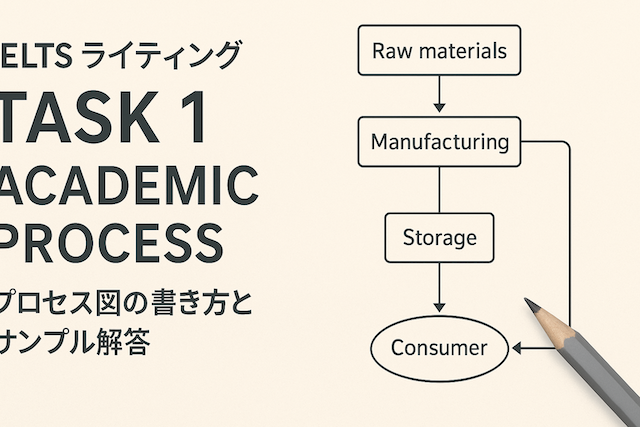
IELTS Writing Preparation
How to Write IELTS Writing Task 1 Academic Process Diagrams and a Sample Answer
01
Introduction
In IELTS Writing Task 1 Academic, you may be given not only bar charts and pie charts but also a "Process Diagram". A process diagram illustrates the manufacturing process of a product or the flow of a natural phenomenon, and candidates are expected to explain that flow objectively and logically.
Unlike questions that compare figures, it is important to convey the order of the stages and the cause-and-effect relationships accurately. For this reason, it is also a question type that leaves many candidates unsure about "where to start writing" and "what expressions to use".
This article explains clearly how to approach process diagram questions in practice, through their characteristics, the basic writing flow, useful expressions and a sample answer.
02
Characteristics of Process Diagram Questions
The process diagram question in IELTS Writing Task 1 tests your ability to explain a flow or process in order, rather than to analyze or compare figures. The differences from other graph questions and the points to watch are as follows.
1. No numerical data appears
Unlike line graphs and bar charts, you do not need to compare numbers or percentages. Instead, you are required to describe the stages in the correct order.
2. A clear beginning and end
Process diagrams often have a clear starting point and end point. Examples include "the process of making bricks from clay" and "the water cycle in which rain returns from rivers to the sea". In the overview, it is important to capture this "beginning" and "end".
3. Two types: natural phenomena and man-made processes
The process diagrams that appear fall broadly into the following two types.
- Man-made processes: manufacturing processes of industrial products (brick production, coffee production, etc.)
- Natural processes: cycles in the natural world (the water cycle, growth life cycles, etc.)
4. You need to explain objectively
No opinions or speculation are needed at all. The key is to describe only the elements in the given diagram, in neutral and accurate English.
5. Vocabulary and grammar points
- Use the passive voice (is heated, are collected, etc.) frequently
- Use sequencing expressions (first, next, subsequently, eventually) to describe the flow smoothly
- Keep in mind a four-paragraph structure: "overall picture → details of the first half → details of the second half"
03
Basic Structure (4 Paragraphs)
Process diagram questions explain the flow of a process rather than comparing figures, so how you construct your text is very important. For IELTS Task 1 Academic, the following **4-paragraph structure** is the most effective.
1. Introduction
- Paraphrase the question statement and state "what process it is".
- Since there are no figures, the key is to keep it brief, in 1 to 2 sentences.
- Example: The diagram illustrates the process of producing bricks for the construction industry.
2. Overview
- Summarize the overall picture of the process.
- State the start and the end clearly, and mention the number of steps and any distinctive elements.
- This is the part that is emphasized in Task 1 marking.
- Example: Overall, the process consists of seven stages, beginning with digging clay and culminating in the delivery of the bricks.
3. Details 1 (Body 1: the first half of the process)
- Explain the **first half of the diagram (from the start to the middle)**.
- Describe the stages in order, making use of linking words and time expressions.
- Example: first, then, next, after that, subsequently
4. Details 2 (Body 2: the second half of the process)
- Explain from the middle to the final stage.
- Mention any branching or merging.
- Finally, show the flow leading to the "finished product or result".
Key points:
- Always explain in chronological order
- Use the passive voice actively to keep the explanation objective
- Do not make sentences too short; adding linking expressions between stages makes the flow natural
04
Commonly Used Expressions and Vocabulary
In process diagram questions, vocabulary that explains the flow of the process smoothly and the passive voice for objective description are important. The following is a list of frequently used and useful expressions.
1. Expressions for sequence
- first / firstly
- next / then
- after that
- subsequently
- following this
- afterwards
- in the next stage
- eventually / finally
Essential when explaining stages in chronological order. They act as the glue of your text.
2. Expressions for the flow of the process
- begins with / starts with: starts with ...
- ends with / finishes with: ends with ...
- is followed by: comes after ...
- consists of: is made up of ...
- involves: includes ...
- undergoes: goes through ...
3. Passive expressions (commonly used verbs)
- is heated (gets heated)
- is cooled (gets cooled)
- is collected (gets collected)
- is transported (gets transported)
- is processed (gets processed)
- is delivered (gets delivered)
- is stored (gets stored)
Process diagrams focus not on "who" but on "what is processed and how", so the passive voice is central.
4. Useful expressions for describing diagrams
- passes through: goes through ...
- flows into: flows into ...
- moves to / goes into: moves to ...
- enters: goes into ...
- exits: comes out of ...
- transforms into: changes into ...
5. Vocabulary for natural processes
- evaporation
- condensation
- precipitation
- accumulation
- cycle / circulation
Tip:
- Combining sequencing expressions with the passive voice produces logical, academic writing. Example: First, the mixture is heated and subsequently cooled before being packaged.
05
Sample question and model answer
Sample question
The diagram shows the process of making bricks for the building industry.
Model Answer (about 180 words)
IntroductionThe diagram illustrates the process of producing bricks that are used in the construction industry.
OverviewOverall, the production of bricks involves seven main stages, starting with the digging of clay from the ground and culminating in the delivery of finished bricks to customers.
Body 1At the initial stage, clay is dug up by a digger and placed on a metal grid where larger pieces are broken down. The filtered clay then passes through a roller, after which sand and water are added to form a mixture. This mixture is shaped into bricks either by using a wire cutter or by pouring it into moulds.
Body 2In the subsequent stage, the raw bricks are dried in a drying oven for 24 to 48 hours. They are then heated in a kiln at moderate temperatures (200–980°C) before being exposed to a higher temperature (870–1300°C). Following this, the bricks are cooled in a cooling chamber for 48 to 72 hours. Finally, the finished bricks are packaged and delivered to the construction industry.
06
Explanation Points
- Introduction: paraphrase the question statement to open
- Overview: summarize the number of steps and the beginning/end
- Body: divide the process into first and second halves, using sequencing expressions and the passive voice
- Word count: around 180 words, meeting the Task 1 standard (at least 150 words)
07
Summary
The process diagram question in IELTS Writing Task 1 Academic is a special type that measures your ability to **explain a flow or process in order**, rather than compare figures.
The key points are as follows.
- Keep in mind the 4-paragraph structure (Introduction → Overview → first-half process → second-half process)
- Make the flow clear with sequencing expressions (first, next, subsequently, finally, etc.)
- Describe objectively by using the passive voice (is heated, are collected, is processed, etc.) frequently
- Always summarize the **beginning and end** in the overview
Because there are no figures and every candidate explains the same diagram, it is hard to create a gap between candidates, but whether you can firmly grasp the overall picture and write logically and readably is what separates scores.
When practicing, using official practice books and past examples to repeatedly practice the essay pattern and usable expressions is the shortcut to a high score.
08
FAQ: How to Write Task 1 Academic Process (Process Diagram) and a Sample Answer
What is the IELTS Task 1 "process diagram"?
It is a question that is not a numerical graph but asks you to explain the "flow" of a manufacturing process or natural phenomenon in chronological order. Based on the diagram, describe it objectively, with neither too much nor too little.
What is the basic structure? (4 paragraphs)
Introduction (paraphrase) → Overview (beginning, end, number of steps) → Body 1 (first-half process) → Body 2 (second-half process).
How many words should I write?
At least 150 words. Aim for around 160-190 words, covering the information without becoming wordy.
What tense should I use?
Because the diagram shows a general flow, use the present simple as the basis. Examples: is heated, flows, undergoes.
Is the passive voice required?
Because it is "things" rather than people that are processed, using mostly the passive voice is natural. Examples: is mixed, are filtered, is delivered.
What should I write in the overview?
The overall picture of the process: the starting point, the end point, the number of main steps, and whether there is branching or merging. Do not include fine details or figures.
How do I explain parallel (simultaneous) stages?
Use expressions that show "simultaneity": Meanwhile, In parallel, At the same time, concurrently. Also state clearly the point where they merge later.
What if a cycle (for example, the Water Cycle) has no beginning or end?
Set a convenient starting point and make clear that it is "a cycle". Example: Overall, the cycle is continuous, beginning with evaporation and eventually returning to the ocean.
What should I do if arrows or symbols are not labeled?
Use neutral expressions without guessing from the diagram: an unidentified chamber, a set of filters, a series of pipes. Avoid unnecessary speculation.
What are the typical linking words?
first, next, then, after that, subsequently, afterwards, in the next stage, finally/eventually. For parallel stages, meanwhile.
What vocabulary is essential for natural processes?
evaporation, condensation, precipitation, accumulation, infiltration, runoff, cycle, etc.
What vocabulary is essential for industrial processes?
is heated/cooled, is mixed, is filtered, is molded/cut, kiln/furnace, conveyor, chamber, packaging, etc.
Do I need to make comparisons even though there are no figures?
Comparison is not needed. Instead, explain the order, cause and effect, branching/merging, and the length of time (only if it is stated in the diagram).
Should I write every detail in the diagram?
Prioritize the important stages and group minor parts together. Summarize using a series of / several.
What are common penalty patterns?
Missing overview Speculation or subjective views ("efficient", "dangerous", etc.) Confused chronology or missing stages Colloquial or non-academic vocabulary
How can I exceed 150 words without being wordy?
Group the stages into chunks (first half / second half). Shorten similar steps with parallel expressions: is cleaned, mixed and molded.
How do I write a branch? (diamond symbols, etc.)
Put the conditional branch into words, such as: At this point, the flow splits into two paths… / Depending on the condition, the material either A or B…
Can I use the labels in the diagram as they are?
Yes, that is appropriate. However, mix in paraphrases (synonyms) to avoid repetition and keep the text readable.
How should I handle times or temperatures that are written in the diagram?
If they are stated in the diagram, describe them objectively: for 24-48 hours, at 200-980°C. If they are unclear, do not guess.
How should I plan and allocate time?
A guide for the whole task is 20 minutes: planning 4-5 minutes, writing 12-13 minutes, checking 2-3 minutes. Write the overview first.
Spelling and variation (British/American)
Either is acceptable, but be strictly consistent. Example: mould (UK) / mold (US).
What if there are multiple diagrams (two or more)?
Group them by common purpose or input/output, and state differences briefly through contrast. Separate the paragraphs to avoid mixing them up.
What is important in the marking criteria?
Task Achievement (coverage including the overview), Coherence & Cohesion (logical development and linking words), Lexical Resource (appropriate vocabulary), Grammar (accuracy and variety).
Is there a template example?
Fit the stages into the skeleton: The diagram illustrates… Overall, the process consists of… Initially,… Subsequently,… Finally,…
What is a proofreading checklist?
Is there an overview Are the sequencing expressions working Is the passive voice natural Have any speculative expressions crept in Consistency of spelling / units / tense
09
Related article
10
Recommended Course
The first step in IELTS preparation is choosing the right environment
With one-on-one classes and real-format mock exams, we help you reach your target score by the most direct route.