
Doctor Study Guide
What Is the Residency Match? How It Works and Strategies to Succeed | Doctor Study Guide
01
Introduction
If you aim to work as a doctor overseas, particularly in the United States, the biggest hurdle you cannot avoid is the “Residency Match.”
This is not simply job hunting. It is a highly structured, nationwide matching system, and the outcome can shape the course of your entire medical career.
- Passing the USMLE alone is not enough
- English ability alone is not enough
- Academic and career credentials alone are not enough
It is an all-round contest in which all of these are evaluated together, and it is extremely hard to get through without a strategy.
In this article, we explain:
- How the Residency Match works
- The actual flow (timeline)
- What is evaluated
- The barriers Japanese doctors face
- Concrete strategies for succeeding
in depth, in more than 3,000 words.
02
What Is the Residency Match?
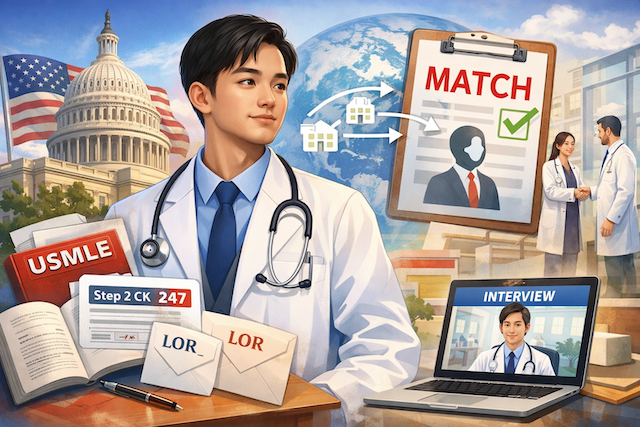
The Residency Match is the “nationwide unified matching system” through which doctors secure clinical training (residency) in the United States.
Its official name is:
**NRMP (National Resident Matching Program)**
In this system,
- doctors (applicants) and
- hospitals (programs)
each submit their preference rankings, and an algorithm determines the optimal pairings.
Key points
- It is not “first come, first served”
- It is not decided by “interview performance” alone
- It is not decided by “scores” alone
→ It is decided by a combination of overall evaluation and preference rankings
03
Why does the Match exist?
To make the hiring of doctors fair.
If hiring relied only on open applications,
- applications would concentrate on popular hospitals,
- applicants would feel anxious (the pressure to decide quickly),
- and hospitals would try to lock candidates in,
among other problems.
So the following were introduced:
- simultaneous applications,
- simultaneous evaluation, and
- simultaneous announcement of results.
That is the system that was built.
04
How the Matching Works
The core of the Residency Match is the “rank order list.”
Applicant side
You rank hospitals in the order you want to go:
1st: Hospital A 2nd: Hospital B 3rd: Hospital C
Hospital side
They rank the candidates they want to hire:
1st: Candidate X 2nd: Candidate Y 3rd: Candidate Z
05
Features of the Matching Algorithm
This system uses an “applicant-proposing algorithm.”
In other words:
Doctors’ preferences are respected as much as possible
The simple flow
- Your first-choice program is considered first
- It is checked against the hospital’s rank order list
- If there is room within its quota, you are provisionally matched
- If a higher-ranked candidate comes along, the places are swapped
This process is repeated until the final result is determined.
06
Annual Residency Match Schedule
(1) ERAS submission (around September)
- Submit your application documents
- Curriculum vitae (CV)
- Personal Statement
- Letters of recommendation (LOR)
(2) Interview season (October to January)
- Online or in person
- Many applicants have dozens of interviews
(3) Rank Order List submission (February)
- Submit your ranked preferences
(4) Match Week (March)
- Monday: notification of whether you matched
- Friday: announcement of where you matched
07
If you do not match: SOAP
If you do not match,
**SOAP (Supplemental Offer and Acceptance Program)**
is available as a safety-net system.
However:
- Only unfilled positions are offered
- Competition is fierce
- You will most likely not get your preferred specialty
→ The key is to secure a match in the initial Match
08
Main Elements Required for Application
1. USMLE scores
One of the most important indicators.
- Step 1 (now Pass/Fail)
- Step 2 CK (a high score is essential)
Step 2 in particular can decide the outcome
2. English ability
- Interview performance
- Clinical communication
OET or TOEFL may also be required.
3. US Clinical Experience (USCE)
Clinical experience in the United States.
Examples:
- Observership
- Clerkship
- Externship
Extremely important
4. Letters of recommendation (LOR)
Recommendations from US physicians carry the most weight.
- Well-known physicians
- Supervising physicians
- Your USCE site
5. Personal Statement
Your personal statement (statement of purpose).
Evaluation points:
- Why this specialty
- Why the United States
- Your vision for the future
6. CV (curriculum vitae)
- Research
- Publications
- Volunteer work
- Work experience
09
Popular Specialties and Their Difficulty
Highly competitive (extremely difficult)
- Dermatology
- Plastic Surgery
- Orthopedics
Almost impossible for IMGs
Moderately competitive
- Internal Medicine
- Pediatrics
Realistic options
Relatively achievable
- Family Medicine
- Psychiatry
Many positions are open to IMGs
10
The Reality for IMGs (International Medical Graduates)
Japanese doctors are generally treated as IMGs.
Disadvantages
- Not a US graduate
- Weak connections
- The English barrier
How to improve your odds
- Build USCE
- Obtain strong LORs
- Score high on Step 2
11
Typical Profile of Successful Applicants
What successful applicants have in common:
- Step 2 CK: 240 or higher (as a guide)
- USCE: 3 months or more
- LOR: 3 or more (from US physicians)
- A clear story
12
The Importance of Interviews
After your documents pass screening, the interview is the deciding factor.
Frequently asked questions
- Why this specialty?
- Why our program?
- Tell me about yourself
- Strengths and weaknesses
Evaluation points
- Communication skills
- Personality
- Ability to fit into a team
“Would we want to work with this person?” is the most important question
13
Strategies for Succeeding in the Residency Match
This is the heart of this article.
14
Strategy 1: Win it with Step 2 CK
Because Step 1 is now Pass/Fail,
Step 2 is the only numerical measure
Target
- Minimum: 230 or higher
- Ideal: 240 to 250
15
Strategy 2: Build as much USCE as you can
Even if the placements are short, gain experience across
- multiple sites and
- multiple physicians.
Gain experience from both.
16
Strategy 3: Secure strong letters of recommendation
What matters is “who writes it”
- Academic physician
- Well-known supervising physicians
17
Strategy 4: Build a story
A scattered record is weak.
Examples:
- A consistent specialty goal
- A unified research theme
- A vision for the future
18
Strategy 5: Increase the number of applications
Match success rate rises with the number of applications.
- Applying to 50 to 150 programs is common
19
Strategy 6: Choose a realistic specialty
Do not rely on ideals alone;
prioritize your chances of matching
20
Strategy 7: Prepare thoroughly for interviews
- Mock interviews
- English practice
- Organizing your story
21
A Realistic Success Route for Japanese Doctors
Typical flow:
- Graduate from medical school (Japan)
- Initial clinical training
- Pass the USMLE
- USCE
- Apply
- Match
22
Common Failure Patterns
(1) Insufficient Step scores
→ Rejected at the document screening stage
(2) Insufficient USCE
→ Weak letters of recommendation
(3) Too few applications
→ No interview invitations
(4) No story
→ Rejected at the interview
23
Difficulty of the Residency Match
Conclusion:
“Extremely difficult, but possible with the right strategy”
In particular:
- Internal Medicine
- Family Medicine
- Psychiatry
are realistic.
24
Summary
The Residency Match is not just an exam;
it is an “all-round strategy game.”
The keys to success are:
- High scores (Step 2)
- USCE
- Strong letters of recommendation
- A clear story
- A sufficient number of applications
And above all,
“early preparation”
decides everything.
25
Final Thoughts
The path to working as a doctor in the United States is by no means easy.
However, with
- the right strategy,
- sustained effort, and
- realistic judgment,
it is an achievable goal.
The Residency Match is not the goal but the starting point.
Keep the career beyond it in view, and start preparing strategically today.
26
FAQ (Frequently Asked Questions)
What is the Residency Match?
The Residency Match is a nationwide unified matching system that determines where you will do your clinical training (residency) in order to work as a doctor in the United States. Applicants and hospitals each submit their rankings, and an algorithm determines the best pairings.
How is the match decided?
Both applicants and hospitals submit rank order lists, and matches are made using an “applicant-proposing algorithm.” Because the system prioritizes applicants’ preferences, it is important to submit your true preference order honestly.
If I pass the USMLE, am I guaranteed to match?
No, passing the USMLE alone is not enough. An overall evaluation of the following is what matters for matching:
- Step 2 CK score
- USCE (US clinical experience)
- Letters of recommendation (LOR)
- English ability
- Interview evaluation You need to bring all of these to a high level together.
Can Japanese doctors match?
Yes, but it is difficult. Japanese doctors are treated as IMGs (international medical graduates), which puts them at a disadvantage compared with graduates of US medical schools. However, with strategic preparation, many succeed in matching into fields such as Internal Medicine and Family Medicine.
Which is more important, Step 1 or Step 2?
Because Step 1 is now Pass/Fail, your Step 2 CK score is the most important. A high score (240 or above as a guide) greatly increases your chances of matching.
Is USCE (US clinical experience) required?
It is practically essential. Without USCE, you cannot obtain letters of recommendation from US physicians, which puts you at a disadvantage at the application screening stage. At least 2 to 3 months of experience is desirable.
How many letters of recommendation do I need?
Usually about three. Letters from US physicians are especially important and strongly affect credibility and evaluation.
What is evaluated in interviews?
The main points evaluated are:
- Communication ability in English
- Personality and ability to fit into a team
- Consistency of your motivation Ultimately, the key criterion is “Would we want to work with this person?”
Which specialties are easier to match into?
Relatively easier for IMGs are:
- Internal Medicine
- Family Medicine
- Psychiatry By contrast, specialties such as Dermatology and Orthopedics are extremely difficult.
How many applications should I submit?
It varies by individual, but applying to about 50 to 150 programs is common. The more you apply, the more interview opportunities you get and the higher your chance of matching.
What happens if I do not match?
You can apply for unfilled positions through SOAP (Supplemental Offer and Acceptance Program). However, competition is very fierce, and you may not be able to enter your preferred specialty.
How good does my English need to be?
Everyday conversational level is not enough; advanced communication in medical settings is required. You need a level that can handle interviews and patient care in particular.
What is the single most important factor in matching?
It is hard to narrow it down to one, but the following combination is especially important:
- A high Step 2 CK score
- USCE
- Strong letters of recommendation Together with interview skills and a consistent story, these are the keys to success.
Can I try the Match more than once?
Basically you can apply every year, but the more years that have passed since graduation, and the older you are, the more disadvantaged you tend to be. It is therefore best to try as early as possible.
When should I start preparing?
Ideally during medical school or initial clinical training. Early preparation, such as USMLE study, improving your English and planning USCE, makes a big difference in matching success.
Complete Doctor Study Guide | How to Work Abroad, Difficulty by Country, Required English Level, and the Fastest Route27
Related articles
28
Recommended courses
Course
IELTS Preparation Course
One-on-one lessons and exam-format mock tests build all four skills in a balanced way in a short time.
See moreCourseOET Preparation Course
Practical, profession-specific training for doctors and nurses to raise your Writing and Speaking scores as quickly as possible.
See moreThe first step in IELTS preparation is choosing the right environment
With one-on-one classes and real-format mock exams, we help you reach your target score by the most direct route.