
Doctor Study Guide
The Complete USMLE Guide | A Roadmap for Japanese Doctors (Doctor Study Guide)
01
Introduction | The USMLE Is a Realistic Route to an International Medical Career
The USMLE (United States Medical Licensing Examination) is the national examination series you must pass to work as a doctor in the United States.
For Japanese doctors, the USMLE is more than an exam.
- Working as a doctor abroad
- Significantly raising your income and career prospects
- Placing yourself in a global healthcare environment
It is the most realistic and well-established route to all of these goals.
In practice, however,
- Information is scattered and hard to understand systematically
- Both English and medical knowledge are required
- It is unclear where to start
For these reasons, many Japanese doctors give up partway through.
In this article, for Japanese doctors, we explain systematically:
- The big picture of the USMLE
- Details of each Step
- A roadmap to passing
- English proficiency and study strategy
- The shortest route
We cover all of these in turn.
02
What Is the USMLE? | Understanding How It Works and Its Overall Structure
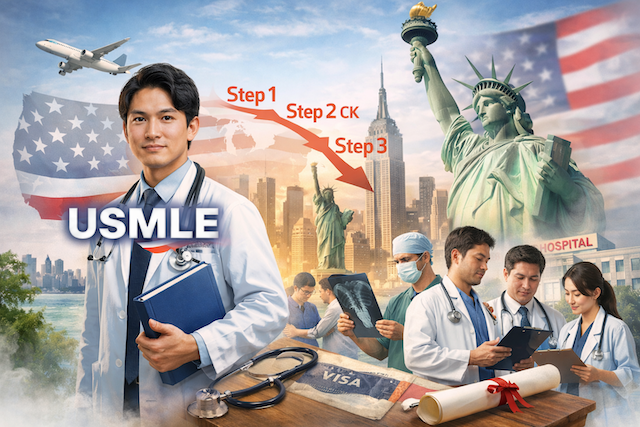
The USMLE is a three-stage examination for obtaining a medical license in the United States.
The Three Steps of the USMLE
- **Step 1**: Basic Sciences
- **Step 2 CK**: Clinical Knowledge
- **Step 3**: Clinical Practice
In addition, to actually work in the United States you also need the following.
- ECFMG certification
- US Clinical Experience (USCE)
- Residency Match (the Match)
- Visa acquisition
In other words, the USMLE is
**a process that combines exams, clinical experience and job hunting**
That is what the USMLE really is.
03
Why Japanese Doctors Aim for the USMLE
1. An Overwhelming Difference in Income
Doctors in the United States earn far more than doctors in Japan.
- General internal medicine: JPY 20-40 million
- Surgical specialties: JPY 50-100 million or more
Over an entire career, this difference has a very large impact.
2. A Different Level of Care and Environment
The United States has one of the world's top healthcare environments, where you can practise
- The latest medical technology
- Evidence-based medicine
- Team-based care
You can practise all of these in daily work.
3. Gaining a Global Career
Once you pass the USMLE, a wide range of options opens up:
- Working overseas
- International medicine
- A research career
These and other paths become available.
4. A Powerful Combination of English and Medicine
More than general English ability,
**English as a professional skill**
That is the greatest value you gain.
04
The USMLE Steps Explained in Detail
Step 1 | Basic Sciences (The First Hurdle)
Exam Content
- Anatomy
- Physiology
- Biochemistry
- Pharmacology
- Pathology
- Microbiology
Features
- Now scored as Pass/Fail
- Even so, the difficulty is very high
- Tests the depth of your foundational understanding
Challenges for Japanese Examinees
- Understanding material in English
- The USMLE's distinctive question format
Recommended Resources
- First Aid for the USMLE Step 1
- UWorld (the most important)
- Pathoma
- Sketchy (visual memory)
Strategy for Passing
- Centre your study on UWorld
- Keep a thorough record of your mistakes
- Focus on truly understanding the material
Step 2 CK | The Most Important Exam, Which Can Decide Everything
Exam Content
- Internal medicine
- Surgery
- Paediatrics
- Obstetrics and gynaecology
- Psychiatry
- Emergency medicine
Features
- Scored numerically (extremely important)
- Directly tied to matching
- Content close to real clinical practice
Difficulty
This is the most important and most difficult of the USMLE Steps.
Recommended Resources
- UWorld (essential)
- NBME practice exams
- AMBOSS
Strategy for Passing
- Practise questions thoroughly (quantity and quality)
- Train your time management
- Concentrate on strengthening weak areas
Step 3 | Clinical Practice
Content
- Diagnostic and treatment decision-making
- Case management
Features
- Usually taken during residency
- A lower priority for Japanese doctors
05
A Roadmap for Japanese Doctors (Complete Version)
From here, we explain the actual path from passing the USMLE to getting a job in the United States.
STEP 0 | Strategic Planning (The Most Important Step)
The first thing to do is to plan your strategy.
What to decide:
- Specialty (internal medicine, surgery, etc.)
- Target score
- Timeline (2 years or 4 years)
If you leave these vague, you will fail.
STEP 1 | Securing Your English Ability
The USMLE is a medical exam and, at the same time, an English exam.
Required English Level
- TOEFL iBT: 90-100 or higher
- Understanding of medical English
Essential Skills
- Reading long passages (understanding the question stems)
- Instantly understanding medical terminology
- Listening (patient scenarios)
A Common Misconception
“Medical knowledge will carry me through.”
-> This is completely wrong.
If you get stuck on the English, you cannot answer the questions.
STEP 2 | Step 1 Preparation (6-12 Months)
Study Schedule
- First half: input (First Aid)
- Second half: output (UWorld)
Key Points
- Do not aim for perfection
- Prioritise the number of review cycles
- Turn your mistakes into an asset
STEP 3 | Step 2 CK Preparation (6-12 Months)
Study Strategy
- Go through UWorld two to three times
- Measure your ability with NBME exams
Key Points
- Step 2 is where it is decided
- Your score can shape your life
STEP 4 | ECFMG Certification
Requirements:
- Graduation from medical school
- Passing Step 1 and Step 2
STEP 5 | US Clinical Experience (USCE)
Why Is It Important?
- Clinical experience in the United States
- Obtaining letters of recommendation (LORs)
- Directly tied to your chances of matching
Main Formats
- Observership (shadowing)
- Clerkship (hands-on rotations)
STEP 6 | The Residency Match
This is the biggest hurdle.
Evaluation Factors
- Step 2 score
- USCE
- LORs (letters of recommendation)
- English ability
- Reasons for applying
06
Timeline and Schedule to Passing
Model Case
- English preparation: 3-6 months
- Step 1: 6-12 months
- Step 2 CK: 6-12 months
- USCE and Match: 1-2 years
Total
**About 2-4 years**
07
English Required for the USMLE | Completely Different from General English
Types of English You Need
- Medical English
- Academic English
- Practical workplace English
Specific Abilities Required
- Reading at the level of academic papers
- Understanding medical conversations
- Instantly processing specialist terminology
Effective Study Methods
1. Start with medical English
-> More efficient than general English
2. Shadowing
-> Strengthens listening and speaking together
3. OET preparation
-> An English exam specialised for medicine
08
Typical Mistakes Japanese Doctors Make
1. Neglecting English
This is the biggest cause of failure.
2. Underestimating Step 2
-> A reason for being rejected in the Match
3. Not enough USCE
-> Rejected at the document-screening stage
4. Lack of information
-> Inefficient study
09
The Shortest-Route Strategy
The Standard Route
- English -> Step 1 -> Step 2 -> USCE -> Match
The Efficiency-Focused Route
- Study medical English and the USMLE at the same time
10
How to Use 3D ACADEMY
For Japanese doctors aiming for the USMLE, the biggest obstacle is
**a lack of English and medical English**
This is the main obstacle.
Medical English Course
- Learn step by step, starting from beginner level
- Content designed around real clinical settings
- Ideal as preparation before the USMLE
OET Preparation Course
- Five one-on-one lessons
- Strengthens writing and speaking
- Builds practical medical English skills
Why Is It a Good Match?
- The USMLE is also an English exam
- A foundation in medical English can decide whether you pass or fail
11
Conclusion | The Essence of USMLE Success
The USMLE is difficult, but with
- The right strategy
- Stronger English ability
- Consistent study
it is well within reach for Japanese doctors.
What matters most is
**English x Medicine x Strategy**
Advancing all three at the same time.
First, start with
- Building a foundation in English
- Mastering medical English
and aim for USMLE success by the shortest route.
12
FAQ
What is the USMLE?
The USMLE is the national licensing examination series required to be involved in clinical practice as a doctor in the United States. Its official name is the United States Medical Licensing Examination, and it consists of three stages: Step 1, Step 2 CK and Step 3. Even if you hold a Japanese medical licence, you need to go through this route separately to work as a clinician in the United States.
Can Japanese doctors pass the USMLE?
Yes, Japanese doctors can certainly aim to pass. In fact, there are doctors who graduate from a Japanese medical school, take on the USMLE and go on to residency in the United States. However, you need a long-term strategy that covers not only medical knowledge but also English ability, exam preparation, clinical experience and application documents.
Which USMLE Step should I take first?
The usual order is to take Step 1 first and then move on to Step 2 CK. Step 3 is in many cases taken around the start of training in the United States, either just before or just after. It is realistic to build your plan mainly around Step 1 and Step 2 CK.
Is USMLE Step 1 still important?
Yes. It is now scored as Pass/Fail, but it is still important. If you do not thoroughly understand the basic sciences in Step 1, it can easily affect your Step 2 CK score as well. Just because no score is shown does not mean you can take it lightly.
Which exam is the most important for Japanese doctors?
In most cases, the most important is Step 2 CK. This is because its score tends to be weighted heavily in the Residency Match and is treated as an indicator of clinical ability. The basic approach is to build a solid foundation in Step 1 and then deliver results in Step 2 CK.
How long does USMLE preparation take?
It varies from person to person, but many people expect about 2-4 years in total, including English preparation. Step 1 may take 6-12 months and Step 2 CK another 6-12 months, and USCE and Match preparation can require additional time. If you are continuing to work while you study, you will need an even more generous plan.
How strong does my English need to be for the USMLE?
Quite strong English is required. Everyday conversational ability alone is not enough: you need to read long question stems accurately, grasp clinical nuance and process medical terms instantly. Getting used to medical English and academic English matters more than general English.
Can I aim for the USMLE if I am not good at English?
You can, but it is important not to put English preparation off. The USMLE is an English exam as well as a medical exam, so if you stumble on the English, your knowledge may not translate into points. If you are worried about your English, it is effective to start by building a foundation in medical English.
Is it possible to study for the USMLE on my own?
Some people study independently, but gathering information and managing your study are difficult. Once you include choosing materials, deciding when to sit the exams, using practice tests and preparing for USCE and the Match, studying alone can end up being a detour. Because there is little consolidated information in Japanese, it is especially important to secure reliable sources early.
What materials are commonly used for Step 1?
Typical resources include First Aid, UWorld and Pathoma. The usual approach is to grasp the big picture first and then repeat practice questions to consolidate your knowledge. Going deeper with a limited set of materials is often more effective than simply adding more of them.
What is important for Step 2 CK preparation?
In Step 2 CK, clinical judgement and time management matter as well as the amount of knowledge. You need to practise plenty of questions while understanding why each correct answer is correct. Because the score tends to be weighted heavily, it is important to use practice exams to check your ability objectively as you finalise your preparation.
What is USCE?
USCE stands for United States Clinical Experience, meaning clinical experience in the United States. It takes forms such as observerships and clerkships, and it not only introduces you to US healthcare settings but also leads to letters of recommendation and helps with Match preparation. It is one of the most important elements for Japanese doctors.
Is it difficult to match without USCE?
In general, having USCE tends to be an advantage. Experience in the US healthcare environment can also demonstrate adaptability and motivation. It may also give you the chance to obtain letters of recommendation from doctors there, which tends to raise the evaluation of your application as a whole.
What is ECFMG certification?
ECFMG certification is an important credential for graduates of medical schools outside the United States who aim to pursue training or clinical opportunities there. You work towards it by meeting the required exam and documentation requirements. Besides studying for the USMLE, you need to understand this certification process in parallel.
If I have a Japanese medical licence, can I work in the United States right away?
No. A Japanese medical licence alone does not allow you to work as a clinician in the United States as it is. You must meet the necessary requirements through the USMLE Steps, ECFMG certification, USCE, the Residency Match and more. Clinical experience in Japan is useful, but it cannot substitute for these.
Is there an age limit for the USMLE?
In general, applicants are not judged on a clear age limit alone, but the number of years since graduation and recent clinical experience are sometimes emphasised. What matters is therefore less your age itself than how your current track record and ongoing activities appear. If you are thinking of taking on the challenge, it is better to start gathering information and preparing as early as possible.
When should I start preparing if I am aiming for the USMLE?
The earlier, the better. If you are exposed to English and USMLE-style questions while still a medical student, you can more easily reduce the burden after graduation. Even if you are already working as a doctor, it is easier to get moving if you start by checking your English level and designing your overall schedule.
Is it possible to balance USMLE preparation with work?
It is possible, but it requires careful planning. If you work full time while preparing, securing study time is the biggest challenge. Rather than setting an unrealistic short-term plan, it is more realistic to decide concretely how you will use weekdays and days off, and to build a routine you can sustain on the assumption of a long campaign.
Is there any point in studying OET or medical English before aiming for the USMLE?
Yes, a great deal. If you jump straight into USMLE preparation, the English barrier can reduce your study efficiency. By first becoming familiar with patient communication and medical expressions through medical English and OET preparation, you will find it easier to understand USMLE question stems and grasp clinical scenarios.
Is the USMLE really a realistic option for Japanese doctors?
It is not an easy path, but it is a realistic option. What matters is not to start on momentum alone but to design the whole plan, including English ability, exam preparation, clinical experience and application preparation. If you prepare in the right order, it is a route that Japanese doctors can well aim to complete.
The Complete Doctor Study Guide | How to Work Abroad, Difficulty by Country, Required English and the Shortest Route Explained13
Related Articles
14
Recommended Courses
Course
IELTS Preparation Course
One-on-one lessons and exam-style mock tests build all four skills in a balanced way in a short time.
See moreCourseOET Preparation Course
Practical training specialised by profession, for doctors and nurses, raises your Writing and Speaking scores as quickly as possible.
See moreThe first step in IELTS preparation is choosing the right environment
With one-on-one classes and real-format mock exams, we help you reach your target score by the most direct route.