
Doctor Study Guide
USMLE Step 1, Step 2 and Step 3: Differences and Preparation | Doctor Study Guide 2026
01
Introduction
The USMLE (United States Medical Licensing Examination) is the national examination series required to work as a doctor in the United States. For Japanese doctors too, it is an important step that cannot be avoided if they want to build a career overseas.
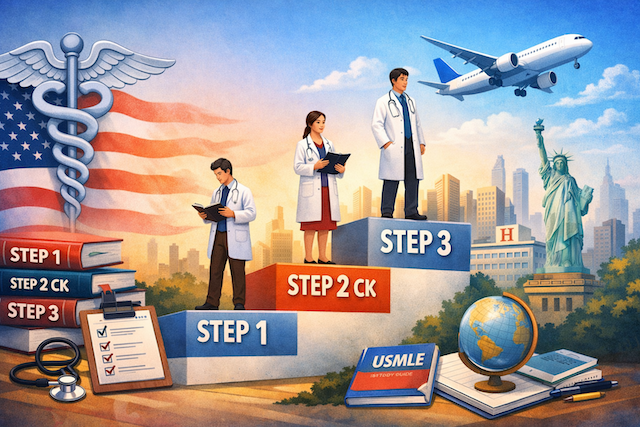
The USMLE consists of the following three stages:
- **Step 1**
- **Step 2 (CK / Clinical Knowledge)**
- **Step 3**
Each Step differs greatly in purpose, content, difficulty and preparation. If you start studying without understanding these differences, you will waste a great deal of time and money.
In this article, we explain in depth:
- The differences between the Steps
- Exam content and difficulty
- Preparation strategies for Japanese doctors
- How to pass by the shortest route
All of this is covered in the **latest 2026 edition**.
02
Understanding the Overall Structure of the USMLE
First, let's get the big picture.
| Exam | Main Content | Timing | Purpose |
|---|---|---|---|
| Step 1 | Basic sciences | Medical school to early stages | Understanding the basics of medicine |
| Step 2 CK | Clinical medicine | After clinical rotations | Clinical judgement |
| Step 3 | Practical medicine | Resident level | Ability to practise independently |
The key points are:
- **Step 1 -> The foundation of knowledge**
- **Step 2 -> Practical judgement**
- **Step 3 -> The finished form of a doctor**
03
Step 1: Features and Preparation
Overview
Step 1 tests your understanding of the basic sciences.
Main Subjects
- Anatomy
- Physiology
- Biochemistry
- Microbiology
- Pathology
- Pharmacology
- Behavioural science
Changes Since 2022 (Important)
- **Scored -> changed to Pass/Fail**
This has changed strategy significantly.
The Essence of Step 1
It is not simple memorisation. What is tested is:
- Understanding of disease processes
- Grasping mechanisms
- Linking the basic and the clinical
These are what the exam tests.
Where Japanese Examinees Struggle
- Understanding medicine in English
- The depth required in pathology and pharmacology
- Question format (unique to the USMLE)
Recommended Resources
Most important
- First Aid for the USMLE Step 1
- UWorld (question bank)
Supplementary
- Pathoma
- Sketchy (Micro / Pharm)
Study Strategy
Phase 1: Building basic understanding
- Go through First Aid once
- Strengthen pathology with Pathoma
Phase 2: Practice questions
- Go through UWorld once
- Create a mistake notebook
Phase 3: Final polish
- Second pass through UWorld
- NBME practice exams
Approximate Study Time
- About 800-1,200 hours
04
Step 2 CK: Features and Preparation
Overview
Step 2 CK tests your clinical knowledge.
Main Areas
- Internal medicine
- Surgery
- Paediatrics
- Obstetrics and gynaecology
- Psychiatry
Differences from Step 1
| Item | Step1 | Step2 |
|---|---|---|
| Content | Basic | Clinical |
| Thinking | Theory | Judgement |
| Questions | Mechanisms | Case-based |
The Importance of Step 2 (Extremely Important)
Currently:
- Step 1 is Pass/Fail -> **The Step 2 score is the most important indicator**
That is where things stand.
Features of the Questions
- Long case-based questions
- Choosing diagnosis and treatment
- Prioritisation decisions
Recommended Resources
Essential
- UWorld (most important)
- NBME
Supplementary
- AMBOSS
- OnlineMedEd
Study Strategy
Phase 1: Building a foundation
- Understand the guidelines for each specialty
Phase 2: Practice questions
- Go through UWorld once or twice
Phase 3: Practice exams
- Check your score with NBME exams
Study Time
- About 1,000-1,500 hours
05
Step 3: Features and Preparation
Overview
Step 3 tests your ability to practise medicine in real settings.
Features
- A two-day exam
- Computer-based Case Simulation (CCS)
Exam Content
- Diagnosis
- Treatment planning
- Follow-up
Differences from Step 2
- More practical
- Emphasis on management
- Time management is important
CCS Preparation (Most Important)
This is the biggest hurdle.
Skills Required
- Initial response
- Ordering tests
- Choosing treatment
- Follow-up
Recommended Resources
- UWorld Step 3
- CCS Cases
Study Time
- About 300-500 hours
06
The Shortest Roadmap to Conquering the Whole USMLE
Ideal Schedule
One-Year Plan
- Step 1: 6 months
- Step 2: 6 months
- Step 3: during residency
The Shortest Route for Japanese Examinees
Pattern 1 (students)
- Step1 → Step2 → US Clinical Experience → Match
Pattern 2 (doctors)
- Step 1 (short-term) -> Focus on Step 2 -> Match
07
Common Failure Patterns
1. Spending too much time on Step 1
-> Passing is enough
2. Underestimating Step 2
-> You will not match
3. Not enough practice questions
-> With the USMLE, questions are everything
4. Not enough English preparation
-> Your score will not improve
08
English Proficiency Guidelines
Required Level
- TOEFL iBT 90 or higher
- Ability to understand medical English
Essential Skills
- Reading long passages
- Medical terminology
- Listening (clinical)
09
Recommended Strategy for Japanese Doctors
Conclusion
- Get through Step 1 as quickly as possible
- Give Step 2 everything you have
- Centre your study on UWorld
Golden Rules of Study
- Output over input
- Analyse your mistakes thoroughly
- Repeat and review
10
Relationship with the Match (Residency)
Evaluation Factors
- Step 2 score
- USCE (clinical experience)
- Letters of recommendation
11
Summary
The USMLE is not just an exam.
It is **the gateway to a medical career overseas**.
Key points:
- Step 1 is a milestone along the way
- Step 2 is the most important
- Step 3 confirms practical ability
And the most important thing of all is:
**The right strategy x consistent study**
That is the key.
12
Finally
The USMLE is difficult, but if you approach it the right way, Japanese doctors can certainly pass.
What matters especially is:
- Planning your strategy early
- Choosing materials efficiently
- Practice-centred study
These are the keys to success.
13
Frequently Asked Questions (FAQ)
Can Japanese people pass the USMLE?
Yes, it is well within reach. In fact, many Japanese doctors and medical students have passed the USMLE and secured residencies in the United States. However, because English ability and the quality of your exam preparation have a major effect on the result, planned preparation is essential.
Which is the most important of Step 1, Step 2 and Step 3?
Currently, **Step 2 CK is the most important**. Because Step 1 has become Pass/Fail, the Step 2 score is now the centre of evaluation in the Residency Match.
How much study is needed to pass Step 1?
A general guideline is **about 800-1,200 hours**. However, this varies greatly depending on your understanding of the basic sciences and your English ability. What matters is not studying for long hours but studying efficiently, centred on UWorld.
What Step 2 CK score do I need?
It depends on the specialty you are aiming for, but in general:
- 230-240: average
- 250 or higher: highly competitive
- 260 or higher: top level
High scores are especially required for popular specialties (such as internal medicine and surgery).
When should I take Step 3?
It is usually taken during residency or after the Match. Step 3 is not mandatory, but it becomes important if you aim to obtain a visa (H1B).
How strong does my English need to be?
As a guideline:
- TOEFL iBT 90 or higher
- A level at which you can read and understand medical English
Because the USMLE in particular has many long questions, reading comprehension is extremely important.
How important is UWorld?
**It is the most important resource.** It is no exaggeration to say that UWorld is the centre of USMLE preparation. Going through it at least once or twice, and ideally reviewing your mistakes thoroughly, is the key to passing.
Can I pass Step 1 with First Aid alone?
First Aid is an essential resource, but it is not enough on its own. Combining it with UWorld, Pathoma and others deepens your understanding and greatly raises your chances of passing.
Can I prepare for the USMLE on my own?
Yes, it is possible. In fact, many examinees pass through self-study. However, because you have to gather information, manage your schedule and choose materials yourself, taking a course is also an option if you want efficiency.
How long does it take to pass the USMLE?
A general guideline is **1-2 years**.
- Step 1: around 6 months
- Step 2: 6 months to 1 year
- Step 3: a few months
However, this varies greatly depending on whether you can study full time.
Is US Clinical Experience (USCE) mandatory?
It is not mandatory, but it is **extremely important in the Match**. Clinical experience in the United States and letters of recommendation have a major effect on your chances of success.
Can I work in the United States with only a Japanese medical licence?
No, you cannot. You need to pass the USMLE, obtain ECFMG certification and also complete a residency.
Is there an age limit for the USMLE?
There is no clear age limit, but a long gap since graduation can be a disadvantage in the Match. It is advantageous to take the exams and apply as early as possible.
How long should the gap be between Step 1 and Step 2?
Ideally, **within 3-6 months**. Moving on to Step 2 while your Step 1 knowledge is still fresh improves efficiency.
Does preparation differ between medical students and doctors?
Yes, it does.
- Medical students: need to learn systematically from the basics
- Doctors: draw on clinical experience and prioritise Step 2
For doctors in particular, a strategy of finishing Step 1 in a short time is effective.
Is there a way to get through the USMLE as quickly as possible?
There is. The key points are as follows:
- Aim to just pass Step 1 in the shortest time
- Concentrate on Step 2
- Centre your study on UWorld
- Secure USCE early
Proceeding strategically can shorten your timeline significantly.
The Complete Doctor Study Guide | How to Work Abroad, Difficulty by Country, Required English and the Shortest Route Explained14
Related Articles
15
Recommended Courses
Course
IELTS Preparation Course
One-on-one lessons and exam-style mock tests build all four skills in a balanced way in a short time.
See moreCourseOET Preparation Course
Practical training specialised by profession, for doctors and nurses, raises your Writing and Speaking scores as quickly as possible.
See moreThe first step in IELTS preparation is choosing the right environment
With one-on-one classes and real-format mock exams, we help you reach your target score by the most direct route.