2026年4月5日
3D ACADEMY offers affordable English study programs in Cebu, Philippines – perfect for beginners, professionals, and exam takers.

3D UNIVERSAL ENGLISH INSTITUTE INC
info.3d-universal.com
8:00-17:00(Mon-Fri)
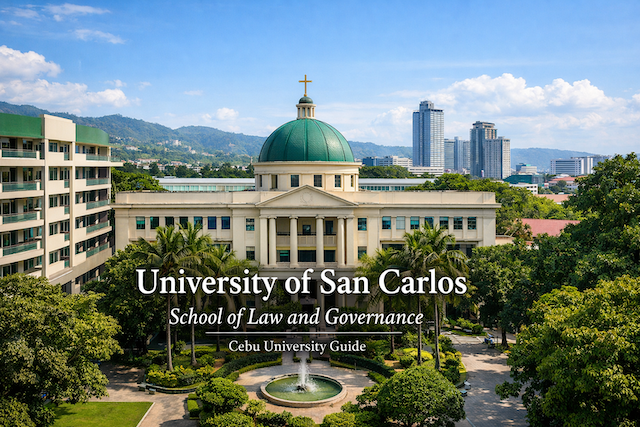
University of San Carlos (USC) School of Law and Governance: Cebu University Guide
Contents
- University of San Carlos (USC) School of Law and Governance: Cebu University Guide
- Why USC for Law and Governance in Cebu
- What “Law and Governance” Usually Covers
- Academic Environment and Learning Culture
- Curriculum Themes You’re Likely to Encounter
- Skills You Build Beyond Memorization
- Student Life and Professional Identity
- Experiential Learning: What to Look For
- Career Pathways After Studying Law and Governance
- Who Should Consider USC School of Law and Governance
- How to Prepare Before Enrolling
- Admissions and Practical Planning
- Choosing the Right Fit in Cebu
- Final Thoughts
- FAQs (Frequently Asked Questions)
- Is the University of San Carlos (USC) School of Law and Governance a good choice for international students?
- Can I become a lawyer after studying at USC?
- What is the difference between “law” and “governance” in this context?
- How heavy is the workload compared to undergraduate programs?
- Do I need a background in political science or pre-law to succeed?
- What skills will I gain even if I do not plan to practice law?
- What should I ask USC before applying?
- How can I prepare academically before the semester starts?
- Is studying law and governance in Cebu worth it for career growth?
University of San Carlos (USC) School of Law and Governance: Cebu University Guide
Why USC for Law and Governance in Cebu
The University of San Carlos (USC) is one of the most established universities in Cebu, known for programs that emphasize academic rigor, community engagement, and professional readiness. For students exploring law and governance pathways, USC is often considered because it sits in the center of Cebu’s academic and civic life, close to courts, government offices, NGOs, and private sector institutions where legal and policy work happens daily. This location matters: law is not only learned in textbooks but also understood through real cases, real disputes, and real communities.
This guide explains what “law and governance” typically means in the USC context, what students can expect from the learning environment, and how to plan your path from inquiry to enrollment to future careers. Because programs, schedules, and requirements may change, treat this as a practical orientation and use it to prepare smarter questions for the official admissions office and program administrators.
What “Law and Governance” Usually Covers
“Law” is the study of rules, rights, duties, institutions, and procedures that shape how people and organizations live together. “Governance” is broader: it includes how decisions are made, implemented, monitored, and improved across public institutions, private organizations, and civil society. When you combine them, you get a powerful toolkit for solving complex problems—problems that include compliance, accountability, public service delivery, dispute resolution, regulatory design, ethics, and social impact.
Students interested in the School of Law and Governance often fall into at least one of these profiles:
- Aspiring lawyers who want a structured, disciplined legal education and eventual admission to the Bar.
- Public policy and governance-minded students who may work in government, development, or public administration roles where legal literacy is essential.
- Professionals who want legal knowledge for careers in HR, compliance, corporate affairs, procurement, education administration, or NGO work.
- Future leaders who want to understand how systems work—laws, institutions, incentives, and oversight—so they can improve them.
Academic Environment and Learning Culture
Law school is different from most other academic programs. It rewards careful reading, structured thinking, and sustained effort. Students are typically trained to interpret texts precisely, argue persuasively, and apply principles to new situations. In many law programs, classroom discussions can feel intense because the goal is not simply to memorize rules but to learn reasoning under pressure—how to defend a position, revise it, and justify it with logic and authority.
In a strong law-and-governance environment, you can expect a culture that encourages:
- Case-based reasoning (learning from real or simulated disputes and decisions).
- Clear writing (briefs, memos, position papers, and structured answers).
- Ethical reflection (professional responsibility, integrity, and public trust).
- Practical awareness (how law interacts with institutions, budgets, politics, and community realities).
If you prefer a learning style that values debate, disciplined preparation, and frequent writing, you will likely find law and governance studies aligned with your strengths. If you are unsure, the best preparation is to observe how you respond to sustained reading and structured argumentation.
Curriculum Themes You’re Likely to Encounter
Specific course lists may vary, but most law-and-governance tracks share core themes. These themes help you anticipate what you will study and what habits you need to build early.
- Foundations of law: legal systems, sources of law, constitutional principles, statutory interpretation.
- Civil and criminal frameworks: rights, obligations, liability, procedures, and remedies.
- Public law and administration: government powers, public accountability, administrative processes, and the relationship between citizens and the state.
- Governance and institutions: oversight mechanisms, transparency, procurement rules, ethics systems, and institutional design.
- Research and writing: legal research methods, citation discipline, persuasive writing, policy writing, and argument structure.
- Professional responsibility: ethics, confidentiality, conflicts of interest, and the role of lawyers and public servants in society.
If you are more governance-focused, you may find strong value in courses that connect law to implementation—how regulations are enforced, how public programs are monitored, and how institutions adapt when rules collide with real-world constraints.
Skills You Build Beyond Memorization
Many people assume law school is about memorizing laws. Memorization matters, but it is not the main skill. The deeper value comes from the habits of mind you gain—habits that are useful even if you do not become a practicing lawyer.
Students typically develop:
- Analytical clarity: breaking complex problems into issues, rules, analysis, and conclusions.
- Precision with language: reading closely and writing with controlled meaning.
- Strategic thinking: anticipating counterarguments and planning decisions under constraints.
- Evidence discipline: building claims on sources, facts, and structured reasoning rather than opinions.
- Professional communication: speaking persuasively, negotiating, and producing reliable written work.
These skills are valuable in compliance, corporate governance, policy research, advocacy, project management, and leadership roles where decisions must be justified and documented.
Student Life and Professional Identity
Law and governance students often balance multiple responsibilities. Some are full-time students; others are working professionals studying in the evenings or weekends (depending on scheduling). Either way, success depends on planning and consistency.
A realistic weekly routine often includes:
- Assigned readings that require slow, careful attention rather than fast scanning.
- Preparing notes or case briefs to avoid confusion during recitations.
- Writing tasks such as reflections, memos, or structured answers.
- Group discussions or study circles for clarification and practice.
- Time for rest, because burnout reduces comprehension and performance.
Just as important as study routines is professional identity. Law and governance pathways require maturity: punctuality, reliability, respectful disagreement, and ethical awareness. These traits matter in internships and networks as much as grades do.
Experiential Learning: What to Look For
In legal and governance education, “experiential learning” can be a major differentiator. It includes activities that simulate or directly engage with real legal and policy work. When evaluating your fit, ask about opportunities such as:
- Moot court or debate-style advocacy to practice structured argumentation.
- Legal aid or community outreach (where permitted) to understand justice issues on the ground.
- Internships or clerkship-like exposure in courts, law offices, government agencies, or NGOs.
- Research projects that connect legal analysis with social problems or governance reforms.
- Seminars and guest lectures led by practitioners who share how law works in real settings.
Even if you are early in your journey, the presence of practical training signals a program that cares about employability and competence, not just theory.
Career Pathways After Studying Law and Governance
Many students enter the program with one goal—becoming a lawyer. That is a valid path, but it is not the only one. Law and governance education can lead to diverse careers, including:
- Legal practice: litigation, corporate practice, family law, labor, tax, real estate, or other specialties (depending on licensing and further requirements).
- Government service: legislative support, local government administration, compliance units, regulatory work, and program oversight.
- Corporate governance and compliance: policy drafting, risk management, internal controls, corporate secretarial support, and contract review roles.
- NGO and development sector: human rights, community development, policy advocacy, and project governance.
- Education and research: teaching support roles, academic research assistance, or policy research positions.
In Cebu, the economy includes growing service industries, real estate development, and expanding public-private collaboration. Legal literacy and governance competence can differentiate candidates in competitive job markets because many organizations need people who can interpret rules, manage risk, and document decisions properly.
Who Should Consider USC School of Law and Governance
This path can be a strong fit if you:
- Enjoy reading complex material and taking responsibility for understanding it deeply.
- Prefer structured reasoning, clear writing, and evidence-based arguments.
- Want work that involves rules, rights, systems, and public accountability.
- Can handle long-term effort without needing constant external motivation.
It may be a tougher fit if you strongly dislike extensive reading, dislike writing, or avoid debate and constructive criticism. These do not mean you cannot succeed, but they signal that you will need stronger study systems and support networks.
How to Prepare Before Enrolling
You do not need to “pre-study” law in a narrow way, but you should prepare your habits and skills. Here are high-impact steps:
- Train your reading stamina: read long-form nonfiction regularly and summarize it in your own words.
- Practice structured writing: write short essays with clear claims, reasons, and examples.
- Build a note system: learn to organize materials by topic, issue, and rule.
- Strengthen time management: use a weekly schedule and protect study blocks consistently.
- Improve communication: join groups that require speaking, debating, or presenting.
If you are shifting from a different field, take time to adjust your expectations. The workload is typically heavier than many undergraduate programs, and assessment often rewards depth and precision rather than broad coverage.
Admissions and Practical Planning
Admissions processes differ across programs and can change over time, but you can usually prepare by organizing documents early and planning your timeline. Practical steps include:
- Confirm the current application requirements and deadlines directly from USC’s official channels.
- Prepare academic records and any required forms well ahead of time.
- Plan for scheduling realities, especially if you will work while studying.
- Ask how classes are delivered (in-person, hybrid, or other formats), and what attendance expectations look like.
- Clarify estimated costs and payment schedules so your finances do not become a mid-semester crisis.
When you communicate with admissions, ask targeted questions. For example: What is the typical class schedule? What academic support exists for writing and research? What opportunities for practical training are available? How does the program support students who are working professionals?
Choosing the Right Fit in Cebu
Cebu offers multiple higher education options, so choosing USC should involve more than reputation alone. Fit depends on teaching approach, culture, schedule, support, and your long-term goals. If possible, try to attend an orientation, speak to current students, or observe public academic events. Law and governance education is a multi-year commitment; the better your fit, the more sustainable your performance will be.
Also consider your personal constraints: commute time in Cebu traffic, work hours, family responsibilities, and your preferred study environment. Small logistical problems repeated every week can become major barriers, so plan your routine with realism.
Final Thoughts
The USC School of Law and Governance can be an excellent choice for students who want serious training in legal reasoning and institutional thinking in Cebu. Whether your goal is to become a lawyer, work in public service, or build a career in governance and compliance, the education you pursue should strengthen your ability to reason clearly, write precisely, and act ethically under pressure.
Use this guide as a starting point. The best next step is to verify current program details with USC, then map your plan: why you are pursuing the program, what schedule you can sustain, what skills you must build, and how you will measure progress. When your daily habits match your long-term goal, law and governance studies become not only possible, but transformative.
FAQs (Frequently Asked Questions)
Is the University of San Carlos (USC) School of Law and Governance a good choice for international students?
It can be a strong option for international students who are specifically interested in studying in Cebu and who want an academically serious environment. However, “good choice” depends on your goal. If you want a Philippine law degree for long-term practice in the Philippines, you must confirm eligibility rules, visa requirements, and any restrictions that may apply to foreign nationals. If your goal is broader—such as governance, public policy literacy, compliance, or legal research skills—then the value may come from learning structured legal reasoning and institutional thinking. Before applying, clarify what credential you will earn, whether it aligns with your home-country plans, and what pathways exist after graduation.
Can I become a lawyer after studying at USC?
Becoming a lawyer generally requires completing the appropriate law program and meeting the requirements for licensure. In the Philippines, the usual pathway involves finishing a Juris Doctor (or the institution’s equivalent professional law degree) and then passing the Philippine Bar Examination. You should confirm the current program structure and the specific steps required, because policies can change and may vary depending on your academic background. If your aim is to practice law, ask USC directly about the program track, eligibility criteria, and how students are prepared for the Bar through review culture, writing discipline, and exam-style training.
What is the difference between “law” and “governance” in this context?
Law focuses on rules, rights, obligations, and formal processes: how disputes are resolved, how contracts work, how criminal responsibility is determined, and how courts and legal institutions operate. Governance focuses on how decisions are made and implemented in real systems: how public agencies deliver services, how organizations maintain accountability, how policies are monitored, and how institutions improve performance. When combined, law and governance helps you understand both the “legal framework” and the “real-world mechanics” of decision-making. This combination is helpful for students who want to work in government, compliance, development, or leadership roles where legal knowledge must translate into practical outcomes.
How heavy is the workload compared to undergraduate programs?
Most students find the workload more demanding than typical undergraduate study because the reading is denser and the expectations for analysis are higher. Law and governance programs usually require careful, line-by-line reading, frequent writing, and structured preparation for recitations or discussions. It is not only the volume of work but also the precision required: you must understand definitions, exceptions, reasoning steps, and how rules apply under different facts. If you are working while studying, the key is to build a consistent weekly schedule that includes reading blocks, review time, and writing practice, rather than relying on last-minute studying.
Do I need a background in political science or pre-law to succeed?
No specific undergraduate major automatically guarantees success. Students come from many backgrounds, including business, education, psychology, engineering, communication, and social sciences. What matters more is your willingness to read carefully, write clearly, and revise your thinking when challenged. A political science or pre-law background can help you feel more familiar with public institutions and argumentation, but it is not a requirement. If you are transitioning from a different field, focus on building core habits early: reading stamina, structured note-taking, and disciplined time management.
What skills will I gain even if I do not plan to practice law?
Even if you do not pursue legal practice, law and governance study can strengthen skills that are highly transferable. You can expect to improve issue-spotting (identifying what truly matters in a complex situation), analytical reasoning (moving from rule to conclusion with logic), and professional writing (memos, structured explanations, and persuasive documents). Many graduates apply these skills in compliance, risk management, corporate governance, policy research, HR and labor relations, procurement, education administration, and NGO leadership. The main benefit is learning to make decisions that are defensible, documented, and aligned with rules and ethics.
What should I ask USC before applying?
To avoid confusion later, ask practical questions that affect your daily life and long-term outcomes. Examples include: What program tracks are currently offered under the School of Law and Governance? What are the admission requirements and key deadlines? What is the typical weekly schedule and class format (weekday evenings, weekends, hybrid, etc.)? What are attendance expectations? What academic support exists for legal writing and research? What experiential learning opportunities are available (moot court, internships, community legal work, seminars)? Also ask about estimated costs, payment schedules, and policies that could affect working students.
How can I prepare academically before the semester starts?
Start by training the habits that law and governance demands. Read long-form nonfiction regularly and summarize it in your own words to build comprehension stamina. Practice writing short structured pieces: state a claim, support it with reasons, and address counterarguments. Improve your organization system by keeping notes sorted by topic and by “issue,” not just by date. If possible, practice basic research discipline: learn how to find reliable sources, compare interpretations, and cite clearly. Most importantly, build a weekly time plan you can realistically follow once classes begin.
Is studying law and governance in Cebu worth it for career growth?
For many students, it can be worth it because Cebu has active legal, government, and business ecosystems where legal literacy and governance competence are valuable. The credential and skills can support career moves into compliance, corporate administration, regulatory work, policy roles, and leadership tracks where decision-making must be accountable. That said, “worth it” depends on your ability to commit time consistently and your clarity about the career outcome you want. The strongest returns usually come when you actively build a portfolio of skills—writing samples, research work, internships, and professional networks—rather than relying on the degree alone.
University of San Carlos (USC) Guide: Courses, Campuses, and Admissions

How to Register for eTravel Philippines (2025 Guide)
Step-by-step guide to completing your eTravel registration before arriving in the Philippines, with images and tips.

Night Market in Cebu – Things You Don’t Know About Cebu Life
Discover the hidden charm of Cebu’s night markets, from street food stalls to local life tips you won’t find in tourist guides.

How to Use ChatGPT for IELTS Preparation: A Complete Guide
Learn how to prepare for IELTS using ChatGPT — including strategies for Writing, Reading, Listening, Speaking, and grammar support.

How to Build a Website Without Coding Using ChatGPT
Discover how to build your own website using AI—no coding skills needed. From structure planning to SEO and design, let ChatGPT guide you.