2026年1月23日
3D ACADEMY offers affordable English study programs in Cebu, Philippines – perfect for beginners, professionals, and exam takers.

3D UNIVERSAL ENGLISH INSTITUTE INC
info.3d-universal.com
8:00-17:00(Mon-Fri)
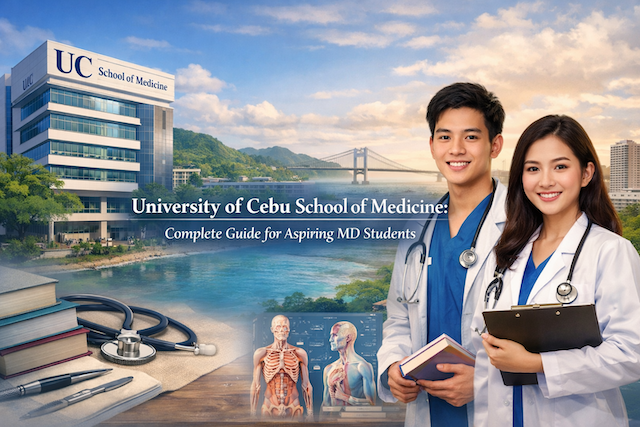
University of Cebu School of Medicine: Complete Guide for Aspiring MD Students
Contents
- University of Cebu School of Medicine: Complete Guide for Aspiring MD Students
- Quick Overview of UCSM
- History and Purpose
- Vision, Mission, and Core Values
- Campus Location and Training Environment
- Doctor of Medicine (MD) Program: What to Expect
- Curriculum Style and Teaching Approach
- Facilities and Learning Resources
- Clinical Exposure and Hospital Training
- Admissions Requirements and Application Process
- NMAT Strategy: Planning Your Timeline
- Tuition, Fees, and Scholarships
- Student Life, Culture, and Support
- Career Path After Graduation
- Who Should Consider UCSM?
- Final Tips Before You Apply
- FAQs (Frequently Asked Questions)
- Is the University of Cebu School of Medicine officially recognized in the Philippines?
- What are the typical admission requirements for the MD program?
- What NMAT score do I need to be considered?
- How long is the Doctor of Medicine (MD) program?
- What is the learning style like: lecture-based, problem-based, or a mix?
- Where do students do their clinical rotations and clerkship?
- How much is tuition, and what other fees should I plan for?
- Does the school offer scholarships or financial assistance?
- Can international students apply, and what extra steps are required?
- What support systems are available for students who struggle academically?
- What happens after graduation in terms of internship and licensure?
University of Cebu School of Medicine: Complete Guide for Aspiring MD Students
The University of Cebu School of Medicine (often called UCSM) is one of the newer medical schools in Cebu, Philippines. It was established to help widen access to medical education while keeping training aligned with national standards and real-world clinical practice. If you are considering studying medicine in Cebu—whether you are from the Visayas, another region in the Philippines, or an international student—UCSM is a school worth understanding in detail before you apply.
This guide explains what UCSM is known for, how its Doctor of Medicine (MD) program is structured, what the learning environment feels like, what clinical exposure can look like, and what you should prepare for during the admissions process. While every medical school has similarities, the best choice depends on your learning style, academic readiness, financial plan, and preferred training setting.
Quick Overview of UCSM
UCSM is part of the University of Cebu system, a long-established private educational institution with multiple campuses in Cebu. The medical school was developed with a strong emphasis on outcomes-based education and practical training, with teaching approaches that mix classroom learning, small-group activities, and clinical exposure. As a relatively young school, UCSM continues to build its identity, strengthen its academic culture, and expand its learning resources over time.
For many applicants, UCSM is attractive because it offers medical education in Cebu City under a large university brand, with a stated focus on producing competent, patient-centered physicians who are prepared for internship and the Physician Licensure Examination (PLE).
History and Purpose
The University of Cebu is known for making higher education more accessible to a wide range of students. UCSM continues that broader philosophy by creating a pathway for aspiring doctors who want quality medical training in Cebu without necessarily going to the most expensive option in the region.
The school was founded in the mid-2010s and positioned to support the growing demand for doctors, not only in Cebu but in the Philippines overall. A key idea behind the school’s creation is that medical education should connect directly with community health needs, real patient care, and professional values—not just exams and memorization.
Vision, Mission, and Core Values
UCSM’s messaging often emphasizes two themes: excellence and service. In practical terms, this usually translates into:
- Academic competence: building strong foundations in basic sciences and clinical reasoning.
- Professional identity: developing ethics, empathy, communication skills, and responsibility.
- Community relevance: encouraging students to see medicine as service, not only as a career.
- Continuous improvement: strengthening curriculum delivery, student support, and faculty development.
If you learn best in an environment that balances standards with mentorship and values-based training, UCSM may fit your preference. That said, your own habits will matter more than any slogan—medical school success depends heavily on consistency, discipline, and resilience.
Campus Location and Training Environment
UCSM is based in Cebu, a major city in the Visayas with strong healthcare activity and a large population base. Studying medicine in Cebu can be an advantage because you are exposed to diverse patient cases, a busy urban health environment, and a growing network of hospitals and clinics.
Because Cebu is also a hub for education and business, students typically have access to transportation options, review centers, student housing markets, and lifestyle conveniences. For many students, this makes daily life more manageable compared with studying in a smaller city where resources may be limited.
However, Cebu can also be demanding: traffic, costs in certain areas, and the fast pace of city life can add stress if you are not prepared. Before enrolling, it is wise to build a realistic budget and housing plan and to choose a living arrangement that supports your study habits.
Doctor of Medicine (MD) Program: What to Expect
UCSM offers a Doctor of Medicine (MD) program designed to meet Philippine medical education requirements. While the exact structure may evolve over time, most Philippine MD programs follow a general flow:
- First and second years: heavy focus on basic medical sciences, integrated with early clinical thinking and skills practice.
- Third year: more clinically oriented coursework, case discussions, and stronger emphasis on diagnosis and management frameworks.
- Fourth year (clerkship): hospital-based clinical rotations where students learn directly in patient care settings under supervision.
In addition to academic content, you should expect regular assessments, practical exams, case presentations, written exams, and skills-based activities. The pace is intense. If you are coming from a non-traditional background or have been out of school for a while, you may need extra preparation in study skills and test strategy.
Curriculum Style and Teaching Approach
UCSM describes its curriculum as aligned with outcomes mandated by the Philippine Commission on Higher Education (CHED). In many modern medical programs, “outcomes-based” means the curriculum is designed backward from what a graduate should be able to do: communicate with patients, apply clinical reasoning, interpret tests, and act ethically in real medical contexts.
Students can generally expect a mix of learning formats, such as:
- Lectures and structured classes: for core foundational concepts.
- Small-group discussions: for clinical reasoning, integration, and teamwork.
- Case-based learning: applying concepts to patient scenarios.
- Skills labs and simulations: practicing history-taking, physical exams, basic procedures, and communication.
- Hybrid or blended elements: depending on institutional policy and course design.
If you learn best through active practice rather than pure memorization, a curriculum that includes case discussions and skills training can be a strong advantage. Still, medical school always requires memorization too—active learning works best when paired with disciplined review.
Facilities and Learning Resources
A medical school’s learning environment is more than classrooms. Your daily training depends on study spaces, laboratories, library resources, skills rooms, simulation tools, and access to clinical cases. UCSM continues to develop these resources as the program grows.
As an applicant, try to evaluate facilities in a practical way. When possible, ask questions like:
- Do students have enough spaces for quiet study and group work?
- Are there skills labs or structured clinical skills sessions?
- How accessible are faculty consultations?
- Do students have clear support systems for academic difficulty?
- What is the clinical rotation experience like for clerks?
Even if a school is newer, strong organization and consistent faculty engagement can compensate for limited infrastructure—while excellent buildings do not guarantee good teaching. You want both, but priorities differ depending on your learning style.
Clinical Exposure and Hospital Training
Clinical training is where medical knowledge becomes real. In clerkship, you will spend long hours in hospital rotations and learn through supervised patient encounters. Your experience depends on the training sites, the patient population, the rotation structure, and the teaching culture of departments.
Students typically rotate through major clinical areas such as:
- Internal Medicine
- Surgery
- Pediatrics
- Obstetrics and Gynecology
- Family and Community Medicine
- Psychiatry and other specialty exposures (depending on rotations)
Clinical exposure can be intense and physically exhausting, but it is also the most motivating part of training for many students. If you want to become a capable doctor, you should actively seek learning opportunities during rotations—ask good questions, volunteer to do patient histories, and reflect on feedback without taking it personally.
Admissions Requirements and Application Process
In the Philippines, medical school admission typically requires completion of a bachelor’s degree (or equivalent), as well as a National Medical Admission Test (NMAT) result. UCSM’s application process generally asks for standard documentation used by Philippine medical schools.
Common requirements include:
- Completed application form
- Recent identification photos (often 2×2)
- NMAT result (photocopy or official proof)
- Transcript of Records (official or informative copy)
- Birth certificate documentation
- Letters of recommendation (often from academic or guidance officials)
- Processing or application fee (amount may vary by year)
Because requirements can change, you should always verify the current checklist directly through UCSM’s official admissions channels before submitting. Missing documents can delay evaluation, and late NMAT scheduling can disrupt your timeline.
NMAT Strategy: Planning Your Timeline
The NMAT is a major part of Philippine medical school admissions. Even if your undergraduate grades are strong, a weak NMAT score can reduce competitiveness. If you are serious about entering medical school in Cebu, plan your NMAT timeline early.
Practical advice:
- Start early: give yourself enough months to review, especially if your science background is weak.
- Use timed practice: NMAT performance depends on speed and accuracy under pressure.
- Focus on basics: many test-takers lose points on fundamentals rather than “hard” topics.
- Be strategic: work on your weakest sections first, then maintain strengths.
If you are an international applicant, confirm NMAT rules and eligibility as early as possible, and clarify what documents are needed for evaluation. Requirements can vary depending on citizenship, previous education system, and equivalency validation.
Tuition, Fees, and Scholarships
Costs are a major factor in choosing a medical school. Tuition and fees can differ significantly between institutions, and total cost of attendance includes more than tuition: housing, transportation, meals, uniforms, equipment, exam fees, and daily living costs add up quickly.
UCSM promotes a message of accessible education, and students may find tuition comparatively more manageable than certain premium institutions. The school and the broader university system may offer scholarships or financial support options depending on academic performance, need-based evaluation, or special programs.
When comparing costs, do not only ask, “How much is tuition?” Ask for a full breakdown:
- Tuition per semester or school year
- Laboratory and miscellaneous fees
- Uniform or clinical attire requirements
- Books and learning materials
- Clerkship-related costs
- Potential additional fees for special activities
A good rule: choose a program that you can sustain financially for the full duration. Financial stress can damage academic performance more than many students expect.
Student Life, Culture, and Support
Medical school is demanding, so student support matters. Look for evidence of mentorship, organized student services, and a culture where students can ask for help early. Some medical schools foster competitive pressure, while others emphasize collaboration. Neither is “perfect,” but you should be honest about what motivates you and what harms your mental health.
Healthy habits that matter in medical school:
- Build a reliable routine for sleep, meals, and exercise (even light exercise helps)
- Form a small, disciplined study group rather than a large, distracting circle
- Use active recall and spaced repetition instead of rereading notes endlessly
- Track your performance and fix weak topics weekly, not “later”
- Ask for feedback early during skills training and clerkship
Medical school is not about being “smart once.” It is about being consistent every day.
Career Path After Graduation
Graduating from a Philippine medical school is only one part of becoming a licensed physician. After completing the MD program, graduates typically proceed to internship and then take the Physician Licensure Examination (PLE). Many doctors then enter residency training to specialize, while others may pursue research, public health, hospital administration, or international pathways depending on their goals.
If your long-term plan includes practicing outside the Philippines, you should research licensing pathways early. Different countries have different requirements, and some require additional exams, supervised training, or credential verification.
Who Should Consider UCSM?
UCSM may be a good fit if you are looking for:
- Medical training in Cebu under a large university institution
- An outcomes-based program that emphasizes both academic foundations and clinical thinking
- A school positioned to support practical, service-oriented medical education
- A medical school option that may be more financially approachable than premium alternatives
You should also consider your personal learning style. If you do best with self-driven study, regular practice, and structured discipline, you can thrive in many environments—including newer schools. If you need highly individualized mentoring, evaluate how accessible faculty and student support services are before you commit.
Final Tips Before You Apply
Before submitting your application, take time to do a realistic self-assessment and gather complete information. Medical school is a multi-year commitment that affects your finances, health, and lifestyle. A clear plan increases your chance of success.
- Confirm requirements early: do not assume last year’s checklist is the same.
- Prepare your NMAT timeline: give yourself enough room to retake if needed.
- Budget honestly: include living expenses, not only tuition.
- Visit or inquire: ask about curriculum delivery, exam frequency, and clerkship structure.
- Choose a support system: plan who will support you emotionally and financially.
The University of Cebu School of Medicine is part of Cebu’s growing medical education landscape. If you are driven, consistent, and serious about becoming a physician, UCSM can be a strong place to begin your professional journey—especially if you approach the program with discipline, curiosity, and a service mindset.
FAQs (Frequently Asked Questions)
Is the University of Cebu School of Medicine officially recognized in the Philippines?
In the Philippines, medical schools operate under national higher-education regulations and are typically expected to follow Commission on Higher Education (CHED) standards for the Doctor of Medicine (MD) program. The University of Cebu School of Medicine functions as part of a long-established university system in Cebu. Because recognition status, program permissions, and compliance updates can change over time, the most reliable approach is to confirm the school’s current standing directly through the University of Cebu’s official admissions or registrar channels, and to cross-check any published listings or announcements from relevant government agencies when available. If you are applying from outside the Philippines, you should also ask how your credentials will be evaluated and what documentation is required for foreign transcripts.
What are the typical admission requirements for the MD program?
Most Philippine medical schools require applicants to hold a bachelor’s degree (or an equivalent qualification) and to submit a valid National Medical Admission Test (NMAT) result. Beyond these core requirements, you should expect standard documents such as transcripts of records, identification photos, personal data forms, and recommendation letters. Some schools also conduct interviews or assessments as part of screening. Since requirements can change per intake cycle, it is best to request the latest admissions checklist and confirm deadlines, accepted NMAT score ranges, and any additional requirements for transferees, second-degree holders, or international applicants.
What NMAT score do I need to be considered?
There is no single universal NMAT score requirement across all medical schools in the Philippines, because each institution sets its own standards and may adjust them depending on the applicant pool. Some schools publish minimum NMAT percentiles, while others evaluate NMAT results together with grades, interviews, and other factors. For the University of Cebu School of Medicine, you should ask admissions for the current minimum NMAT percentile (if any), whether higher scores improve scholarship chances, and whether the school accepts older NMAT results. If your NMAT score is borderline, also ask whether the school allows conditional acceptance, remedial requirements, or a reapplication pathway.
How long is the Doctor of Medicine (MD) program?
In the Philippines, the MD program is commonly structured as a four-year professional program, with the final year typically focusing on clinical clerkship (hospital-based rotations). After completing the MD degree, graduates usually proceed to a post-graduate internship and then take the Physician Licensure Examination (PLE). The exact structure and academic calendar can vary by school. When you inquire, confirm the number of semesters per year, the expected start month, and whether there are summer terms, bridging modules, or integrated clinical exposures earlier in the program.
What is the learning style like: lecture-based, problem-based, or a mix?
Many modern medical programs use a blended approach: lectures for foundational concepts, small-group discussions for integration, and case-based or skills-based sessions for clinical reasoning and patient communication. The most practical way to understand the learning style is to ask about weekly schedules, the balance between lectures and small-group learning, and how often you will have assessments. You can also ask whether the school uses competency-based outcomes, objective structured clinical examinations (OSCEs), simulation labs, and early patient exposure. If you learn best by doing, look for a program that includes structured skills training and case discussions—not only long lectures.
Where do students do their clinical rotations and clerkship?
Clinical training depends on a school’s affiliated hospitals and partner training sites. Clerkship usually includes core rotations such as Internal Medicine, Surgery, Pediatrics, Obstetrics and Gynecology, Family and Community Medicine, and often Psychiatry and other electives. For the University of Cebu School of Medicine, ask which hospitals and community sites are used, how rotations are scheduled, whether students rotate in multiple locations, and how supervision is handled. It is also worth asking about patient volume and case diversity, because these strongly affect learning. A strong clerkship environment provides both exposure and teaching support, not just workload.
How much is tuition, and what other fees should I plan for?
Medical education costs go beyond tuition. In addition to base tuition, you may encounter miscellaneous fees, laboratory fees, library or technology fees, uniforms, medical instruments (such as a stethoscope), books or digital resources, and clerkship-related expenses. Costs can also increase due to transportation, meals, and housing in Cebu. To plan properly, request a full fee breakdown per semester or school year and ask about payment schedules. If you are budgeting tightly, also ask whether there are installment options, deposits, or late-payment policies that could affect you.
Does the school offer scholarships or financial assistance?
Scholarship availability depends on institutional policy and can vary by academic year. Some schools offer merit-based scholarships for high academic performance or high NMAT scores, while others offer need-based support, athletic or leadership grants, or special university programs. Ask admissions what scholarships are currently available, what the eligibility criteria are, and whether scholarships can be renewed each year. Also confirm whether scholarship recipients must maintain a certain grade level, join service programs, or meet attendance and conduct requirements. If you are relying on financial assistance, clarify the process early so you do not miss deadlines.
Can international students apply, and what extra steps are required?
International applicants may be eligible, but the process can be more document-heavy. You may need authenticated transcripts, proof of degree equivalency, passport documentation, and sometimes additional clearances or student visa guidance depending on your status. Ask the school whether the NMAT is required for international applicants in your category, how foreign credentials are evaluated, and how long document verification typically takes. If you plan to practice medicine outside the Philippines later, also research your destination country’s licensing pathway early, because credential recognition and required exams differ widely.
What support systems are available for students who struggle academically?
Medical school is challenging, and most students hit difficult periods. Support can include faculty consultation hours, mentoring programs, tutoring, academic advising, counseling services, and structured remediation policies. Ask whether the school has formal remediation for failed subjects, how many times a course can be repeated, and what happens if a student fails a major requirement. You should also ask about the school’s approach to student wellness and workload management. The best environment is one where students are held to standards but also guided toward improvement rather than left alone when they struggle.
What happens after graduation in terms of internship and licensure?
After completing the MD program, graduates typically proceed to a post-graduate internship (often called PGI) and then take the Physician Licensure Examination (PLE). Passing the PLE is required to practice as a licensed physician in the Philippines. Your medical school years should be treated as preparation not only for passing exams but also for becoming safe and competent in patient care. If you already have a specialty interest, you can also ask the school how graduates typically transition into residency training and whether the school provides guidance for internship matching, review planning, and career development.
Complete List of Medical Schools in the Philippines (All 78 MD Programs)
Best Medical Schools in the Philippines (Local & International Rankings)
Recommend
2026年1月23日
Sultan Kudarat State University College of Medicine: Complete Guide for Aspiring MD Students
2026年1月23日
University of Southern Mindanao College of Medicine: Complete Guide for Aspiring MD Students
2026年1月23日
Mindanao State University – General Santos College of Medicine: Complete Guide for Future MD Students

How to Register for eTravel Philippines (2025 Guide)
Step-by-step guide to completing your eTravel registration before arriving in the Philippines, with images and tips.

Night Market in Cebu – Things You Don’t Know About Cebu Life
Discover the hidden charm of Cebu’s night markets, from street food stalls to local life tips you won’t find in tourist guides.

How to Use ChatGPT for IELTS Preparation: A Complete Guide
Learn how to prepare for IELTS using ChatGPT — including strategies for Writing, Reading, Listening, Speaking, and grammar support.

How to Build a Website Without Coding Using ChatGPT
Discover how to build your own website using AI—no coding skills needed. From structure planning to SEO and design, let ChatGPT guide you.