2026年1月23日
3D ACADEMY offers affordable English study programs in Cebu, Philippines – perfect for beginners, professionals, and exam takers.

3D UNIVERSAL ENGLISH INSTITUTE INC
info.3d-universal.com
8:00-17:00(Mon-Fri)
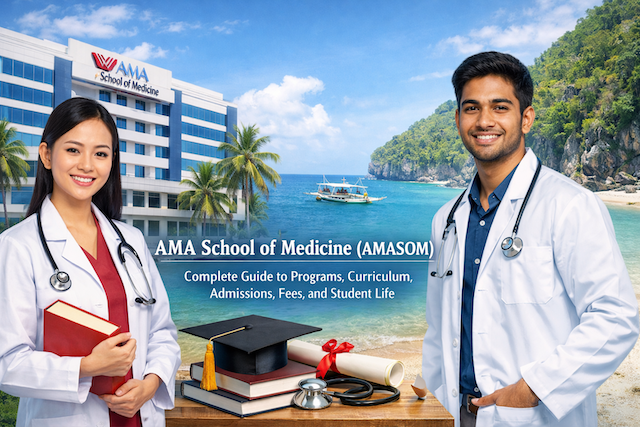
AMA School of Medicine (AMASOM): Complete Guide to Programs, Curriculum, Admissions, Fees, and Student Life
Contents
- AMA School of Medicine (AMASOM): Complete Guide to Programs, Curriculum, Admissions, Fees, and Student Life
- Quick Overview
- Location and Campus Environment
- Academic Philosophy: Case-Based and Hybrid Medical Curriculum
- Doctor of Medicine (MD) Program: What to Expect
- Clinical Training and Partner Institutions
- Facilities and Learning Spaces
- Admissions Requirements (Local and Foreign Students)
- International Students: Pathways and Practical Considerations
- Fees and Cost of Living: How to Budget Realistically
- Scholarships and Financial Support
- Who AMASOM May Be Best For
- How to Strengthen Your Application
- Student Life: Managing Stress and Staying Consistent
- Contact and Next Steps
- FAQs (Frequently Asked Questions)
- Is AMA School of Medicine (AMASOM) a good choice for international students?
- What program does AMASOM offer?
- Does AMASOM use a case-based curriculum?
- What are the admission requirements for local applicants?
- What documents do foreign students typically need?
- Is there an entrance exam besides the NMAT?
- How does the interview process work?
- Is admission guaranteed?
- Where is AMASOM located, and does location matter for students?
- What about clinical training and hospital exposure?
- How much does it cost to study at AMASOM?
- Does AMASOM offer scholarships?
- What should I check before enrolling if I want to practice medicine outside the Philippines?
AMA School of Medicine (AMASOM): Complete Guide to Programs, Curriculum, Admissions, Fees, and Student Life
AMA School of Medicine (often shortened as ASM or AMASOM) is the medical school of the AMA Education System (AMAES). It is known for an outcomes-focused, case-based approach designed to help students connect basic science to clinical reasoning early in the program. For many applicants—especially those looking for an internationally oriented environment—AMASOM’s emphasis on structured learning, technology-enabled assessments, and a clearly defined admissions process can be appealing.
This guide explains what to expect from AMASOM, including its Doctor of Medicine program, the school’s teaching style, partner institutions and clinical exposure, admissions requirements (local and foreign), typical cost categories, and practical tips to help you decide if it matches your goals.
Quick Overview
- School: AMA School of Medicine (AMASOM / ASM)
- Parent organization: AMA Education System (AMAES)
- Location: Osmeña Highway, corner Gen. Mojica, Makati City, Philippines
- Main program: Doctor of Medicine (MD)
- Learning approach: Hybrid curriculum with case-based and problem-based learning elements; integration of information technology tools for learning and assessment
Location and Campus Environment
AMASOM is located in Makati—one of Metro Manila’s most established business districts. Studying in Makati can be convenient if you want access to major transportation routes, hospitals, clinics, and a wide range of accommodation options. The city environment also means you can usually find essential services quickly (printing, mobile shops, groceries, banks, co-working spaces), which matters more than many people expect during a demanding medical program.
That said, city life comes with trade-offs: living costs can be higher than in provincial areas, and commuting can be stressful at peak hours. Most medical students reduce daily friction by living as close to campus as possible or choosing predictable commuting routes.
Academic Philosophy: Case-Based and Hybrid Medical Curriculum
AMASOM describes its medical program as a hybrid curriculum that synchronizes and integrates basic science concepts using case-based scenarios. The core idea is simple: instead of studying topics in isolation, students repeatedly return to real or simulated clinical cases that force them to apply anatomy, physiology, biochemistry, and related disciplines in a practical way.
Many students find this approach effective because medical knowledge “sticks” better when it is attached to a patient story, a diagnostic dilemma, or a management plan. This method can also improve confidence in clinical reasoning because you practice the logic of medicine—history taking, differential diagnosis, and decision-making—earlier than in purely lecture-driven formats.
AMASOM also highlights the integration of information technology (IT)-based capabilities to enhance learning and assessments. In practice, this often means more structured digital materials, systems that support quiz/exam workflows, and technology-supported tracking of learning progress.
Doctor of Medicine (MD) Program: What to Expect
The Doctor of Medicine program is the central offering of AMASOM. While medical curricula can vary, the overall MD journey typically includes:
- Pre-clinical foundation: Building strong basic science knowledge while learning how to apply it through cases, tutorials, and guided discussions.
- Integrated clinical thinking: Repeated exposure to clinical scenarios designed to connect symptoms and signs to underlying mechanisms.
- Skills and professional development: Communication, professionalism, teamwork, and habits that support safe patient care.
- Clinical exposure: Training in affiliated hospitals and clinical environments to observe and eventually participate in patient care under supervision.
If you perform best with structured schedules and clear academic expectations, a curriculum built around guided cases and measurable assessments may suit you. If you prefer highly self-directed learning with minimal structure, you may need to proactively manage your study plan and time to keep pace.
Clinical Training and Partner Institutions
Clinical training is one of the most important considerations when choosing a medical school. AMASOM lists multiple partner institutions and affiliations, and it identifies an affiliate training hospital for clinical exposure: Quirino Memorial Medical Center (QMMC).
When evaluating clinical training, consider these practical questions:
- Case volume and variety: Do students see common internal medicine, pediatrics, surgery, OB-GYN, and emergency cases regularly?
- Teaching culture: Are residents and consultants accustomed to teaching and supervising students?
- Student-to-clinical-slot ratio: Does the hospital have enough departments and patient flow so students can gain meaningful hands-on learning?
- Logistics: How far is the hospital from campus? Are rotations clustered or spread across multiple sites?
Even if a school has formal affiliations, day-to-day clinical learning is shaped by scheduling, rotation design, faculty involvement, and student initiative. The best strategy is to request updated rotation details directly from the admissions office, and if possible, talk to current students about their actual clinical week—how many hours, what tasks, what supervision, and what learning activities.
Facilities and Learning Spaces
AMASOM showcases campus facilities and learning spaces through its official materials. While facility photos can be helpful, it’s even more important to understand how the facilities are used. In medical education, key facility categories typically include:
- Classrooms and small-group rooms: Essential for case discussions, tutorials, and problem-based sessions.
- Skills areas: Spaces for practicing clinical examinations, basic procedures, and communication scenarios.
- Study-friendly environment: Quiet zones, reliable internet access, and a setup that supports long hours of reading and review.
If you are comparing schools, ask the same questions for each: How many students share the facilities? Are small-group sessions actually small? How often can you access study areas? These details influence the day-to-day student experience more than branding.
Admissions Requirements (Local and Foreign Students)
AMASOM outlines a clear set of admissions requirements and procedures. In general, applicants should prepare for documentation and eligibility checks, plus an interview process.
General qualifications commonly include:
- A four-year Bachelor’s degree in Science or the Arts
- Eligibility for the National Medical Admission Test (NMAT)
Core documents commonly required include:
- Application and processing fees
- Transcript of Records (Bachelor’s degree)
- Diploma or Certificate of Graduation
- Certificate of Eligibility from the Commission on Higher Education (CHED)
- NMAT result
Additional requirements for foreign students commonly include:
- Copy of passport
- Copy of tourist visa for conversion to student visa, or student visa (if available)
- Copy of Bureau of Quarantine stamp in passport
Typical admissions procedure includes:
- Complete the application form through the school’s admissions office
- Interview with the Dean and/or College Secretary
- Submit required documents
- Assessment of fees (often different for foreign students)
- Payment to the cashier
Because medical school admissions can be document-heavy, the best approach is to build a checklist and complete it in phases: academic documents first, exam results next, then visa-related requirements if you are applying from overseas.
International Students: Pathways and Practical Considerations
AMASOM states that it has a specialized setup for international students who want to pursue combined pathways (for example, a pre-med component plus the medicine program). For some student backgrounds, certain subjects may be credited based on prior curriculum, but you should confirm the most current policy directly with admissions.
If you are an international applicant, plan for these realities:
- Visa timeline: Student visa processes can take longer than expected. Start early and keep digital copies of every document.
- Budget beyond tuition: Accommodation, food, utilities, transportation, and visa-related costs add up quickly.
- Adjustment and support: Your first 4–8 weeks can be the hardest due to climate, food, local transport, and academic pace.
- Licensing pathway: If you plan to practice in your home country after graduation, confirm the exact licensing exams and documentation required.
Some prospective students focus only on admission and tuition, then struggle later with licensing requirements. Before enrolling anywhere, map your plan from Day 1 to licensure: graduation requirements, internship/clerkship expectations, national board or licensing exams, and any required eligibility documentation.
Fees and Cost of Living: How to Budget Realistically
Medical school costs are best understood in categories. Even if a school provides fee tables, the real question is your total cost of attendance—not just tuition.
- Tuition and academic fees: Program fees, lab fees, and school charges.
- Administrative processing: Application fees and student services costs.
- Visa-related expenses (foreign students): Conversions, extensions, and compliance-related fees.
- Living expenses: Rent, food, utilities, phone/data, and transportation.
- Study expenses: Books, subscriptions, printing, equipment, and exam preparation materials.
As a practical budgeting method, estimate your monthly living costs conservatively and multiply by 12, then add a buffer for emergencies. Medical students often underestimate costs because schedules limit part-time work options. A stable financial plan can reduce stress and help you focus on academics.
Scholarships and Financial Support
AMASOM indicates scholarship options for local students. Scholarships can reduce the burden, but they often come with performance expectations or specific eligibility criteria. If you want to apply for a scholarship, request details early and ask for:
- Eligibility criteria
- Document requirements
- Renewal conditions (GPA or conduct requirements)
- Deadlines and review timelines
If you are a foreign student, scholarship availability may be more limited, so treat scholarships as a bonus rather than a guaranteed plan.
Who AMASOM May Be Best For
Every medical school fits certain learner types better than others. AMASOM may be a good match if you:
- Learn well through cases, guided discussions, and structured problem-solving.
- Prefer a program that highlights technology-enabled learning and assessment.
- Want to study in Metro Manila with access to major city resources.
- Are an international applicant who wants a clearly described admissions process and support pathways.
You may need to think carefully if you:
- Strongly prefer a quieter, provincial campus environment.
- Struggle with city logistics (traffic, commuting, higher cost of living).
- Need a program with a very specific licensing pathway—always verify recognition and requirements for your intended country of practice.
How to Strengthen Your Application
Medical schools want students who can handle academic intensity, communicate professionally, and remain resilient. Practical ways to strengthen your AMASOM application include:
- Organize your documents early: Transcripts, diploma certificates, and any required eligibility documents can take time to obtain.
- Prepare for NMAT strategically: Your NMAT performance matters. Set a study timeline and practice under timed conditions.
- Show consistent motivation: In interviews, explain why medicine, why now, and what kind of doctor you aim to become.
- Demonstrate discipline: Medical school rewards systems, not bursts of motivation. Describe how you manage schedules and long-term goals.
In interviews, avoid vague statements like “I want to help people.” Instead, discuss a concrete story that shaped your interest in medicine and what you learned from it—teamwork, empathy, responsibility, or exposure to patient care realities.
Student Life: Managing Stress and Staying Consistent
Medical school is a marathon. The best students are not always the “smartest” on paper—they are often the most consistent. If you join AMASOM (or any medical program), build habits that protect your long-term performance:
- Daily review routine: Short, consistent reviews beat occasional cramming.
- Active recall and practice questions: Case-based learning improves when you test yourself often.
- Sleep and exercise basics: Your brain is your core tool; protect it.
- Study groups with purpose: Use groups for case discussion and explaining concepts, not passive reading.
If you are an international student, also plan for cultural adjustment: learning local transport options, planning meals that support focus, and creating a small support network early (classmates, roommates, student services).
Contact and Next Steps
If AMASOM sounds like a possible fit, the best next step is to request the most current admissions details directly from the official contact channels, including program start timelines, updated fee tables, and any recent changes related to eligibility and licensing pathways.
- Address: Osmeña Highway, corner Gen. Mojica, Makati City 1200, Philippines
- Admissions hours: Monday to Saturday, 8:00 AM to 5:00 PM (verify before visiting)
- Phone: +63(951) 188-0999
- Email (Dean / official contact): info@amaschoolofmedicine.org.ph
Final tip: Before you commit, confirm your end goal (where you plan to practice) and validate the licensing pathway from school to licensure in that country. Doing this early can save you years of uncertainty and protect your investment in your medical education.
FAQs (Frequently Asked Questions)
Is AMA School of Medicine (AMASOM) a good choice for international students?
AMASOM can be a practical option for international students who want to study medicine in Metro Manila, especially if you prefer a structured curriculum that uses case-based learning and technology-supported assessments. The school also lists specific document requirements for foreign applicants, which can make the process feel clearer. However, “good choice” depends on your personal goals—particularly where you plan to take licensing exams after graduation. Before enrolling, confirm your intended country’s recognition rules, required exams, and document requirements, then compare them with AMASOM’s curriculum and clinical training setup.
What program does AMASOM offer?
AMASOM’s main offering is the Doctor of Medicine (MD) program. Like most medical programs, it typically begins with strong foundational sciences and moves toward clinical exposure and practical training. AMASOM emphasizes a hybrid approach that integrates basic sciences through case scenarios to build clinical reasoning early. For applicants, the key is not only the program title, but also how learning is delivered—small-group discussions, case analysis, and the assessment style. Ask admissions for the most recent curriculum outline and academic calendar so you understand how subjects and rotations are sequenced.
Does AMASOM use a case-based curriculum?
Yes. AMASOM describes its approach as a hybrid curriculum that integrates basic science concepts using case-based scenarios. In simple terms, this means you will study anatomy, physiology, biochemistry, and related topics while repeatedly applying them to patient-style cases. If you learn best by connecting theory to real-world decision-making, this approach can be a strong advantage. If you prefer pure lecture-based learning, you may need to adapt your study habits to succeed in discussion-heavy and problem-solving formats.
What are the admission requirements for local applicants?
AMASOM commonly requires a four-year Bachelor’s degree (in Science or Arts), plus eligibility for the National Medical Admission Test (NMAT). You should expect to submit documents such as your Transcript of Records, proof of graduation (diploma or certificate), and other school-specific forms and processing fees. Because requirements can be updated, treat any checklist as “versioned.” The safest process is to request the latest requirements directly from AMASOM admissions and confirm which documents must be original copies, which can be certified true copies, and which can be submitted digitally.
What documents do foreign students typically need?
Foreign applicants usually need the core academic documents plus additional identity and immigration documents. These often include a passport copy and proof of lawful stay (such as a tourist visa initially, with steps for conversion to a student visa when applicable). Some schools also request documentation related to health clearances or entry stamps. Since immigration requirements can change, you should confirm the latest process and timeline with the school and (when needed) with official Philippine immigration guidance. Start early, keep multiple copies, and maintain both digital and printed versions.
Is there an entrance exam besides the NMAT?
AMASOM typically recognizes the NMAT as the standardized admission test for medical school eligibility in the Philippines. Beyond that, applicants may undergo interviews and document evaluation. Some schools also use internal assessments or additional screening steps depending on the applicant’s background. The best way to avoid surprises is to ask admissions two specific questions: (1) “Are there additional exams or screenings beyond NMAT?” and (2) “What are the interview criteria and typical interview format?”
How does the interview process work?
Applicants may be interviewed by academic leadership such as the Dean and/or the College Secretary. Interviews commonly focus on motivation, readiness for the demands of medical training, communication skills, and professionalism. To prepare, be ready to explain why you want to study medicine, why you chose AMASOM, how you handle stress, and what your long-term plan is for training and licensing. It also helps to describe your study system—how you manage time, maintain consistency, and recover after setbacks.
Is admission guaranteed?
No. Admission is not guaranteed, because the school evaluates eligibility, documents, and fit through its admissions process. If you are working with a counselling or support service, you can still aim for a strong success rate by following requirements carefully and submitting complete documents on time. The most common reasons for delays or rejections are missing or inconsistent paperwork, unclear eligibility status, or insufficient exam/credential alignment. Treat your application like a formal project: checklist, deadlines, and double verification.
Where is AMASOM located, and does location matter for students?
AMASOM is located in Makati, Metro Manila. Location matters because it affects cost of living, daily logistics, and your energy level. Makati can offer convenience—access to services, transportation routes, and hospitals—but it can also mean higher rent and heavier traffic. Many students reduce stress by living closer to campus, choosing stable commuting options, and building routines that protect study time. When comparing schools, calculate your true monthly cost (rent, food, transport, utilities) rather than focusing only on tuition.
What about clinical training and hospital exposure?
Clinical training quality depends on where you rotate, the case volume, and how teaching is structured. AMASOM lists clinical affiliations and identifies an affiliate training hospital for clinical exposure. When evaluating this, ask for specifics: rotation sites, how clerkships are scheduled, how many students rotate at the same time, and what supervision looks like in daily practice. If possible, speak with current students and ask what they actually do during rotations—patient interviews, basic procedures, presentations, or observation—and how feedback is delivered.
How much does it cost to study at AMASOM?
Costs typically include tuition and school fees, plus living expenses and personal study costs. For foreign students, immigration-related expenses may add another layer. Because fee tables can change, request the latest official breakdown from admissions and compare it with your expected monthly budget in Makati. A realistic medical student budget should include rent, utilities, food, transport, phone/data, printing, books, exam preparation materials, and an emergency buffer. Financial stability is not just comfort—it directly affects your academic performance.
Does AMASOM offer scholarships?
AMASOM indicates scholarship options for local students. Scholarship policies vary, and they often require maintaining specific academic standing or conduct standards. If scholarships are important for your plan, ask for the exact eligibility criteria, required documents, deadlines, and renewal conditions. If you are an international student, scholarship availability may be limited, so you should plan as if you will self-fund unless you receive written confirmation of support.
What should I check before enrolling if I want to practice medicine outside the Philippines?
Confirm your target country’s licensing pathway first. Different countries have different rules about recognizing foreign medical degrees and clinical training. Ask what exams you will need, whether you must complete additional internship/residency steps, and what documents must be issued by your medical school. Then compare those requirements with AMASOM’s curriculum structure and clinical training. Doing this early helps you avoid costly surprises and ensures your medical degree supports your long-term career plan.
Complete List of Medical Schools in the Philippines (All 78 MD Programs)
Best Medical Schools in the Philippines (Local & International Rankings)
Recommend
2026年1月23日
Sultan Kudarat State University College of Medicine: Complete Guide for Aspiring MD Students
2026年1月23日
University of Southern Mindanao College of Medicine: Complete Guide for Aspiring MD Students
2026年1月23日
Mindanao State University – General Santos College of Medicine: Complete Guide for Future MD Students

How to Register for eTravel Philippines (2025 Guide)
Step-by-step guide to completing your eTravel registration before arriving in the Philippines, with images and tips.

Night Market in Cebu – Things You Don’t Know About Cebu Life
Discover the hidden charm of Cebu’s night markets, from street food stalls to local life tips you won’t find in tourist guides.

How to Use ChatGPT for IELTS Preparation: A Complete Guide
Learn how to prepare for IELTS using ChatGPT — including strategies for Writing, Reading, Listening, Speaking, and grammar support.

How to Build a Website Without Coding Using ChatGPT
Discover how to build your own website using AI—no coding skills needed. From structure planning to SEO and design, let ChatGPT guide you.