2025年12月31日
3D ACADEMY offers affordable English study programs in Cebu, Philippines – perfect for beginners, professionals, and exam takers.

3D UNIVERSAL ENGLISH INSTITUTE INC
info.3d-universal.com
8:00-17:00(Mon-Fri)
Are Jeepneys Safe for First-Time Visitors? Manila Transportation Guide
Contents
- Are Jeepneys Safe for First-Time Visitors? Manila Transportation Guide
- Introduction: Why Safety Is a Common Concern for First-Time Visitors
- What Exactly Is a Jeepney?
- General Safety Overview: Are Jeepneys Dangerous?
- Traffic Safety: The Biggest Risk for Visitors
- Crime and Personal Safety on Jeepneys
- Daytime vs Nighttime Jeepney Safety
- Jeepneys vs Other Transport Options for Tourists
- Route Familiarity: A Major Safety Factor
- Language and Communication Challenges
- Comfort, Hygiene, and Health Considerations
- Are Jeepneys Safe for Solo Travelers?
- Common Myths About Jeepney Safety
- When First-Time Visitors Should Avoid Jeepneys
- When Jeepneys Are a Good Choice
- Final Verdict: Are Jeepneys Safe for First-Time Visitors?
- FAQs (Frequently Asked Questions)
- Are jeepney routes in Metro Manila fixed, or do drivers change them?
- How can I quickly figure out if a jeepney goes to my destination?
- What are the most common jeepney route hubs tourists should know?
- Do jeepney routes connect well with MRT and LRT stations?
- How many transfers are normal when using jeepneys in Metro Manila?
- What time of day is best for using common jeepney routes?
- Are there “tourist-friendly” jeepney routes that are easier to ride?
- How do I pay correctly if I’m unsure about the distance?
- Is it safe to use common jeepney routes as a visitor?
- What should I do if I accidentally board the wrong jeepney?
- Are traditional jeepneys and modern jeepneys on the same routes?
Are Jeepneys Safe for First-Time Visitors? Manila Transportation Guide
Introduction: Why Safety Is a Common Concern for First-Time Visitors
For many first-time visitors to Manila, jeepneys are one of the most confusing—and intimidating—forms of transportation. They are loud, crowded, colorful, and seemingly chaotic. Unlike trains or ride-hailing apps, jeepneys do not follow a system that is immediately obvious to outsiders. This often leads travelers to ask a very reasonable question: are jeepneys safe for first-time visitors?
The short answer is yes, jeepneys can be safe, but only if you understand how they work, when to use them, and what precautions to take. This guide is designed specifically for first-time visitors who want a realistic, honest assessment of jeepney safety in Metro Manila, without exaggeration or unnecessary fear.
By the end of this article, you will understand:
-
The real safety risks associated with jeepneys
-
When jeepneys are safe to use and when to avoid them
-
How tourists and locals experience jeepney travel differently
-
Practical safety tips to minimize problems
-
Whether jeepneys are suitable for you on your first visit
What Exactly Is a Jeepney?
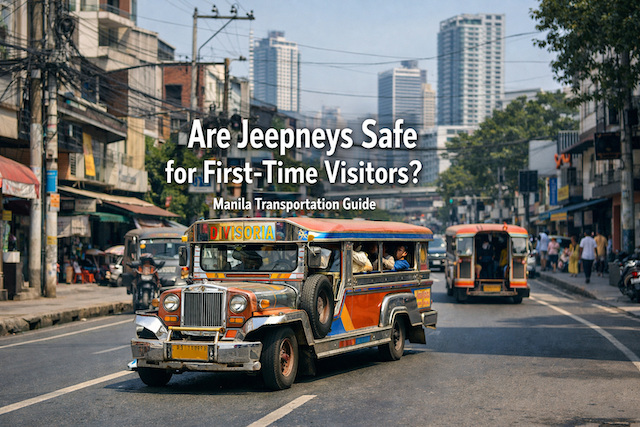
Jeepneys are the most iconic form of public transportation in the Philippines. Originally converted from surplus U.S. military jeeps after World War II, they evolved into long, customized vehicles that operate on fixed routes across Metro Manila and beyond.
Jeepneys are:
-
Privately operated
-
Route-based (not point-to-point)
-
Very affordable
-
Used mainly by locals for daily commuting
They stop almost anywhere to pick up or drop off passengers, and payment is done in cash, handed forward to the driver through other passengers.
Understanding this informal structure is essential when evaluating safety.
General Safety Overview: Are Jeepneys Dangerous?
Jeepneys are not inherently dangerous, but they are less controlled and less regulated compared to trains, buses, or ride-hailing services. Safety issues typically fall into four categories:
-
Traffic-related risks
-
Petty crime (pickpocketing, snatching)
-
Comfort and hygiene concerns
-
Navigation and communication difficulties
Serious violent crime involving jeepney passengers is rare, especially during daytime and on busy routes. Most safety issues involve inconvenience or minor theft rather than physical harm.
Traffic Safety: The Biggest Risk for Visitors
Driving Style in Manila
The most significant risk when riding jeepneys is Manila traffic itself, not crime. Jeepney drivers operate in a highly competitive environment and often:
-
Stop suddenly to pick up passengers
-
Change lanes without signaling
-
Drive close to other vehicles
-
Compete for space on narrow roads
For first-time visitors, this can feel chaotic and stressful.
Vehicle Condition
Traditional jeepneys often lack:
-
Seat belts
-
Proper doors (many are open at the back)
-
Modern safety features
Sudden braking can cause passengers to lose balance, especially when standing or sitting near the edge.
How to Reduce Traffic Risk
-
Sit as far inside the jeepney as possible
-
Avoid standing unless absolutely necessary
-
Hold onto rails or supports at all times
-
Avoid riding during heavy rain or late-night hours
Crime and Personal Safety on Jeepneys
Pickpocketing and Theft
The most common crime affecting jeepney passengers is petty theft, not violent crime. This includes:
-
Pickpocketing in crowded jeepneys
-
Bag slashing in rare cases
-
Phone snatching near open entrances
Tourists may be targeted more often simply because they look unfamiliar or distracted.
Violent Crime: How Common Is It?
Violent incidents involving jeepney passengers are very uncommon, especially during:
-
Daytime
-
Rush hours
-
Busy commercial routes
Most locals, including office workers and students, ride jeepneys daily without incident.
Practical Anti-Theft Tips
-
Keep bags zipped and worn in front
-
Avoid using your phone near the entrance
-
Do not display expensive jewelry
-
Keep small bills accessible to avoid opening your wallet
Daytime vs Nighttime Jeepney Safety
Daytime: Generally Safe
For first-time visitors, daytime jeepney travel (6:00 AM–8:00 PM) is generally safe on major routes. These jeepneys are:
-
Crowded with commuters
-
Highly visible
-
Less likely to attract criminal activity
Nighttime: Higher Risk
Late-night jeepney travel carries more risk due to:
-
Fewer passengers
-
Poor lighting
-
Reduced police presence
If you are unfamiliar with Manila, it is best to avoid jeepneys after 9:00 PM, especially in unfamiliar neighborhoods.
Jeepneys vs Other Transport Options for Tourists
Jeepneys vs Trains (MRT/LRT)
Trains are:
-
More predictable
-
More secure
-
Easier to understand for foreigners
However, they are extremely crowded during rush hours.
Jeepneys vs Buses
Modern city buses offer:
-
Air-conditioning
-
Fixed stops
-
More regulated operations
They are safer and more comfortable but slower in traffic.
Jeepneys vs Grab or Taxis
Ride-hailing apps are:
-
The safest option for first-time visitors
-
More expensive
-
Less immersive
Jeepneys offer cultural experience but require more awareness.
Route Familiarity: A Major Safety Factor
Jeepneys are safest when:
-
You already know your route
-
You can recognize landmarks
-
You know where to get off
They become risky when:
-
You rely entirely on signs you cannot read
-
You are unsure whether the jeepney goes where you need
-
You hesitate or look confused while onboard
For your first few days in Manila, it is advisable to observe jeepneys before riding them.
Language and Communication Challenges
Most jeepney drivers and passengers speak some English, but instructions are often shouted in Tagalog. Common commands include:
-
“Para” (stop)
-
“Bayad po” (payment)
-
Route names shouted quickly
Miscommunication can lead to:
-
Missing your stop
-
Overpaying
-
Stress in crowded situations
This is not dangerous, but it can be overwhelming for first-time visitors.
Comfort, Hygiene, and Health Considerations
Jeepneys are not designed for comfort. Expect:
-
Tight seating
-
High noise levels
-
Heat and poor ventilation
-
Strong smells during peak hours
For travelers sensitive to heat, noise, or crowds, discomfort can feel unsafe even if there is no real danger.
Are Jeepneys Safe for Solo Travelers?
Yes, especially for:
-
Confident travelers
-
Daytime travel
-
Short distances
Extra caution is advised if:
-
You are carrying luggage
-
You appear lost
-
You are riding late at night
Solo female travelers generally report safe experiences during the day but often prefer other transport at night.
Common Myths About Jeepney Safety
“Jeepneys Are Extremely Dangerous”
This is exaggerated. Millions of Filipinos use jeepneys daily without incident.
“Tourists Are Always Targeted”
Tourists are not automatically targeted, but distracted behavior increases risk.
“Only Locals Can Ride Jeepneys Safely”
With preparation and awareness, first-time visitors can ride jeepneys safely.
When First-Time Visitors Should Avoid Jeepneys
Avoid jeepneys if:
-
It is your first day in Manila
-
You are tired or jet-lagged
-
You are traveling late at night
-
You are carrying large bags
-
You are unsure of the route
There is no shame in choosing safer, simpler transport options.
When Jeepneys Are a Good Choice
Jeepneys are a good option when:
-
You want an authentic local experience
-
You are traveling during the day
-
You already understand the route
-
You want to save money
-
You are traveling short distances
Final Verdict: Are Jeepneys Safe for First-Time Visitors?
Jeepneys can be safe for first-time visitors, but they are not beginner-friendly. Safety depends less on crime and more on:
-
Situational awareness
-
Route familiarity
-
Time of day
-
Personal comfort with crowds and chaos
For your first visit to Manila:
-
Start with trains, buses, or Grab
-
Observe jeepney routes first
-
Ride jeepneys during the day on busy routes
-
Follow basic safety precautions
Jeepneys are not dangerous by default, but they demand attention and confidence. If you respect their limitations and understand how they work, they can be a safe and memorable part of your Manila experience.
FAQs (Frequently Asked Questions)
Are jeepney routes in Metro Manila fixed, or do drivers change them?
Most jeepney routes are fixed and regulated as point-to-point corridors (for example, “Divisoria–Baclaran” or “Cubao–Fairview”). Drivers generally follow the same main roads every trip because passengers expect those stops and landmarks. That said, small variations can happen due to road closures, flooding, traffic rerouting, or local ordinances. In some areas, drivers may take a parallel road to bypass congestion while still serving the same neighborhoods. If you are unsure, ask the driver before boarding: “Does this pass by (landmark)?” Using landmarks like “MRT station,” “mall,” “church,” or “market” is more reliable than street names for visitors.
How can I quickly figure out if a jeepney goes to my destination?
Start by identifying a major hub near you and a major hub near your destination. Jeepney routes usually connect hubs: transport terminals, big malls, markets, or train stations. Read the route signboard on the windshield or side; it often lists key points along the route. If the sign includes your destination area, you are likely on the right vehicle. If it includes a nearby landmark, that can also work. When in doubt, ask the driver a simple yes/no question, such as “España?” “Quiapo?” or “Ayala?” If the driver nods or says “Oo,” you can board. If you still feel uncertain, ride a short segment and confirm with a seated passenger who looks familiar with the route.
What are the most common jeepney route hubs tourists should know?
Tourists benefit most from learning hub areas rather than memorizing every route. In Manila City, key hubs include Divisoria, Quiapo, España, Taft Avenue, and Lawton. In Quezon City, common hubs include Cubao, SM North/Trinoma, Commonwealth (Philcoa), and Fairview. In the south, Baclaran, Pasay Rotonda, and areas near the airport zone can be helpful. In business districts, Guadalupe and Ayala are major transfer points. Once you can identify a hub near your hotel and a hub near your attraction, you can often connect using one or two jeepney rides.
Do jeepney routes connect well with MRT and LRT stations?
Yes. Jeepneys often act as feeder transport for train stations, especially where walking is inconvenient. You can find jeepneys near many MRT-3 stations (like Cubao, Shaw, Guadalupe, and Ayala) and near LRT stations along Taft Avenue or Rizal Avenue. A common strategy is to take the train for the longest part of your trip, then use a jeepney for the “last mile.” However, station areas can be crowded, and jeepney terminals may be on side streets. If you are new, look for lines of waiting passengers or ask a security guard nearby where the jeepneys for your direction usually load.
How many transfers are normal when using jeepneys in Metro Manila?
For short trips within the same district, one jeepney is often enough. Across cities, two rides are common: one jeepney to a hub (like Cubao or Quiapo), then another jeepney to the final area. Three transfers can happen if your destination is deep inside a residential neighborhood or far from major roads. If you find yourself needing multiple transfers, consider combining jeepneys with MRT/LRT to reduce travel time and confusion. For visitors, a simple and practical rule is: if the trip requires more than two jeepney rides, using trains or Grab might be easier.
What time of day is best for using common jeepney routes?
Mid-morning and early afternoon are usually the easiest times: fewer crowds, shorter queues, and less stress. Peak hours in Metro Manila (roughly 6:00–9:00 AM and 5:00–9:00 PM) can mean packed jeepneys and slow traffic, especially on routes passing business districts, schools, and major intersections. Weekends can also be busy near malls and tourist areas. If you must travel during rush hour, plan extra time, keep your belongings secure, and expect that you might need to wait for the next jeepney if the first one is full.
Are there “tourist-friendly” jeepney routes that are easier to ride?
Routes along major corridors like Taft Avenue, España, and the areas around large malls tend to be easier because signage is clearer and there are more commuters who can help. Routes that connect to train stations are also beginner-friendly since you can use the station as a starting landmark. More confusing routes are those that loop inside residential areas, where signage may be minimal and the route name is known mainly by locals. If you are riding your first jeepney, choose a simple corridor route first, then build confidence before trying smaller neighborhood routes.
How do I pay correctly if I’m unsure about the distance?
Most jeepney trips start with a minimum fare and increase slightly with distance. If you are unsure, you can ask, “How much to (landmark)?” before paying. Hand your fare forward and say your destination clearly. If you pay with a larger bill, you may wait for change, so it helps to carry coins and small bills. If the jeepney is modern (often air-conditioned and larger), payment may be different depending on the operator, but many still accept cash collected by staff or through a system used on that route.
Is it safe to use common jeepney routes as a visitor?
Many visitors use jeepneys safely every day, but you should follow practical precautions. Keep your bag in front of you, avoid flashing valuables, and stay alert in crowded areas like Divisoria, Baclaran, and major terminals. Sit near the exit if you want an easier alight, and avoid riding late at night in unfamiliar districts. If you feel uneasy, get off near a busy, well-lit place such as a mall or train station and switch to a different option. The most important safety advantage for tourists is choosing routes with steady foot traffic and predictable stops.
What should I do if I accidentally board the wrong jeepney?
Don’t panic. Jeepneys stop frequently, so you can get off at the next safe point. Try to alight near a recognizable landmark (a station, mall, or busy intersection) where you can reorient yourself. If you have already traveled some distance, ask a local where you are and which jeepney goes back toward your intended hub. Many routes have return jeepneys on the opposite side of the road. Consider using a train station as your “reset point,” since stations are easy to identify and usually have guards or staff you can ask.
Are traditional jeepneys and modern jeepneys on the same routes?
In many areas, yes, you may see both vehicle types serving the same corridor, but it depends on the route and local operations. Some routes are being reorganized and consolidated, and certain corridors may transition toward modern units. For travelers, the practical approach is to focus on the route name and key landmarks rather than the vehicle style. If your priority is comfort, modern jeepneys are often air-conditioned and less cramped. If your priority is flexibility, traditional jeepneys may stop more frequently and are extremely common along older routes.

How to Register for eTravel Philippines (2025 Guide)
Step-by-step guide to completing your eTravel registration before arriving in the Philippines, with images and tips.

Night Market in Cebu – Things You Don’t Know About Cebu Life
Discover the hidden charm of Cebu’s night markets, from street food stalls to local life tips you won’t find in tourist guides.

How to Use ChatGPT for IELTS Preparation: A Complete Guide
Learn how to prepare for IELTS using ChatGPT — including strategies for Writing, Reading, Listening, Speaking, and grammar support.

How to Build a Website Without Coding Using ChatGPT
Discover how to build your own website using AI—no coding skills needed. From structure planning to SEO and design, let ChatGPT guide you.