2026年1月23日
3D ACADEMY offers affordable English study programs in Cebu, Philippines – perfect for beginners, professionals, and exam takers.

3D UNIVERSAL ENGLISH INSTITUTE INC
info.3d-universal.com
8:00-17:00(Mon-Fri)
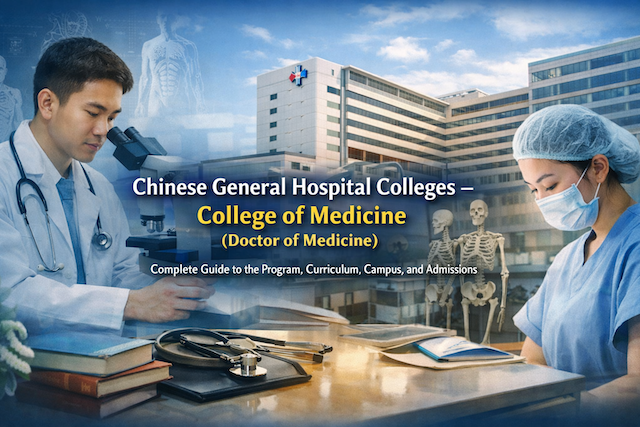
Chinese General Hospital Colleges – College of Medicine (Doctor of Medicine): Complete Guide to the Program, Curriculum, Campus, and Admissions
Contents
- Chinese General Hospital Colleges – College of Medicine (Doctor of Medicine): Complete Guide to the Program, Curriculum, Campus, and Admissions
- Overview: What CGHC College of Medicine Is
- Location and Campus Environment
- Program Structure: 4 Years, Full-Time, Post-Baccalaureate
- Curriculum Style: Outcome-Based Medical Education
- Clinical Training and Rotating Clerkship
- Hospital-Linked Advantage: Learning in a Working Medical Center
- Who the Program Can Be a Good Fit For
- Admissions: How the Process Commonly Works at CGHC
- National Requirement Context: NMAT in the Philippines
- Documents and Preparation: What Applicants Should Get Ready
- How to Evaluate CGHC vs Other Medical Schools
- Student Life Considerations in Manila
- Tuition and Fees: What to Do the Smart Way
- Contact Details and Next Steps
- Final Thoughts: Is CGHC College of Medicine Worth Considering?
- FAQs (Frequently Asked Questions)
- Is Chinese General Hospital Colleges (CGHC) College of Medicine the same as the hospital?
- What degree does CGHC College of Medicine offer?
- How long is the MD program at CGHC?
- Does CGHC include clinical clerkship as part of the program?
- Is NMAT required to apply to CGHC College of Medicine?
- Does CGHC have its own entrance exam or assessment?
- What documents should applicants prepare for the MD application?
- Does CGHC guarantee admission if I meet the requirements?
- What is the main advantage of studying medicine in a hospital-linked school like CGHC?
- Is CGHC College of Medicine suitable for international students?
- What is student life like around the CGHC campus in Manila?
- How can I compare CGHC with other medical schools in Metro Manila?
- How do I get the most accurate tuition and fee information for the MD program?
- Who should I contact for the latest admissions updates?
Chinese General Hospital Colleges – College of Medicine (Doctor of Medicine): Complete Guide to the Program, Curriculum, Campus, and Admissions
Overview: What CGHC College of Medicine Is
Chinese General Hospital Colleges (CGHC) is a private, non-sectarian institution in Manila that is closely linked to the Chinese General Hospital and Medical Center (CGHMC). The school’s College of Medicine offers a Doctor of Medicine (MD) program designed for students who already hold a bachelor’s degree and want to complete their medical education in a hospital-connected environment.
According to CGHC’s official program page, the College of Medicine was granted its license to operate and began enrolling its first batch of medical learners in 2017. The curriculum is described as outcome-based and structured as a full-time, 4-year post-baccalaureate program: three years of basic and clinical courses plus one year of rotating clinical clerkship. :contentReference[oaicite:0]{index=0}
If you are comparing medical schools in Metro Manila, CGHC’s key identity is straightforward: it is a medicine program built around a real hospital ecosystem, with training and clinical exposure shaped by the needs and realities of patient care in a busy urban setting.
Location and Campus Environment
CGHC is located along Blumentritt in Santa Cruz, Manila. This area is highly urban and well-connected by public transportation, which can be convenient for commuting students, but it also means you should expect typical Manila traffic patterns and plan your schedule accordingly. :contentReference[oaicite:1]{index=1}
Because the campus is associated with a functioning medical center, students often benefit from being in a setting where healthcare delivery is not theoretical—it is happening around them. For many medical students, that hospital-linked atmosphere becomes a daily motivator, especially once clinical subjects intensify.
Program Structure: 4 Years, Full-Time, Post-Baccalaureate
CGHC describes its Doctor of Medicine program as a duly-recognized 4-year post-baccalaureate track, covering both basic sciences and advanced clinical courses. The program also highlights “Western and Eastern Medicine fundamentals” and multidisciplinary practices. :contentReference[oaicite:2]{index=2}
In practical terms, the medical proper journey usually looks like this:
- Years 1–2: Heavy foundation in medical sciences and introductory clinical thinking.
- Year 3: More advanced clinical courses, integration, and preparation for intensive hospital exposure.
- Year 4: Rotating clinical clerkship (hospital-based rotations across major departments).
CGHC’s official outline confirms the “three years of basic and clinical courses and one year of rotating clinical clerkship” format. :contentReference[oaicite:3]{index=3}
Curriculum Style: Outcome-Based Medical Education
CGHC states that its MD curriculum is outcome-based. :contentReference[oaicite:4]{index=4} In outcome-based education, the focus is not only on what topics are covered, but on what competencies students must demonstrate by the time they reach specific checkpoints (and especially by graduation). In medicine, those outcomes generally include:
- Sound clinical reasoning and safe decision-making
- Communication skills with patients and healthcare teams
- Professionalism and ethical practice
- Ability to interpret laboratory and imaging results appropriately
- Readiness for internship, licensure preparation, and supervised practice
For students, the “real” implication is this: assessments tend to be more frequent, more structured, and more linked to observable performance—not just memorization. If you prefer a system where expectations are clearly defined and performance is tracked, an outcome-based approach can be a good fit.
Clinical Training and Rotating Clerkship
Clerkship is the year when medicine becomes fully hands-on. CGHC explicitly includes a one-year rotating clinical clerkship as the capstone of the 4-year MD program. :contentReference[oaicite:5]{index=5}
During rotating clerkship, students typically cycle through major clinical departments such as:
- Internal Medicine
- Surgery
- Pediatrics
- Obstetrics and Gynecology
- Emergency Medicine and related services
- Additional specialty exposures depending on hospital capacity and rotation design
Clerkship is also where students learn the rhythm of hospital work: rounds, case presentations, charting standards, patient communication, and the practical realities of teamwork. If you learn best by doing (and by being coached in real settings), clerkship becomes the most formative part of medical school.
Hospital-Linked Advantage: Learning in a Working Medical Center
CGHC’s connection to the Chinese General Hospital and Medical Center matters because it shapes clinical exposure and training culture. CGHMC itself presents structured training offerings such as post-graduate internship programs and residency tracks, which suggests an environment accustomed to teaching and supervised clinical development. :contentReference[oaicite:6]{index=6}
Even if you are “only” an undergraduate medical learner, being in a hospital that runs formal training pathways often translates into:
- More consistent clinical protocols and teaching routines
- Better-defined roles for trainees
- More opportunities to observe how medical education continues beyond graduation
In many cases, students who train in teaching-oriented hospitals develop stronger professional habits earlier because they see structured supervision, evaluation, and responsibility modeled daily.
Who the Program Can Be a Good Fit For
CGHC College of Medicine may be a strong option if you identify with one or more of the following:
- You want a hospital-connected medical education with real clinical exposure as a central feature, not an afterthought.
- You prefer Manila-based training and want access to a large urban patient population.
- You do well in structured systems (outcome-based expectations, step-by-step competency building).
- You are serious about clinical readiness and want clerkship to be a major focus in your training plan.
On the other hand, if your top priority is a quiet, spacious campus environment or a rural-style setting, you may want to compare CGHC with schools that have larger standalone campuses outside Manila.
Admissions: How the Process Commonly Works at CGHC
CGHC publishes a general admissions procedure flow that includes school portal registration, payment of processing fees, an online assessment plus an entrance examination process, release of results, reservation, medical and physical examinations, submission of requirements, and enrollment. :contentReference[oaicite:7]{index=7}
Because specific requirements can vary by level and program (and medical programs often have additional screening), treat the published flow as a useful map of how CGHC operationally handles admissions, then confirm the Doctor of Medicine-specific checklist with the admissions office.
National Requirement Context: NMAT in the Philippines
In the Philippines, medical school admission commonly involves the National Medical Admission Test (NMAT). The NMAT system’s own admissions guidance references CHED policies and explains that the requirements and procedures for admission to Philippine medical schools are based on CHED Memorandum Order guidelines. :contentReference[oaicite:8]{index=8}
Also, CEM (Center for Educational Measurement), which administers the NMAT, states in its NMAT FAQs that those intending to enroll in a medical degree program in the Philippines are required to take the NMAT. :contentReference[oaicite:9]{index=9}
What this means for applicants: even if a school has its own internal exams or screening steps, NMAT is typically part of the broader Philippine medical education admissions landscape. Your target percentile requirement can vary by school, so you should verify CGHC’s current required NMAT percentile directly with CGHC admissions before finalizing your application plan.
Documents and Preparation: What Applicants Should Get Ready
While program-specific lists can differ, medical applicants generally benefit from preparing the following early:
- Official proof of bachelor’s degree completion (or certificate of candidacy if graduating)
- Official transcripts and academic records
- Good moral character documentation (if required by the institution)
- Government-issued identity documents
- NMAT results (as applicable to Philippine medical school admission standards)
- Personal statement and/or interview preparation (if the program includes interviews)
If you are applying from outside Manila or from overseas, build extra time for document authentication and courier timelines. Medical admissions can be time-sensitive, and delays are usually caused by missing paperwork rather than academic performance.
How to Evaluate CGHC vs Other Medical Schools
If you are choosing among multiple medical schools, use a comparison framework that goes beyond marketing:
- Clinical volume and diversity: Does the affiliated hospital give you enough patient exposure across core disciplines?
- Teaching culture: Are residents and consultants accustomed to mentoring learners?
- Curriculum clarity: Can the school explain competencies and progression clearly (especially in an outcome-based system)?
- Board exam preparation: What academic support exists for licensure preparation?
- Schedule realism: Are you ready for the demands of a full-time 4-year medical proper program?
CGHC’s published curriculum structure (3 years courses + 1 year rotating clerkship) makes it easy to understand the broad pathway. :contentReference[oaicite:10]{index=10} The next step is confirming the day-to-day reality: rotation schedules, evaluation methods, and student support systems.
Student Life Considerations in Manila
Medical school success is not only academic—it’s operational. In Manila, your ability to manage time, commute, meals, and rest can directly affect performance. If you plan to live off-campus, prioritize:
- Housing with predictable travel time to Blumentritt / Santa Cruz
- Safe walking routes and reliable transport options
- Access to affordable meals and groceries (you will not always have time to cook)
- A study environment that supports concentration and sleep
Also consider your support system. Medicine is a long training pathway, and students who plan their living setup thoughtfully often reduce avoidable stress during exam weeks and clinical rotations.
Tuition and Fees: What to Do the Smart Way
Tuition and total cost of attendance can change by academic year, and medical program fees can be structured differently from undergraduate programs. Instead of relying on third-party estimates, the best practice is:
- Request the latest Doctor of Medicine fee schedule directly from CGHC admissions or accounting.
- Ask what is included (laboratory fees, uniforms, clinical rotation fees, ID, insurance, etc.).
- Confirm payment methods and deadlines early to avoid enrollment disruption.
CGHC provides official contact channels for admissions inquiries, which is the safest way to get the most current numbers and policies. :contentReference[oaicite:11]{index=11}
Contact Details and Next Steps
If you want the most accurate, up-to-date admissions checklist for the College of Medicine, contact CGHC directly. The school lists its campus address in Santa Cruz, Manila and provides a telephone line and admissions email for inquiries. :contentReference[oaicite:12]{index=12}
Suggested next steps:
- Review the official CGHC College of Medicine overview to confirm the program structure and clerkship year. :contentReference[oaicite:13]{index=13}
- Ask admissions for the Doctor of Medicine-specific requirements (including whether additional screening steps apply).
- Plan your NMAT timeline (registration, testing window, and release of results), then match it to the school’s application deadlines. :contentReference[oaicite:14]{index=14}
- Prepare your documents early and keep both physical and scanned copies organized.
Final Thoughts: Is CGHC College of Medicine Worth Considering?
CGHC’s College of Medicine is a relatively newer medical program (first enrollees in 2017) with a clearly stated 4-year structure culminating in a rotating clinical clerkship. :contentReference[oaicite:15]{index=15} For applicants who value hospital-linked training in Manila and want an outcome-based framework, it can be a practical and compelling option—especially if your learning style improves with real clinical exposure and structured competency targets.
As with any medical school choice, the right answer depends on your priorities: clinical environment, academic culture, logistics, and long-term training goals. If you confirm the Doctor of Medicine admissions checklist directly with CGHC and align your NMAT and documents early, you will be in a strong position to decide whether CGHC is the best fit for your medical journey.
FAQs (Frequently Asked Questions)
Is Chinese General Hospital Colleges (CGHC) College of Medicine the same as the hospital?
They are closely linked but not identical. Chinese General Hospital Colleges (CGHC) is the educational institution, while Chinese General Hospital and Medical Center (CGHMC) is the healthcare facility. The College of Medicine benefits from this relationship because students can learn in an environment connected to a functioning hospital. However, administrative offices, academic policies, enrollment procedures, and student services are managed by the college, not by the hospital.
What degree does CGHC College of Medicine offer?
CGHC College of Medicine offers the Doctor of Medicine (MD) program. In the Philippines, the MD is a post-baccalaureate professional degree, meaning applicants must typically complete an undergraduate bachelor’s degree before entering medical proper. The MD program is designed to build foundational medical science knowledge, develop clinical reasoning, and prepare students for supervised clinical training, followed by the next stages of the physician pathway.
How long is the MD program at CGHC?
The MD program is typically structured as a four-year medical proper program: three years covering basic and clinical courses, followed by one year of rotating clinical clerkship. This is a common format in Philippine medical education. The clerkship year is where students spend most of their time in hospital rotations and learn how to apply classroom knowledge to real patient care under supervision.
Does CGHC include clinical clerkship as part of the program?
Yes. The program includes a rotating clinical clerkship year. During clerkship, students rotate through major departments such as Internal Medicine, Surgery, Pediatrics, and Obstetrics and Gynecology, along with other services depending on the hospital’s rotation design. Clerkship is demanding, and students are expected to show professionalism, reliability, and continuous learning because clinical evaluations are often based on performance in real settings.
Is NMAT required to apply to CGHC College of Medicine?
In the Philippines, the National Medical Admission Test (NMAT) is commonly required for admission into medical degree programs. Many medical schools use NMAT results as part of their screening and eligibility criteria. Because requirements can be updated, the safest approach is to confirm CGHC’s current required NMAT percentile, validity period of NMAT results, and submission timing directly with CGHC admissions before you finalize your application plan.
Does CGHC have its own entrance exam or assessment?
Schools often include their own assessment steps in addition to national requirements. CGHC publishes an admissions flow that may involve online assessment and/or an entrance examination process, depending on the program and intake period. The best practice is to ask admissions specifically for the College of Medicine process, because medical programs sometimes have additional screening such as interviews, document evaluation, or other internal assessments.
What documents should applicants prepare for the MD application?
While exact requirements vary, applicants typically prepare academic records (transcripts), proof of bachelor’s degree completion or graduation eligibility, identification documents, and other standard admission items such as certificates and completed forms. For medical programs, you may also need NMAT results and may be asked for additional documents that support academic readiness. If you are applying from outside Manila, prepare both physical and scanned copies and factor in delivery time for official documents.
Does CGHC guarantee admission if I meet the requirements?
No. Admission is not guaranteed. Even if you meet baseline eligibility requirements, medical programs usually evaluate applicants through a selection process. That said, many students who complete the required steps properly and submit complete documents are successfully admitted. The key is to follow the official process carefully, meet deadlines, and ensure your paperwork is complete and verifiable.
What is the main advantage of studying medicine in a hospital-linked school like CGHC?
A hospital-linked environment can help students connect learning to real clinical practice earlier and more naturally. Instead of treating clinical exposure as something that starts late, students often feel more immersed in healthcare systems, patient care realities, and professional expectations. This can be particularly helpful for students who learn best through observation, clinical discussion, and practical application of concepts.
Is CGHC College of Medicine suitable for international students?
It can be, but international applicants should clarify eligibility rules, document authentication requirements, and any additional steps required for foreign credentials. You should confirm whether transcripts need specific authentication, whether you must submit equivalent certifications, and whether there are program-specific rules about language proficiency or residency documentation. Contacting admissions early is important because international paperwork can take longer.
What is student life like around the CGHC campus in Manila?
Student life is strongly shaped by Manila’s urban pace. Many students plan their housing and commute carefully to reduce daily stress. You should prioritize reliable transportation options, safe routes, and a living setup that supports sleep and consistent study time. Medical school workloads are intense, so lifestyle planning is not optional; it is part of academic strategy.
How can I compare CGHC with other medical schools in Metro Manila?
Compare based on clinical training quality, teaching culture, evaluation methods, and logistical fit. Ask about rotation structures, supervision style, and how students are assessed during clerkship. Also check academic support systems for struggling students, review schedules, and the overall learning environment. A school can look strong on paper but still be a poor match if commuting, daily routines, or training culture do not suit you.
How do I get the most accurate tuition and fee information for the MD program?
Tuition and fees can change by academic year and may be structured differently for medical programs. The most reliable approach is to request the latest MD fee schedule directly from CGHC. When you ask, also clarify what is included (laboratory fees, clinical rotation fees, uniforms, IDs, and other required costs) and confirm payment deadlines. This prevents budget surprises and helps you plan your full cost of attendance realistically.
Who should I contact for the latest admissions updates?
For the most up-to-date information, contact CGHC admissions using the official communication channels listed by the school. Ask specifically about the College of Medicine intake period, current NMAT requirements, the step-by-step application process, and deadlines. Policies can change, and the admissions office is the only source that can confirm the latest requirements for your intake.
Complete List of Medical Schools in the Philippines (All 78 MD Programs)
Best Medical Schools in the Philippines (Local & International Rankings)
Recommend
2026年1月23日
Sultan Kudarat State University College of Medicine: Complete Guide for Aspiring MD Students
2026年1月23日
University of Southern Mindanao College of Medicine: Complete Guide for Aspiring MD Students
2026年1月23日
Mindanao State University – General Santos College of Medicine: Complete Guide for Future MD Students

How to Register for eTravel Philippines (2025 Guide)
Step-by-step guide to completing your eTravel registration before arriving in the Philippines, with images and tips.

Night Market in Cebu – Things You Don’t Know About Cebu Life
Discover the hidden charm of Cebu’s night markets, from street food stalls to local life tips you won’t find in tourist guides.

How to Use ChatGPT for IELTS Preparation: A Complete Guide
Learn how to prepare for IELTS using ChatGPT — including strategies for Writing, Reading, Listening, Speaking, and grammar support.

How to Build a Website Without Coding Using ChatGPT
Discover how to build your own website using AI—no coding skills needed. From structure planning to SEO and design, let ChatGPT guide you.