2026年1月9日
3D ACADEMY offers affordable English study programs in Cebu, Philippines – perfect for beginners, professionals, and exam takers.

3D UNIVERSAL ENGLISH INSTITUTE INC
info.3d-universal.com
8:00-17:00(Mon-Fri)
University of the Philippines (UP) Diliman: Tourism and Hospitality Management Schools
Contents
- University of the Philippines (UP) Diliman: Tourism and Hospitality Management Schools
- Overview of Tourism and Hospitality Education at UP Diliman
- Bachelor of Science in Tourism (UP Diliman Context)
- Hospitality Management Through an Interdisciplinary Lens
- College of Home Economics and Hospitality-Related Studies
- Asian Institute of Tourism (AIT): A Legacy of Excellence
- Graduate Programs in Tourism and Hospitality
- Research, Policy, and National Impact
- Campus Environment and Learning Culture
- Industry Linkages and Internships
- Career Opportunities for Graduates
- Admission Standards and Academic Expectations
- Why Choose UP Diliman for Tourism and Hospitality Management
- Conclusion
- FAQs (Frequently Asked Questions)
- Does UP Diliman offer a dedicated Tourism and Hospitality Management degree?
- How is UP Diliman’s approach different from traditional hospitality schools?
- What kind of student is the best fit for tourism-related studies at UP Diliman?
- Can I study hospitality management specifically, like hotel or resort operations?
- Are there research opportunities for tourism and hospitality students at UP Diliman?
- What types of internships or fieldwork can students expect?
- What career paths are common for graduates with tourism and hospitality-related training from UP Diliman?
- Is UP Diliman a good choice if I want to work abroad in hospitality or tourism?
- Does UP Diliman emphasize sustainable and community-based tourism?
- What skills should I develop while studying tourism and hospitality at UP Diliman?
- How can I confirm the latest program structure and admission requirements?
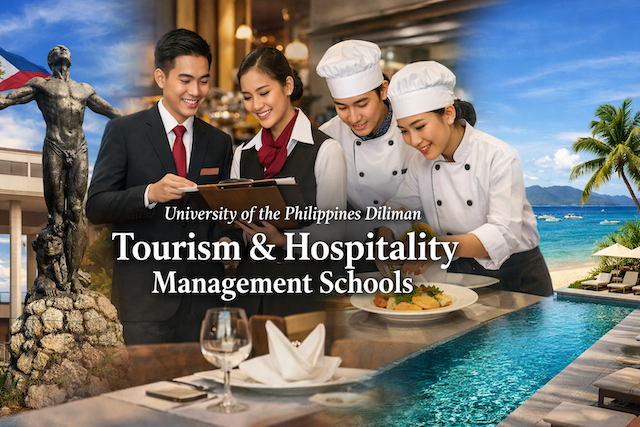
University of the Philippines (UP) Diliman: Tourism and Hospitality Management Schools
The University of the Philippines Diliman (UP Diliman) is widely recognized as the country’s premier state university and a leading academic institution in Southeast Asia. While UP Diliman is often associated with fields such as engineering, law, public administration, and the social sciences, it also plays a crucial role in shaping professionals for the tourism, hospitality, and leisure industries through interdisciplinary programs, research initiatives, and policy-oriented education.
Rather than operating a standalone “hotel management” college in the traditional sense, UP Diliman approaches tourism and hospitality education from a multidisciplinary and developmental perspective, emphasizing sustainability, cultural heritage, economics, planning, and governance. This approach reflects the university’s mandate as the national university of the Philippines—to contribute to nation-building, public service, and global competitiveness.
Overview of Tourism and Hospitality Education at UP Diliman
Tourism and hospitality-related education at UP Diliman is offered through multiple colleges and institutes, each contributing a unique academic lens. Programs focus not only on operational skills but also on policy analysis, destination planning, cultural management, and sustainable development.
Key academic units involved include:
-
College of Home Economics
-
School of Urban and Regional Planning
-
College of Social Sciences and Philosophy
-
Asian Institute of Tourism (historical and continuing influence)
-
College of Economics
-
UP Center for Integrative and Development Studies
This structure allows students to gain a broader and more strategic understanding of tourism as an industry that intersects with culture, environment, urban planning, and national development.
Bachelor of Science in Tourism (UP Diliman Context)
UP Diliman historically housed the Asian Institute of Tourism (AIT), which pioneered tourism education in the Philippines and Asia. While administrative structures have evolved over time, the influence of AIT remains deeply embedded in UP’s tourism-related curriculum and research culture.
Academic Focus
Tourism education at UP Diliman emphasizes:
-
Sustainable tourism development
-
Cultural and heritage tourism
-
Ecotourism and community-based tourism
-
Tourism economics and policy
-
Destination planning and management
-
Tourism research and data analysis
Rather than training students solely for hotel operations, UP prepares graduates to become planners, policymakers, consultants, researchers, and development leaders within the tourism and hospitality ecosystem.
Hospitality Management Through an Interdisciplinary Lens
Hospitality management at UP Diliman is not limited to hotel front-office or food service operations. Instead, it is studied as part of:
-
Service management
-
Consumer behavior
-
Cultural production
-
Urban and regional development
-
Public-private sector collaboration
Students learn how hospitality functions within larger tourism systems, including transportation, infrastructure, environmental management, and local governance.
This makes UP Diliman graduates particularly suited for strategic and leadership roles, rather than purely operational positions.
College of Home Economics and Hospitality-Related Studies
The College of Home Economics (CHE) plays a significant role in hospitality-related education at UP Diliman. Programs under CHE integrate:
-
Food service management
-
Nutrition and food systems
-
Consumer studies
-
Service quality management
Students interested in hospitality operations, food and beverage management, and service design often find CHE programs to be an excellent foundation, especially when combined with tourism electives or internships.
Asian Institute of Tourism (AIT): A Legacy of Excellence
The Asian Institute of Tourism was one of the earliest tourism education institutions in the region. Its mission was to develop tourism professionals capable of balancing economic growth with cultural integrity and environmental protection.
Lasting Contributions
-
Development of tourism policy frameworks
-
Training of tourism planners and government officials
-
Research on sustainable tourism models
-
Strong collaboration with international organizations such as UNWTO and ASEAN bodies
Many of today’s tourism leaders in the Philippines and Southeast Asia are alumni or beneficiaries of AIT-led programs and research initiatives.
Graduate Programs in Tourism and Hospitality
UP Diliman offers graduate-level programs that are particularly attractive to professionals seeking leadership, academic, or policy-oriented careers.
Master’s and Doctoral Pathways
Graduate programs may focus on:
-
Tourism planning and development
-
Sustainable tourism systems
-
Cultural heritage management
-
Leisure studies
-
Public policy and governance related to tourism
These programs are ideal for:
-
Government tourism officers
-
NGO and development practitioners
-
Tourism consultants
-
Academics and researchers
-
Senior managers in hospitality and destination management
Research, Policy, and National Impact
One of UP Diliman’s greatest strengths is its role in shaping national tourism policy. Faculty members frequently serve as:
-
Government advisors
-
Policy consultants
-
Researchers for national tourism plans
-
Contributors to international development projects
Students are exposed to real-world issues such as:
-
Overtourism and destination carrying capacity
-
Climate change and tourism resilience
-
Cultural preservation
-
Inclusive and community-based tourism
-
Tourism’s role in regional development
This policy-oriented environment sets UP Diliman apart from purely industry-focused hospitality schools.
Campus Environment and Learning Culture
UP Diliman’s expansive campus in Quezon City provides a dynamic learning environment. While not a resort-style or hotel-campus setting, it offers:
-
Strong academic freedom
-
Active student organizations
-
Interdisciplinary collaboration
-
Access to national government agencies
-
Proximity to major tourism institutions and embassies
The campus culture encourages critical thinking, debate, and research, which are essential for leadership roles in tourism and hospitality.
Industry Linkages and Internships
UP Diliman maintains strong partnerships with:
-
Department of Tourism (DOT)
-
Local government units
-
International organizations
-
Research institutions
-
Cultural agencies
-
Selected hospitality and tourism enterprises
Students often engage in:
-
Fieldwork and community immersion
-
Research-based internships
-
Policy projects
-
Development planning workshops
These experiences prepare graduates for complex, real-world challenges, rather than limiting them to narrow operational roles.
Career Opportunities for Graduates
Graduates of UP Diliman’s tourism and hospitality-related programs pursue diverse career paths, including:
-
Tourism planning and development
-
Government service (DOT, LGUs, national agencies)
-
Hospitality management at executive levels
-
Destination marketing and branding
-
Cultural and heritage management
-
Sustainable tourism consulting
-
International development organizations
-
Academic and research institutions
UP Diliman alumni are particularly well-positioned for leadership, policy, and strategic roles, both locally and internationally.
Admission Standards and Academic Expectations
Admission to UP Diliman is highly competitive. Students are expected to demonstrate:
-
Strong academic performance
-
Analytical and writing skills
-
Interest in public service and development
-
Ability to handle research-intensive coursework
Tourism and hospitality-related programs at UP demand a high level of intellectual engagement, making them best suited for students who want to shape the industry rather than simply participate in it.
Why Choose UP Diliman for Tourism and Hospitality Management
Choosing UP Diliman means choosing:
-
A national and global perspective on tourism
-
Strong emphasis on sustainability and ethics
-
Research-driven education
-
Policy and development orientation
-
Prestigious academic reputation
-
Broad career flexibility
For students who aspire to become leaders, planners, policymakers, or researchers in tourism and hospitality, UP Diliman offers an education that goes far beyond traditional hotel management training.
Conclusion
The University of the Philippines Diliman stands as a unique and influential institution for tourism and hospitality management education in the Philippines. Its interdisciplinary approach, strong research culture, and deep involvement in national and regional tourism development make it an ideal choice for students who want to understand tourism as a powerful social, economic, and cultural force.
Rather than focusing solely on operational skills, UP Diliman prepares graduates to design, manage, and transform tourism systems—ensuring that the industry contributes meaningfully to sustainable development, cultural preservation, and national progress.
For future professionals who seek depth, impact, and leadership in tourism and hospitality, UP Diliman remains one of the most respected and forward-thinking options in the country.
FAQs (Frequently Asked Questions)
Does UP Diliman offer a dedicated Tourism and Hospitality Management degree?
UP Diliman is known for an interdisciplinary approach to tourism and hospitality rather than a single, purely operations-focused “hotel management” track. Depending on the current academic structure and offerings, tourism-related education may be delivered through specific institutes, departments, and elective clusters that connect planning, culture, economics, and development studies. Students who want a UP Diliman education for tourism often build their pathway by combining relevant majors, electives, internships, and research topics. Because program names and administrative homes can change over time, prospective students should confirm the latest options through official UP sources and admissions announcements.
How is UP Diliman’s approach different from traditional hospitality schools?
Many hospitality schools focus heavily on operational training such as front office systems, housekeeping standards, restaurant operations, and practical service routines. UP Diliman’s strength, by contrast, is often its policy-oriented and research-driven environment. Coursework and learning experiences may emphasize sustainable tourism, heritage protection, destination planning, tourism governance, and the social and economic impacts of tourism. This can be especially valuable for students who aim for leadership roles in government, development organizations, research institutions, or strategic positions in the private sector rather than only entry-level operational roles.
UP Diliman tends to be a strong fit for students who enjoy academic rigor, critical thinking, reading and writing-intensive classes, and research-based learning. If you are interested in understanding tourism beyond hotels—such as how destinations are planned, how communities benefit (or are harmed), how cultural assets are protected, and how policies shape the industry—UP Diliman can be a great match. Students who prefer a purely hands-on hotel training environment may still succeed, but they typically need to intentionally seek applied experiences through internships, projects, and industry collaborations.
Can I study hospitality management specifically, like hotel or resort operations?
You can still pursue hospitality-focused learning at UP Diliman, but it may be approached through service management, consumer studies, food-related programs, or electives connected to tourism systems. Instead of training you only to run a hotel department, UP Diliman can help you understand how hospitality fits into broader tourism ecosystems, including transportation, infrastructure, destination branding, labor systems, and sustainability standards. If your goal is hotel operations, your best strategy is to pair UP-based academic training with practical internships in hotels, resorts, and tourism enterprises.
Are there research opportunities for tourism and hospitality students at UP Diliman?
Yes. One of UP Diliman’s major advantages is access to research culture and mentorship. Students may explore topics such as sustainable tourism models, ecotourism development, cultural heritage management, tourism economics, community-based tourism, and climate resilience. Research can be conducted through thesis work, capstone projects, independent studies, or participation in faculty-led initiatives. This is especially helpful if you plan to work in policy, consulting, graduate school, or roles that require analysis and evidence-based decision-making.
What types of internships or fieldwork can students expect?
Tourism education in a UP Diliman context often includes fieldwork components, community immersion, and research-oriented placements. Students may engage with local government units, tourism offices, NGOs, cultural agencies, or destination-related projects. Internships can range from destination planning support and tourism research assistance to marketing and development projects in the private sector. The key is to proactively plan your internship path early, identify target roles, and choose placements that match your career direction—operations, planning, marketing, policy, or research.
Graduates may pursue careers in government tourism offices, destination marketing organizations, hospitality leadership tracks, tourism consulting, cultural and heritage institutions, development organizations, research and analytics roles, and academic pathways. UP Diliman’s interdisciplinary environment can be especially useful for careers in tourism planning, governance, sustainability programs, and strategic management. Many students also pursue graduate studies locally or abroad, particularly if they want to specialize in tourism policy, regional development, or sustainability.
Is UP Diliman a good choice if I want to work abroad in hospitality or tourism?
It can be, especially if you build a strong portfolio that combines academic credibility with applied experience. International employers typically value communication skills, problem-solving ability, and a track record of real-world training. UP Diliman can strengthen your analytical skills and global perspective, while internships and certifications can strengthen your operational readiness. If working abroad is your goal, consider gaining experience in internationally branded hotels, improving professional English, learning service standards, and documenting measurable achievements during internships.
Does UP Diliman emphasize sustainable and community-based tourism?
UP Diliman’s tourism-related learning environment often aligns strongly with sustainability, ethics, and inclusive development. Students are encouraged to analyze how tourism affects local livelihoods, natural environments, and cultural heritage. Community-based tourism, responsible travel models, and long-term destination resilience are common themes in research and planning-oriented coursework. This emphasis can be highly relevant today, as destinations increasingly require strategies for climate adaptation, cultural protection, and balancing visitor growth with community well-being.
What skills should I develop while studying tourism and hospitality at UP Diliman?
In addition to industry knowledge, focus on transferable skills: academic and professional writing, data analysis, research methods, stakeholder communication, project management, and presentation skills. Tourism and hospitality are people-centered industries, so leadership, cultural sensitivity, and service mindset also matter. If your goal is hospitality operations, add practical skills through internships and training. If your goal is planning or policy, develop strong analytical frameworks and learn how to write clear proposals, reports, and evidence-based recommendations.
How can I confirm the latest program structure and admission requirements?
Because universities periodically update curricula, department structures, and degree titles, the best practice is to verify details through official UP channels. Check the UP Diliman website, relevant college or institute pages, and official admissions announcements. If possible, attend orientation events or request guidance from academic offices. This ensures you have accurate information about current degree offerings, required courses, application timelines, and whether tourism-related tracks are offered as majors, specializations, electives, or graduate options.
Best Tourism and Hospitality Management Schools in the Philippines

How to Register for eTravel Philippines (2025 Guide)
Step-by-step guide to completing your eTravel registration before arriving in the Philippines, with images and tips.

Night Market in Cebu – Things You Don’t Know About Cebu Life
Discover the hidden charm of Cebu’s night markets, from street food stalls to local life tips you won’t find in tourist guides.

How to Use ChatGPT for IELTS Preparation: A Complete Guide
Learn how to prepare for IELTS using ChatGPT — including strategies for Writing, Reading, Listening, Speaking, and grammar support.

How to Build a Website Without Coding Using ChatGPT
Discover how to build your own website using AI—no coding skills needed. From structure planning to SEO and design, let ChatGPT guide you.