2026年1月23日
3D ACADEMY offers affordable English study programs in Cebu, Philippines – perfect for beginners, professionals, and exam takers.

3D UNIVERSAL ENGLISH INSTITUTE INC
info.3d-universal.com
8:00-17:00(Mon-Fri)
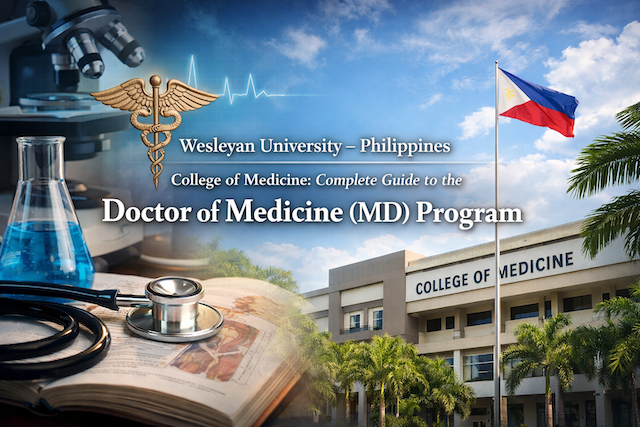
Wesleyan University – Philippines College of Medicine: Complete Guide to the Doctor of Medicine (MD) Program
Contents
- Wesleyan University – Philippines College of Medicine: Complete Guide to the Doctor of Medicine (MD) Program
- Where Wesleyan University–Philippines Is Located
- Quick Overview of the WU-P College of Medicine
- Understanding the MD Program Structure in the Philippines
- Curriculum Approach: Integrated and Outcomes-Based Learning
- Key Learning Themes You Can Expect
- Clinical Training and Exposure
- Facilities and Learning Resources
- Admission Requirements and NMAT Expectations
- How to Prepare a Strong Application
- Student Life: What Medical School Really Feels Like
- Costs, Scholarships, and Budget Planning
- Who Is WU-P College of Medicine Best For?
- Career Path After the MD
- How to Contact the University
- Final Thoughts
- Frequently Asked Questions (FAQs)
- What is the Doctor of Medicine (MD) program at Wesleyan University – Philippines College of Medicine?
- Where is Wesleyan University – Philippines College of Medicine located?
- How long does it take to complete the MD program?
- What are the admission requirements for the MD program?
- Is there a minimum NMAT score required for admission?
- What is the language of instruction in the MD program?
- What is the teaching approach used in the program?
- Which hospitals are used for clinical training?
- How much is the tuition fee for the MD program?
- Are scholarships or financial assistance available?
- Is the MD degree recognized by the Philippine Medical Board?
- Can international students apply to the MD program?
- Does the program prepare students for medical practice abroad?
- What is student life like at Wesleyan University – Philippines College of Medicine?
- How competitive is admission to the College of Medicine?
- How can I apply to the MD program?
Wesleyan University – Philippines College of Medicine: Complete Guide to the Doctor of Medicine (MD) Program
Wesleyan University–Philippines (WU-P), based in Cabanatuan City, Nueva Ecija, offers a Doctor of Medicine (MD) program through its College of Medicine. The program is designed to help students build strong foundations in the basic medical sciences, develop clinical reasoning and communication skills, and gain practical exposure to real patient care in hospital and community settings. WU-P emphasizes producing competent and compassionate physicians who can serve the needs of communities in the Philippine healthcare system.
This guide explains what to expect from the WU-P College of Medicine—its location, curriculum approach, typical MD structure in the Philippines, clinical training focus, admission requirements (including NMAT expectations), student life considerations, and practical tips for applicants deciding whether WU-P is a good fit.
Where Wesleyan University–Philippines Is Located
WU-P is located in Cabanatuan City, Nueva Ecija, in Central Luzon. For students who want to study medicine outside Metro Manila while still being in a major regional hub, Cabanatuan offers a practical balance: access to city services, transportation links, and a community setting where public health needs are visible and meaningful for clinical learning.
Studying in a provincial city can also shape your medical education in a positive way. You are likely to encounter a broad range of common cases—primary care concerns, internal medicine conditions, pediatrics, OB-GYN needs, and community health challenges—without the intense congestion often associated with larger metropolitan training environments. For some students, that mix of exposure and pace supports deeper learning and less day-to-day friction.
Quick Overview of the WU-P College of Medicine
WU-P’s College of Medicine presents the MD program as a four-year medical course that aims to develop graduates with the knowledge, skills, and professional attitudes expected of a primary care physician. The school also describes a curriculum approach that is outcomes-based and integrated, and it highlights alignment with leadership, service, and community stewardship as part of its institutional mission.
While every medical school has its own culture and strengths, WU-P’s positioning is appealing for students who want:
- A medical program rooted in community relevance and service orientation
- An integrated learning approach that connects basic sciences to clinical practice
- A Central Luzon location that may be more accessible for students from nearby provinces
Understanding the MD Program Structure in the Philippines
In the Philippines, the Doctor of Medicine program typically follows a structured progression:
- Years 1–2: Heavy focus on basic medical sciences and early clinical correlation (anatomy, physiology, biochemistry, pathology, pharmacology, microbiology, etc.)
- Year 3: More clinically oriented subjects and case-based learning (medicine, surgery, pediatrics, OB-GYN, psychiatry, community medicine, and related disciplines)
- Year 4: Clinical clerkship/rotations in hospital departments and community settings
After completing the MD degree, graduates usually proceed to a one-year Postgraduate Internship (PGI) in an accredited hospital, followed by the Physician Licensure Examination (PLE). Many then enter residency training in their chosen specialty.
Curriculum Approach: Integrated and Outcomes-Based Learning
WU-P describes its MD program as using a Traditional Integrated Outcomes-based Curriculum. In practical terms, an integrated approach means students are encouraged to connect concepts across subjects instead of learning each discipline in isolation. For example, rather than studying anatomy as a purely memorization-based course, you might learn anatomy alongside clinical correlations—how a nerve injury affects function, how anatomical landmarks guide physical exams, or how structures relate to common surgical procedures.
An outcomes-based approach typically means the program defines what graduates should be able to do—such as taking a patient history, performing a focused physical exam, forming differential diagnoses, interpreting basic lab results, communicating with empathy, and applying ethical decision-making—and aligns teaching and assessments to those competencies.
If you learn best when lessons are tied to real-world medical practice, an integrated outcomes-based structure can be a strong match. It often helps students answer the question early: “Why does this topic matter for patient care?”
Key Learning Themes You Can Expect
While the exact course list and sequencing can change by academic year, most MD programs (including WU-P’s) aim to develop students across several consistent themes:
- Scientific foundation: Understanding normal human structure and function, disease mechanisms, and principles of treatment
- Clinical reasoning: Turning symptoms into differential diagnoses, choosing appropriate tests, and deciding initial management plans
- Communication: Patient interviewing, counseling, teamwork with nurses and allied health professionals, and documentation
- Professionalism and ethics: Patient privacy, consent, boundaries, integrity, and respect
- Community and public health: Prevention, health promotion, epidemiology basics, and healthcare delivery systems
These themes matter because becoming a physician is not only about passing exams. It’s also about becoming reliable under pressure, working respectfully with patients and colleagues, and continuing to learn throughout your career.
Clinical Training and Exposure
Clinical training is where medical knowledge becomes medical skill. The MD curriculum builds toward hands-on patient care, typically increasing responsibility over time. Students usually begin with basic clinical skills—vital signs, patient communication, physical exam techniques—and later move into ward work, case presentations, and supervised involvement in procedures depending on departmental policies.
WU-P emphasizes that medical training needs exposure to actual cases and commonly encountered challenges in hospitals and local healthcare units. That focus is important because a strong physician is not defined only by textbook knowledge. Real patients present with uncertainty, incomplete histories, social constraints, and sometimes delayed care. Learning to navigate those realities—while staying safe, ethical, and compassionate—is a major part of clinical maturity.
If you are considering WU-P, a useful practical step is to learn more about the school’s clinical affiliations and how rotations are organized. In any medical school, the quality of your clerkship experience is strongly influenced by patient volume, case mix, supervision quality, and the learning culture in the training environment.
Facilities and Learning Resources
WU-P highlights medical education resources that support anatomy and clinical learning, including modern instructional tools. For example, the university has shared updates about incorporating advanced anatomy learning technology such as a virtual dissection table (often used to visualize life-sized anatomy in 3D). Tools like these can help students understand spatial relationships more efficiently, especially when paired with structured teaching and frequent practice.
That said, facilities are most valuable when they are integrated into a strong teaching system. When evaluating a medical school, try to consider:
- How frequently students access key lab and simulation resources
- Whether skills training is structured (checklists, feedback, repeat practice)
- Availability of learning support (libraries, online databases, review resources)
Admission Requirements and NMAT Expectations
Medical school admissions in the Philippines generally require an undergraduate degree (or completion of required pre-med units) plus standardized requirements like the National Medical Admission Test (NMAT). WU-P’s College of Medicine lists NMAT documentation as part of its admissions requirements, including a minimum percentile score expectation.
Based on the school’s published admissions information, applicants should prepare an NMAT result taken within the allowed time window, and the school indicates a minimum NMAT percentile score of 40 (with the NMAT taken not more than two years from the time of admission). Because medical school requirements can be updated, it is still wise to confirm the latest details directly with the College of Medicine before you submit your application.
In addition to NMAT, the school lists typical documentation required by many Philippine medical schools, such as:
- Birth certificate
- Certificates of good moral character (often from professors or academic references)
- Official transcript of records (TOR) and general weighted average information
- Passport-style photos and other standard forms as requested
Schools may also require interviews, additional screening, or other submission steps depending on the academic year and applicant volume. Plan your timeline early—especially if you need to request documents from your university, obtain clearances, or retake the NMAT.
How to Prepare a Strong Application
If you want your application to stand out (and also set yourself up for success once classes begin), focus on three areas: academic readiness, motivation clarity, and professionalism.
- Academic readiness: Your transcript should show you can handle heavy science loads. If you have weaker grades in key science subjects, consider explaining how you improved later or how you built study systems that now work.
- Motivation clarity: Avoid generic statements like “I want to help people.” Instead, describe specific experiences that shaped your decision—volunteering, family medical experiences, exposure to healthcare work, or community service that made you understand the realities of the profession.
- Professionalism: Submit clean, complete documents; follow instructions precisely; communicate politely. Medical schools notice these details because they reflect how you might perform in clinical environments.
If there is an interview, prepare to discuss stress management, ethical scenarios, teamwork, and your reasons for choosing a community-oriented medical education environment.
Student Life: What Medical School Really Feels Like
Medical school is academically intense, but the larger challenge for many students is consistency. The workload is steady, deadlines are frequent, and assessments can be demanding. Success often depends less on raw intelligence and more on routine.
Helpful habits include:
- Studying daily in smaller blocks rather than cramming
- Using active recall (practice questions, flashcards, teaching concepts aloud)
- Building a dependable peer group for review and emotional support
- Protecting sleep when possible—fatigue destroys retention and decision-making
- Asking for help early when you fall behind
Because WU-P is in Cabanatuan City, your lifestyle may be more predictable and less commute-heavy than in larger cities—depending on your housing and daily schedule. Many medical students find that reducing daily friction (transport, noise, long travel times) directly improves grades and mental health.
Costs, Scholarships, and Budget Planning
Tuition and fees for medical schools can vary significantly by institution and academic year, and they can change. If you are planning your finances, build a full medical school budget rather than looking only at tuition. Consider:
- Tuition and miscellaneous school fees
- Books and learning resources (print and digital)
- Medical instruments (stethoscope, BP apparatus, basic diagnostic tools)
- Uniforms, clinical attire, and rotation-related expenses
- Housing, food, and transportation
- Review costs for major exams
If scholarships, grants, or payment plans are available, ask early. Even small support options can reduce pressure during heavy exam periods. The best approach is to contact the College of Medicine or admissions office to request the latest fee schedule and available financial assistance pathways.
Who Is WU-P College of Medicine Best For?
WU-P can be a strong fit for students who value a community-oriented medical education and who want to train in Central Luzon. It may also appeal to students who prefer learning environments where service and leadership are emphasized alongside academic performance.
You may especially consider WU-P if you are:
- From Nueva Ecija or nearby provinces and want a program closer to home
- Interested in primary care, community medicine, or public health-related practice
- Looking for an MD program with integrated learning goals and practical patient exposure
On the other hand, if you require a highly specialized tertiary referral center environment from the earliest years (for rare subspecialty exposure), you should compare clerkship settings across schools. Many students still thrive in community-based training and later specialize through residency, so it depends on your long-term plan and learning preferences.
Career Path After the MD
After completing the MD, most graduates proceed to:
- Postgraduate Internship (PGI): A year of supervised hospital training
- Physician Licensure Examination (PLE): The national exam required to practice medicine in the Philippines
- Residency training: Specialization in fields like Internal Medicine, Surgery, Pediatrics, OB-GYN, Family Medicine, Psychiatry, Radiology, and others
Some graduates also choose public health, research, hospital administration, academe, or combined clinical and community roles. If your long-term goal includes working abroad, start learning early about credentialing pathways, language requirements, and postgraduate training equivalencies—because planning ahead can save you years later.
How to Contact the University
For the most accurate and updated details (application timelines, document checklists, tuition and fee schedules, clerkship arrangements, and program updates), contact Wesleyan University–Philippines directly through its official channels. The university lists its location in Mabini Extension, Cabanatuan City, Nueva Ecija, Philippines, and provides phone and email contact information on its official website.
Final Thoughts
Choosing a medical school is not only about getting admitted—it is about choosing the environment where you will spend years building habits, clinical judgment, and professional identity. WU-P’s College of Medicine presents an MD program aimed at producing competent, compassionate physicians with strong community relevance, supported by an integrated outcomes-based curriculum approach and a Central Luzon location.
If you are deciding whether WU-P is right for you, your next best step is to confirm the latest admissions details, ask how clinical rotations are structured, and assess whether the school’s mission and training environment match your preferred learning style. Medical school is difficult everywhere, but the right fit makes the difficulty meaningful—and sustainable.
Frequently Asked Questions (FAQs)
What is the Doctor of Medicine (MD) program at Wesleyan University – Philippines College of Medicine?
The Doctor of Medicine (MD) program at Wesleyan University – Philippines College of Medicine is a four-year professional medical degree designed to prepare students for the practice of medicine in the Philippines and abroad. The program combines foundational medical sciences, clinical skills training, and hands-on hospital exposure, followed by a mandatory one-year post-graduate internship after graduation.
Where is Wesleyan University – Philippines College of Medicine located?
Wesleyan University – Philippines is located in Cabanatuan City, Nueva Ecija. The College of Medicine benefits from its proximity to affiliated hospitals and healthcare facilities in Central Luzon, providing students with clinical exposure in both urban and semi-rural healthcare settings.
How long does it take to complete the MD program?
The MD program typically takes four academic years to complete. The first two years focus on basic medical sciences, the third year emphasizes clinical subjects, and the fourth year is dedicated to clinical clerkship rotations. After graduation, students must complete a one-year post-graduate internship before taking the Philippine Physician Licensure Examination.
What are the admission requirements for the MD program?
Applicants must hold a bachelor’s degree, preferably in a science-related field, from a recognized institution. A valid National Medical Admission Test (NMAT) score is required, along with academic transcripts, a certificate of good moral character, and other supporting documents. Some applicants may also be required to undergo interviews or entrance assessments.
Is there a minimum NMAT score required for admission?
Yes, Wesleyan University – Philippines College of Medicine follows the guidelines set by the Commission on Higher Education (CHED) regarding NMAT requirements. The minimum NMAT percentile rank may vary depending on institutional policies and applicant volume, so prospective students are advised to check the latest admission criteria directly with the university.
What is the language of instruction in the MD program?
The primary language of instruction is English. Lectures, textbooks, examinations, and clinical discussions are conducted in English, which is essential preparation for both local licensure exams and international medical pathways.
What is the teaching approach used in the program?
The College of Medicine employs a combination of traditional lectures, small-group discussions, case-based learning, and practical laboratory sessions. Clinical exposure is gradually introduced and intensifies during the clerkship years, allowing students to apply theoretical knowledge in real healthcare environments.
Which hospitals are used for clinical training?
Students complete their clinical clerkship and training in affiliated teaching hospitals associated with Wesleyan University – Philippines. These hospitals provide exposure to major clinical departments such as Internal Medicine, Surgery, Pediatrics, Obstetrics and Gynecology, and Community Medicine.
How much is the tuition fee for the MD program?
Tuition fees vary by academic year and may change without prior notice. Compared to many private medical schools in the Philippines, Wesleyan University – Philippines College of Medicine is generally considered more affordable. Students should contact the admissions or finance office for the most updated fee structure and payment options.
Are scholarships or financial assistance available?
Yes, the university may offer scholarships, discounts, or financial assistance programs based on academic merit, financial need, or specific eligibility criteria. External scholarships from government or private organizations may also be available to qualified students.
Is the MD degree recognized by the Philippine Medical Board?
Yes, graduates of Wesleyan University – Philippines College of Medicine are eligible to take the Philippine Physician Licensure Examination administered by the Professional Regulation Commission (PRC), provided they meet all regulatory requirements.
Can international students apply to the MD program?
International students may apply, subject to additional requirements such as visa documentation, credential evaluation, and proof of English proficiency if applicable. Admission policies for foreign students may differ slightly, so early coordination with the university is recommended.
Does the program prepare students for medical practice abroad?
The MD program provides a solid foundation in medical sciences and clinical skills that can support international medical career pathways. However, graduates who plan to practice abroad must comply with the licensing and examination requirements of their target country, such as USMLE, PLAB, or other equivalent exams.
What is student life like at Wesleyan University – Philippines College of Medicine?
Student life is academically demanding but balanced with extracurricular activities, student organizations, and community outreach programs. The supportive campus environment and smaller class sizes allow for closer interaction between students and faculty members.
How competitive is admission to the College of Medicine?
Admission can be competitive, depending on the number of applicants each year. Academic performance, NMAT scores, and overall applicant profile are carefully evaluated to ensure students are capable of meeting the rigors of medical education.
How can I apply to the MD program?
Interested applicants can apply directly through the admissions office of Wesleyan University – Philippines. It is recommended to submit applications early, prepare all required documents in advance, and stay informed about application deadlines and interview schedules.
Complete List of Medical Schools in the Philippines (All 78 MD Programs)
Best Medical Schools in the Philippines (Local & International Rankings)
Recommend
2026年1月23日
Sultan Kudarat State University College of Medicine: Complete Guide for Aspiring MD Students
2026年1月23日
University of Southern Mindanao College of Medicine: Complete Guide for Aspiring MD Students
2026年1月23日
Mindanao State University – General Santos College of Medicine: Complete Guide for Future MD Students

How to Register for eTravel Philippines (2025 Guide)
Step-by-step guide to completing your eTravel registration before arriving in the Philippines, with images and tips.

Night Market in Cebu – Things You Don’t Know About Cebu Life
Discover the hidden charm of Cebu’s night markets, from street food stalls to local life tips you won’t find in tourist guides.

How to Use ChatGPT for IELTS Preparation: A Complete Guide
Learn how to prepare for IELTS using ChatGPT — including strategies for Writing, Reading, Listening, Speaking, and grammar support.

How to Build a Website Without Coding Using ChatGPT
Discover how to build your own website using AI—no coding skills needed. From structure planning to SEO and design, let ChatGPT guide you.