
Contents
- NMAT Timeline: From Exam to Enrollment – NMAT Exam Guide
- What Is the NMAT and Why Timing Matters
- Overview of the NMAT Timeline
- Stage 1: Deciding to Take the NMAT (12–9 Months Before Enrollment)
- Stage 2: NMAT Registration Period (6–8 Months Before Enrollment)
- Stage 3: NMAT Preparation Phase (3–6 Months Before Exam)
- Stage 4: NMAT Exam Day
- Stage 5: Waiting for NMAT Results (4–6 Weeks After Exam)
- Stage 6: Medical School Applications (Overlapping With Results)
- Stage 7: Interviews and School Evaluations
- Stage 8: Acceptance Results and Enrollment
- NMAT Score Validity and Retake Timeline
- Ideal NMAT Timeline Example (Typical Applicant)
- Common Timeline Mistakes to Avoid
- Final Thoughts: Plan Early, Move Strategically
- FAQs (Frequently Asked Questions)
- When should I take the NMAT if I want to enroll in medical school this year?
- How long does it take for NMAT results to come out after the exam?
- Can I apply to medical schools before my NMAT score is released?
- What documents should I prepare while waiting for NMAT results?
- How do I choose the best NMAT testing window for my goals?
- What NMAT percentile do I need to get accepted into medical school?
- If my NMAT score is low, should I retake the exam or apply anyway?
- How many times can I take the NMAT, and how does it affect my timeline?
- How long is an NMAT score valid, and will schools accept an older score?
- What should I do after I receive my NMAT results?
- How does the NMAT timeline connect to interviews and acceptance decisions?
- What happens if I miss an NMAT registration deadline or medical school application deadline?
NMAT Timeline: From Exam to Enrollment – NMAT Exam Guide
The National Medical Admission Test (NMAT) is a critical step for anyone aiming to enter medical school in the Philippines. However, many applicants underestimate how long the entire process actually takes—from deciding to take the NMAT, to sitting for the exam, receiving results, applying to medical schools, and finally enrolling.
This guide walks you through the complete NMAT timeline, explaining what happens at each stage, how long it takes, and what you should be doing to stay on track. Whether you are a first-time test taker, a retaker, or an international applicant, understanding this timeline will help you plan strategically and avoid costly delays.
What Is the NMAT and Why Timing Matters
The NMAT is administered by the Center for Educational Measurement (CEM) and is required by almost all medical schools in the Philippines. Your NMAT score percentile plays a major role in determining:
-
Which medical schools you can apply to
-
Whether you meet minimum admission cutoffs
-
Your competitiveness for scholarships and top-tier programs
Timing is crucial because:
-
NMAT is offered only during specific testing windows
-
Scores have a limited validity period
-
Medical school application cycles are fixed
Missing one deadline can delay your medical school journey by an entire year.
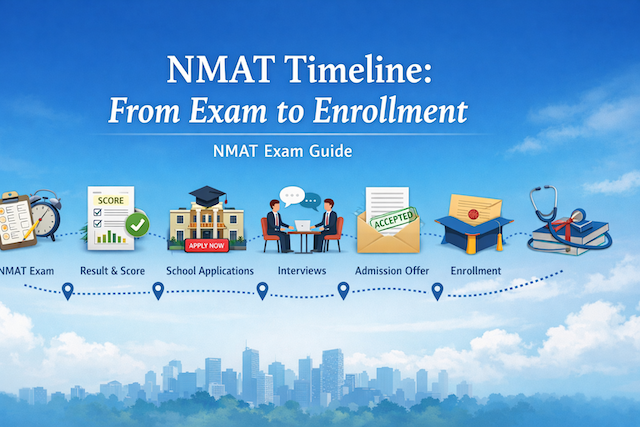
Overview of the NMAT Timeline
Before diving into details, here is a high-level overview of the typical NMAT-to-enrollment timeline:
-
Decision to take NMAT (12–9 months before enrollment)
-
Registration period (6–8 months before enrollment)
-
Preparation phase (3–6 months)
-
NMAT exam day
-
Release of official NMAT results (4–6 weeks later)
-
Medical school applications (overlapping with score release)
-
Interviews and evaluations
-
Acceptance and enrollment
Each step is explained in detail below.
Stage 1: Deciding to Take the NMAT (12–9 Months Before Enrollment)
The timeline starts long before you sit for the exam.
Who Should Take the NMAT
You should plan to take the NMAT if you:
-
Are a graduating pre-med student
-
Have already completed a bachelor’s degree
-
Are planning to apply to Philippine medical schools
-
Are an international applicant meeting local eligibility requirements
Key Decisions to Make Early
At this stage, you should decide:
-
Which NMAT testing cycle you will target
-
Which medical school intake year you want to join
-
Whether you will need one attempt or multiple attempts
Most students aiming to enroll in August–September take the NMAT between October and March of the previous academic year.
Stage 2: NMAT Registration Period (6–8 Months Before Enrollment)
NMAT registration opens several months before each testing window.
NMAT Testing Cycles
The NMAT is typically offered in two main cycles:
-
October–November
-
January–February (sometimes extending to March/April)
Exact dates vary each year, so applicants must regularly check official announcements.
Registration Process
During registration, you will:
-
Create an online NMAT account
-
Choose your preferred test date and testing center or online option
-
Upload required documents
-
Pay the examination fee
Important Timing Considerations
-
Popular test dates fill up quickly
-
Late registration options are limited
-
Errors in documents can delay confirmation
Registering early gives you:
-
More date choices
-
Less stress
-
Time to fix administrative issues
Stage 3: NMAT Preparation Phase (3–6 Months Before Exam)
Preparation is the longest and most demanding phase of the NMAT timeline.
Recommended Preparation Duration
-
Strong science background: 2–3 months
-
Average background: 3–4 months
-
Weak or non-traditional background: 5–6 months
Subjects Covered
NMAT consists of two parts:
-
Part I: Mental Ability (Verbal, Inductive Reasoning, Quantitative Ability, Perceptual Acuity)
-
Part II: Academic Proficiency (Biology, Physics, Chemistry, Social Science)
What You Should Be Doing During This Phase
-
Reviewing core science concepts
-
Practicing timed mock exams
-
Identifying weak areas
-
Refining test-taking strategies
Many students also decide during this phase whether:
-
They aim for a competitive percentile (90+)
-
They will retake the NMAT if needed
Stage 4: NMAT Exam Day
This is the most stressful but shortest part of the timeline.
What Happens on Exam Day
-
Identity verification
-
System or testing center check-in
-
Instructions and exam proper
-
Strict timing per section
The NMAT is a long exam, typically lasting several hours with minimal breaks.
Common Mistakes to Avoid
-
Poor time management
-
Overthinking questions
-
Panicking during difficult sections
Your performance on this single day will influence the next several months of your academic life.
Stage 5: Waiting for NMAT Results (4–6 Weeks After Exam)
After taking the exam, there is a waiting period before results are released.
What Happens During This Time
-
Exams are processed and scored
-
Percentile rankings are calculated
-
Official results are uploaded to your NMAT account
Understanding NMAT Results
Your score is reported as a percentile rank, not a raw score. This indicates how you performed compared to other examinees.
For example:
-
90th percentile = better than 90% of test takers
-
60th percentile = average competitiveness
-
Below 40th percentile = limited medical school options
Stage 6: Medical School Applications (Overlapping With Results)
Many applicants begin medical school applications before NMAT results are released.
Why Applications Start Early
-
Application deadlines may come earlier than score release
-
Some schools allow conditional submission pending NMAT results
-
Early applications improve chances for interviews
Documents Typically Required
-
NMAT score report
-
Transcript of records
-
Recommendation letters
-
Personal statement
-
Application forms and fees
Different schools have different minimum NMAT cutoffs, usually ranging from 40 to 90 percentile.
Stage 7: Interviews and School Evaluations
After applications are submitted, selected applicants are invited for interviews.
Interview Timeline
-
Can begin as early as 1–2 months after NMAT results
-
May be conducted online or in person
-
Some schools conduct multiple interview rounds
What Schools Evaluate
-
Academic background
-
NMAT percentile
-
Communication skills
-
Motivation for medicine
-
Emotional maturity and ethics
Strong NMAT scores often lead to:
-
Faster interview invitations
-
More school options
-
Higher acceptance probability
Stage 8: Acceptance Results and Enrollment
Once interviews are completed, schools release acceptance decisions.
Acceptance Timeline
-
Rolling admissions: results released gradually
-
Fixed admissions: results released on a specific date
Applicants may receive:
-
Full acceptance
-
Conditional acceptance
-
Waitlist status
-
Rejection
Enrollment Process
After acceptance, you must:
-
Confirm your slot
-
Pay reservation or enrollment fees
-
Submit final documents
-
Attend orientation
Failing to enroll on time can result in forfeiting your slot.
NMAT Score Validity and Retake Timeline
How Long Is an NMAT Score Valid?
NMAT scores are typically valid for two years from the test date. However, some schools prefer recent scores, so always verify with your target institution.
When to Retake the NMAT
You may consider retaking if:
-
Your percentile does not meet target school cutoffs
-
You underperformed due to illness or stress
-
You want to improve chances for competitive schools
Retakes usually require waiting for the next testing cycle, which can delay enrollment by a year if not planned carefully.
Ideal NMAT Timeline Example (Typical Applicant)
Here is a realistic example for a student planning to enroll in August 2026:
-
June–August 2025: Decide to take NMAT, start light review
-
September 2025: Register for October NMAT
-
October 2025: Take NMAT
-
November–December 2025: Receive results
-
December 2025–February 2026: Apply to medical schools
-
February–April 2026: Interviews
-
May–June 2026: Acceptance offers
-
July–August 2026: Enrollment and orientation
Common Timeline Mistakes to Avoid
Many applicants struggle not because of ability, but because of poor timing.
Frequent Errors
-
Registering too late
-
Taking NMAT without enough preparation
-
Missing application deadlines
-
Assuming one NMAT attempt is enough
-
Not checking score validity requirements
Avoiding these mistakes can save you an entire year.
Final Thoughts: Plan Early, Move Strategically
The NMAT is not just an exam—it is a process that spans nearly a full year from preparation to enrollment. Students who understand the full timeline gain a major advantage by:
-
Reducing stress
-
Maximizing score potential
-
Expanding medical school options
-
Avoiding unnecessary delays
If medical school is your goal, the best time to plan your NMAT journey is now. A well-managed timeline can make the difference between immediate enrollment and waiting another year.



